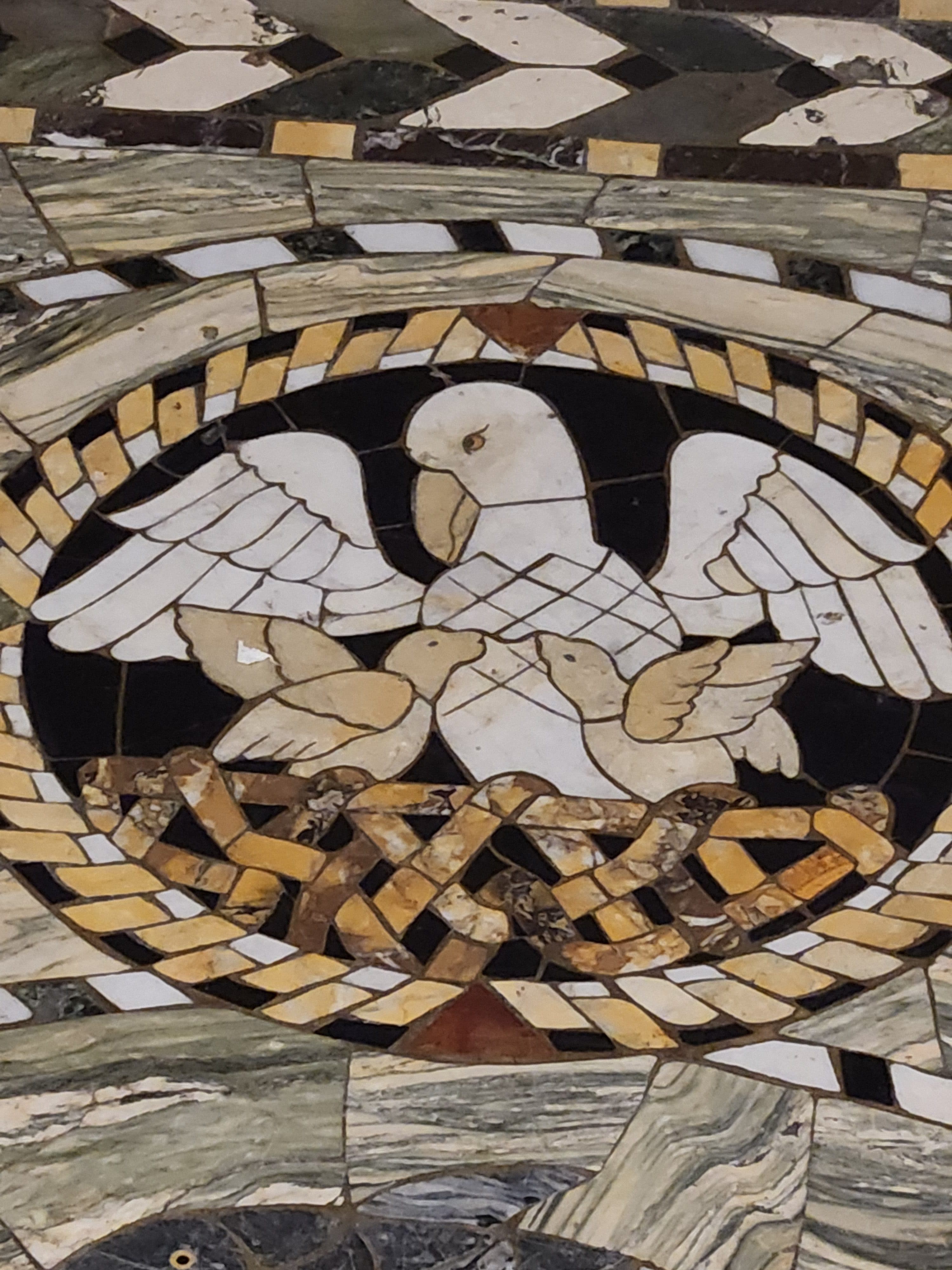
Inside St. Bartholomew’s Church, if you look closely, you’ll notice a surprising number of animal depictions. Some shimmer in the golden mosaics designed by Hildreth Meière, while others are similar to the marble images found in the churches of Sienna or Rome.
These animals are neither accidental nor merely decorative; they are a part of the Early Christian tradition, when most worshipers were illiterate and turned to the world of images rather than texts. These images acted as symbolic codes that carried moral lessons and clear analogies. Animals weren’t chosen for realism but for what people believed about them.
During the Middle Ages (12th–13th centuries), these symbolic meanings were collected and organized into books known as bestiaries. Wildly popular at the time, bestiaries described animals—both real and mythical—and attached a moral or spiritual lesson to each. That is why mythical creatures such as unicorns and phoenixes appear comfortably alongside lions, deer, and birds.
Every animal followed a clear structure: a behavior, its interpretation, and a moral lesson.
Though created in the 20th century, the animals in St. Bartholomew’s Church use the visual language of Christian symbolism and medieval bestiaries. Each depiction expresses a theological idea about Christ, sacrifice, resurrection, or the soul’s journey.
The Creation of Life mosaics


The gilded narthex (entrance lobby) of St. Bartholomew’s Church displays Hildreth Meière’s mosaics depicting “The Creation of Life.” Each creation day has its own dome, except days five and six—when Animals and Man were made—are combined in the central dome. Finished in 1930, the mosaics depict an abstract Art Deco take on the biblical creation cycle.
Meière organizes living beings according to the biblical structure of Creation:
- The Waters: In early Christian art, aquatic life symbolized birth, baptism, and salvation.
- The Air: Birds stand for spirit and ascent, suggesting the invisible forces of life.
- The Earth: Land animals, strong and monumental, represent stability and material life.
Peacock
In medieval bestiaries and Christian symbolism, the peacock represents immortality, resurrection, and the incorruptibility of the soul. Derived from ancient legends that claimed its flesh would never decay, it symbolized Christ and the promise of eternal life. Its annual shedding of feathers further signified spiritual renewal.

- Immortality and Resurrection: Early Christians adopted the peacock to signify the resurrection of Christ and the eternal life of the soul.
- The “All-Seeing” God: The “multitude of eyes” on the peacock’s tail feathers were interpreted as representing the all-seeing eye of God or the omniscience of the Church.
- Renewal: The bird’s annual shedding of old feathers and growth of newer, brighter plumage symbolized the renewal of the soul and the resurrection.
- Moral Allegory: Bestiaries often contrasted the peacock’s beauty with its harsh cry and ugly feet, symbolizing that teachers or priests should not be vain, but rather focus on the spiritual message while ignoring worldly vanity.
Moral lesson: Eternal life promised by Christ, tempered by a warning against vanity.
Lamb
In medieval bestiaries, the lamb is one of the clearest—and most loaded—symbols you’ll find. The lamb represents Christ. Its innocence, meekness, and willingness to be led to slaughter make it the perfect image of sacrifice and redemption.
“Behold the Lamb of God, who takes away the sins of the world.”

Innocence & Purity: Lambs are gentle and defenseless. Bestiaries stress their lack of aggression, turning them into models of Christian humility.
Obedience: A lamb follows its shepherd willingly. This illustrates the Christian’s duty to follow Christ, even to suffering or death.
Blood That Saves: The lamb’s blood symbolizes both the Passover lamb of the Old Testament, sacrificed to save the Israelites, and the Crucifixion, where Christ’s blood is shed to redeem humanity. Bestiaries loved this continuity—Old Law fulfilled by the New.
The Flock: Lambs always belong to a flock, an allegory of the Church community watched over by Christ the Good Shepherd.
Moral lesson: The lamb warns against pride and self-will, showing that true strength lies in meekness; it sacrifices itself for the good of others.
Fish (Ichthys)
Fish as a Symbol of Christ (Ichthys). While the fish symbol was dominant in the early church as a “secret code” during times of persecution, it became less central in the later Middle Ages, gradually replaced by the crucifix, though it remained a powerful symbolic element in art and literature. The most significant use of the fish symbol is the Ichthys (or Ichtus), a Greek acronym for “Jesus Christ, Son of God, Savior”

Baptism & New Life: Fish live in water, which is often seen as a symbol of life. Bestiaries connect fish to baptism, where Christians are “reborn” in Christ.
Multiplication & Abundance: The miracle of the loaves and fishes makes the fish a symbol of physical and spiritual nourishment. Bestiaries emphasize that Christ feeds both body and soul.
Silence & Humility: Fish do not cry out. Their silence becomes a lesson in humility and restraint, highly prized virtues.
Victory Over Death: Since people once believed fish never closed their eyes, some bestiaries saw them as symbols of wakefulness and eternal life.
The Great Fish: Stories about Jonah and the whale, often called a “great fish,” highlight themes of death, rebirth, and resurrection. Jonah spends three days in the depths before returning to life.
The Moral Lesson: The fish teaches that belief can be practiced quietly, and faith does not need noise to endure
Pelican
In medieval bestiaries, the pelican is one of the most dramatic—and emotionally charged—Christian symbols. It’s theology told as a family tragedy. The pelican is a symbol of Christ’s Passion and the Eucharist, piercing her own breast to revive her young with blood. This legend symbolized Christ’s sacrifice on the cross to save humanity from death.

Death and Resurrection: Bestiaries claim that young pelicans strike their parents in anger and are killed in return. After three days, the parent pelican pierces its own breast, letting its blood fall onto the dead chicks—bringing them back to life. This is a direct allegory of Christ’s death and Resurrection.
Christ’s Sacrifice: The pelican feeding its young with its own blood becomes a vivid image of Christ on the Cross and the Eucharist, where Christ offers his body and blood for the salvation of humanity. The blood shed by the pelican is allegorically linked to the sacrament of Holy Communion (the Eucharist), in which Christ offers his blood as spiritual nourishment.
Symbol of Selfless Love: Beyond theology, bestiaries emphasize the pelican as the ultimate model of self-sacrificial love—a parent willing to die so its children may live.
Purity and Redemption: Because the pelican was believed to eat snakes and lizards (symbols of the devil), it was seen as a force for cleansing sin.
Moral lesson: The pelican teaches that redemption comes through sacrifice and true love is self-giving, even unto suffering. In medieval sermons, the pelican reminded Christians that parents, rulers, and spiritual leaders should nourish others with selfless care.
Stag (Deer)
In medieval bestiaries, the stag is a noble, almost heroic creature. The stag is a powerful symbol of Christ and the faithful Christian, representing renewal and the destruction of evil. Based on the belief that stags hunt snakes, they symbolize Christ’s conquest of the devil. Drinking from springs and shedding antlers represent spiritual renewal and the rejection of sin.

The Enemy of the Serpent: Bestiaries state that the stag tracks snakes into cracks in the earth, then uses water from its mouth to force the snake out and kill it, symbolizing Christ’s destruction of the devil.
The stag’s longing for water reflects the soul’s search for God and the cleansing of sins through baptism.
Antler Renewal: The shedding and regrowing of antlers were looked upon as a metaphor for shedding earthly sins and renewing faith.
Spiritual Guidance: The Medieval Bestiary notes that when stags swim across rivers, they rest their heads on the stag ahead, symbolizing Christians helping one another through life’s struggles.
Moral lesson: A virtuous soul must actively seek God, not wait passively. Evil must be confronted, not avoided. Renewal comes through spiritual nourishment after struggle. The stag is pure, alert, and courageous.
Unicorn
In medieval bestiaries, the unicorn is not fantasy—it is theology in mythic form. Strange, wild, and impossible to tame, it becomes one of the most poetic images of Christ ever created.

The Unicorn Legend: Fierce, untamable, and impossibly strong, the unicorn is Immune to traps and hunters. There is only one way to capture it. The unicorn will willingly lay its head in the lap of a pure virgin, becoming calm and defenseless. This story is an allegory for the untamable God entering the human world through purity and humility.
Christ’s Two Natures: The unicorn is wild and powerful, which stands for Christ’s divine nature. But in the virgin’s lap, he is gentle. Bestiaries admired this paradox of absolute power, choosing to be vulnerable.
The Single Horn: The horn stands for the unity of God—one God, one truth—and for divine authority.
Death and Redemption: In a parallel to the Crucifixion, the unicorn is often killed after it is captured. This is a clear sign of its willing submission, which is seen as the ultimate act of divine sacrifice.
Purifier of Poison: People believed the unicorn’s horn could neutralize poison, so it became a symbol of Christ purifying sin and corruption from the world.
Moral lesson: The unicorn teaches that true power is shown through self-restraint; purity is not weakness, but moral clarity, and the greatest strength lies in willing surrender to love.
Dolphin


In medieval bestiaries, the dolphin is seen as more than just a playful sea creature. It is a moral and spiritual guide of the waters, acting as a protector, guide, and a symbol of baptism, loyalty, and the joyful promise of salvation. Ancient writers said dolphins guided ships through dangerous waters, rescued drowning sailors, and led the lost safely to shore. For early Christians, the dolphin became a symbol of Christ guiding souls through the dangers of life toward salvation.
Savior of Souls: People believed that dolphins rescued drowning sailors and guided ships to safety, which made them symbols of Christ as protector and savior. As dolphins lead people through danger, so Christ leads souls through the challenges of life.
Friendship & Loyalty: Dolphins are known for their loyalty, forming close bonds with people and other animals. Bestiaries use this loyalty as an example of brotherly love and Christian fellowship.
Baptism & Water: Because dolphins live in water, they also stand for baptism and spiritual cleansing. Their skill in the sea is seen as a symbol of the soul moving through life with God’s guidance.
Joy & Resurrection: When dolphins leap above the waves, it is seen as a sign of joy in the Resurrection and the freedom of the redeemed soul. This reminds believers that salvation brings not only safety but also happiness in God’s presence.
Moral lesson: Salvation is not solitary—it involves lifting others up; true faith guides others safely, especially the lost; joy and kindness are signs of spiritual health
Leave a Reply