
Foley Square
A part of New York’s Civic Center, Foley Square sits on the site of a Collect Pond — the main source of drinking water in colonial New York. After the Pond got polluted and drained in 1811, the area became a home for the most notorious New York City slum known as Five Points. The place was dirty, dangerous, lawless, and… beyond repair. Around the 1900s, it was raised to the ground and replaced by the most important strongholds of law and order — the temple-looking New York Supreme Court and the stately United States Courthouse.
New York Supreme Court
Architect: Guy Lowell
Date: 1927
Style: Neo-Classicism

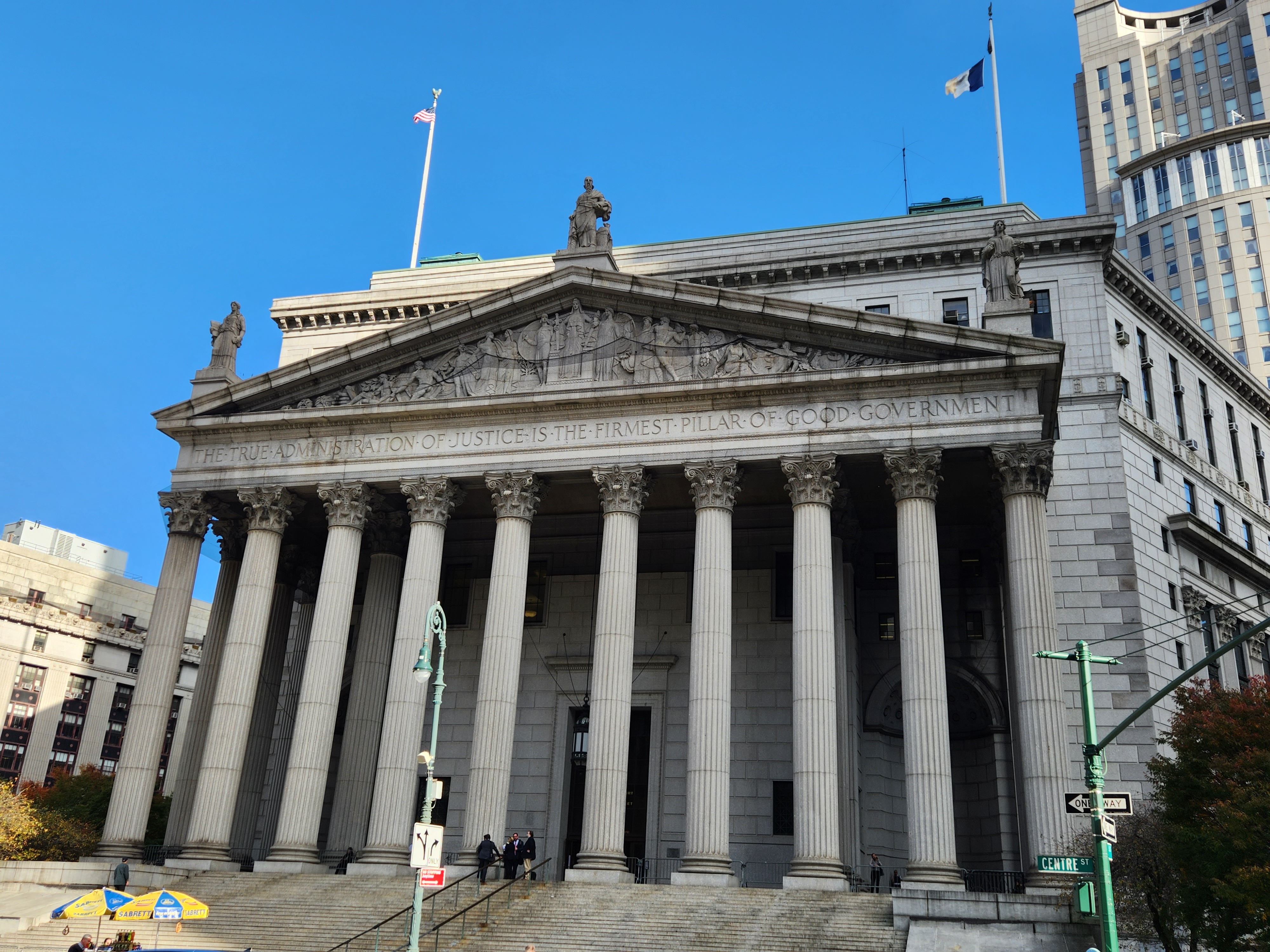
The New York Supreme Court has the appearance of a Roman temple — a popular style for courthouse architecture at the beginning of the 20th century. It features a sweeping flight of steps leading to a massive Corinthian colonnade topped by an elaborate triangular pediment. The statues adorning the roofline, appropriately to the purpose of the structure, are “Law,” “Truth,” and “Equity.” The inscription on a frieze bears a quotation attributed to George Washington: “The True Administration of Justice is the Firmest Pillar of Good Government.”
The courthouse was the first major New York commission for Boston-based architect Guy Lowell, known for designing the Boston Museum of Fine Arts and Harvard University. Lowell originally proposed a circular design for the courthouse. But since the price tag for the circular building was astronomic — $20 to $30 million — it was changed to a smaller and less expensive hexagonal structure.


The “Temple of Justice” was featured in many films; the most famous movie scene was that of a massacre in The Godfather (1972). As Emilio Barzini and his associate exit the Supreme Court building, they are gunned down on the steps by a disguised police officer in a hit ordered by Michael Corleone.
Thurgood Marshall United States Courthouse
Architect: Cass Gilbert
Style Neo-Classicism
Built: 1936

The United States Courthouse was built to house federal offices and courtrooms previously located in City Hall Post Office and Courthouse. Built during the Great Depression, The Federal Courthouse was one of only two skyscrapers in Manhattan completed in the mid-1930s (the other being the Rockefeller Center), and it was one of the first federal skyscrapers constructed.

The commission for the United States Courthouse went to one of the most prominent American architects, Cass Gilbert. The building located between earlier constructed the New York County Courthouse (1927), and the Municipal Building (1914) was meant to complement their design; Gilbert achieved it by adapting classical design elements to a steel-framed skyscraper.
When the Courthouse was completed in 1935, it drew much criticism. Lewis Mumford called it “the supreme example of pretentiousness, mediocrity, bad design, and fake grandeur.” Christopher Gray of The New York Times was not as harsh, saying that the composition is impressive but not inspirational.
Ironically, the United States Courthouse, one of Cass Gilbert’s latest works, is located in close proximity to the spectacular Woolworth Building, the architect’s earlier work considered one of the greatest architectural masterpieces of the 20th century.


Leave a Reply