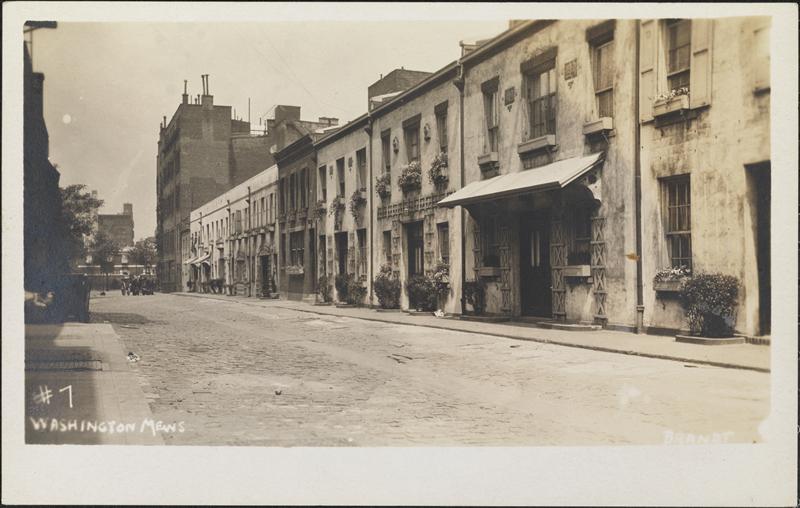
Washington Mews


Washington Mews is a charming, private, gated street just half a block north of Washington Square North, stretching from University Place to Fifth Avenue.
The term “mews” reflects its original purpose as horse stables. In the 1830s, the elegant townhouses along Washington Square North—known as “The Row”—were home to New York’s wealthiest residents, who enjoyed the luxury of private stables. Greenwich Village, one of Manhattan’s oldest neighborhoods, had numerous stables that were eventually converted into residences. Washington Mews followed a similar trajectory, with its stables transformed in the early 1900s into spacious, light-filled studios for the area’s thriving artistic community.
In 1881, New York City’s Department of Public Works ordered the construction of gates to distinguish Washington Mews from public streets. By 1916, a dozen of the former stables had been remodeled into artist studios, attracting notable creatives such as sculptors Paul Manship and Gaston Lachaise.


Around 1950, New York University leased most of the Mews and gradually converted its buildings into offices and faculty housing. Today, the street retains much of its historic charm, with ivy-draped façades, cobblestones, and historic street signs. The gates to Washington Mews remain unlocked during the day, offering visitors a rare glimpse into a beautifully preserved slice of New York’s past.
MacDougal Alley


Just north of Washington Square Park lies MacDougal Alley, one of the city’s hidden dead-end streets. Built in the 1830s as stables for the grand townhouses on Washington Square North and Eighth Street, the Alley was transformed into artists’ studios at the turn of the 20th century.
The street’s name honors Alexander McDougall, a Revolutionary War hero who served under George Washington in the Continental Army, was a delegate to the Continental Congress, and, later, a Senator and became the first president of Hamilton’s Bank of New York. Despite his significant contributions, McDougall’s legacy has been largely overlooked—not only that, but also the streets bearing his name have it misspelled.
As the fashionable residential area around Washington Square migrated uptown in the late 19th century, MacDougal Alley fell into disrepair and was even considered unsafe. Its fortunes changed in 1907 when Gertrude Vanderbilt Whitney—one of America’s wealthiest individuals, a sculptor, and a passionate patron of the arts—established her studio at Number 19. Over time, Whitney purchased eight more buildings in the Alley, transforming it into an art colony and laying the foundation for what would become the Whitney Museum of American Art.


The Alley also became home to other renowned artists. From 1949 to 1950, Jackson Pollock lived at Number 9. After voluntarily residing in a Japanese internment camp during World War II, Isamu Noguchi moved into a home and studio at Number 33. Here, Noguchi created some of his most celebrated works, including his interlocking sculptures.
Today, alongside private residences, MacDougal Alley houses the New York Studio School of Drawing, Painting, and Sculpture, which continues Alley’s rich artistic legacy.


Leave a Reply