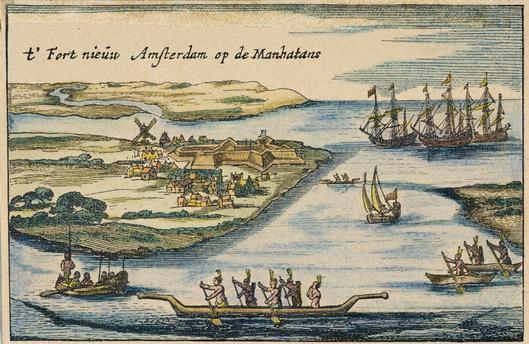
Dates and events in the history of New York from the time of the first European explorers to the end of the Dutch colony. The area originally inhabited by Native American tribes is settled by the Dutch and becomes the Dutch Colony of New Amsterdam. The Dutch colonial period which laid the foundation for the city’s future as a global crossroads lasted from 1624 to 1664.

Audio guide: The Battery: NYC origins from Bowling Green Park to Stone Street
1524 The First European to see Manhattan
Giovanni da Verrazano enters New York Harbor
Giovanni da Verrazano was an Italian explorer in the service of King Francis I of France. He sailed into New York Harbor in 1524 in search of the Northwest Passage and was the first European to see Manhattan. Even though he never set foot on land due to severe weather, he claimed it for France.
King Francis was so busy fighting Holy Roman Emperor Charles V, and changing alliances with or against Henry the VIII, that he never followed through on the discovery. Verrazano himself finished his explorations on a sad note, being eaten by locals in the Lesser Antilles, while trying to negotiate another conquest for France.
1609 The First European to set foot in Manhattan
Henry Hudson sails up Hudson river
Henry Hudson, an English explorer on the employ of the Dutch East India Company, was the first European to set foot in Manhattan. In search for India, he sailed up the Hudson (North River) as far as Albany. Having convinced himself that this particular body of water would take him to neither India nor China, he promptly decided to bring back material goods, which would make his trip worthwhile for his employer. Local beavers fit the bill with their lavish beaver tails. Hudson claimed the land for Holland; the Dutch East India Company was renamed to be the Dutch West India Company, and started trading in fur, finally providing Russia with healthy competition on the European market.
1624 Permanent colony of New Netherland
The first colony and its settlers
Permanent colony of New Netherland established by the Dutch West India Company and named New Netherland. The first settlers were a mere 30 families (110 people). They were mostly Walloons, French-speaking Protestants, and refugees from Spanish Netherlands who had fled to Holland from the Holy Inquisition. They had settled on Nut (now Governor’s) Island and started a fur trade with local Indians.
The island of Manhattan at the time was densely populated with geese, ducks, foxes, bears, turkeys, and, of course, beavers.
1626 New Amsterdam is born
The purchase of the Island of Manhattan
New Amsterdam was born when Peter Minuit took over as the first director general of the newly established colony. He renamed it New Amsterdam and moved it to the island of Manhattan. Feeling generous, he arranged the purchase of Manhattan Island from the Algonquian Indians, for beads, trinkets, cloth, axes and other items valued at approximately $24. This story would go down in history as the best real estate deal ever, if only it were true. In reality, American Indians did not use the European idea of land ownership, and therefore couldn’t sell the land. Besides, there were various tribes hunting on the island of Manhattan, and ‘purchasing’ it from one of them would not have made it legitimate. Nevertheless, the colonists, being blissfully unaware of that fact, relocated to their new home at the southern tip of Manhattan.
Queens was settled by the Dutch in 1635. Brooklyn – in 1654.
Bronx was bought by the Dutch West India Company in 1639. Later it was purchased by Danish immigrant Jonas Bronsk. Thus, the name….
1647 The first governor of New Amsterdam
Peter Stuyvesant appointed to ensure order and collect taxes
Peter Stuyvesant, the first governor of New Amsterdam, was appointed to rule the colony by the Dutch West India Company with the noble purpose of making it profitable. A stern, even mean ruler, Stuyvesant was referred to as ‘peg leg Peter’. Indeed, one of his legs was made out of wood. Before being appointed to New Amsterdam, he served as a soldier for the Dutch West India Company and rose through the ranks to become governor of Curaçao. After losing his leg in a battle, he went back to Holland until he was appointed governor of New Amsterdam. Stuyvesant was a stern administrator; he instituted night curfews for pubs, imposed punishments for public rowdiness, outlawed fighting and sex with Indians, created schools primarily to keep youth off the streets, and forbade common law marriages.
Stuyvesant’s estate, aka Bouwerie, was located between 5th and 20th Street, east of 4th Ave. Hence, the name Bowery.
1653 New Amsterdam is charted as a city
It used to be a colony, now it’s a city
The colony New Amsterdam incorporates as a city in 1653 with great pomp and parade down Broadway. The reason? Order and taxes! Peter Stuyvesant was sent to the new world to establish a proper city government. That way, laws would be enforced and taxes would be collected. At the same time, New Amsterdam officially as a city, gained municipal rights similar to those in the Dutch Republic. It went from a mere trading post to an urban commercial significant entity.
To ensure that the new city was well protected from the Indians, wild animals, and, most importantly, the English, Stuyvesant builds a wall from the East River to Hudson River (along what is now, therefore, called Wall street). The main reason for this was that England was, at the time, at war with Holland. By the way, England was going through an unusually rough patch in its history: Oliver Cromwell beheaded King Charles I and seized power in 1651.
1654 First Jewish settlers in New Amsterdam
Unbelievable story of the first Jewish settlers
The first Jewish settlers arrived to New Amsterdam in the summer of 1654. The very first Jew arrives from Holland, but in a month a small community of 27 joins him. These people had quite a journey! Their ancestors were expelled from Spain and Portugal in 1492 when Ferdinand and Isabella cleansed their realm of Jews and Muslims in a Christian frenzy. The expelled Jews took refuge in Holland, and then relocated to Brazil, which was then partly Dutch. In 1654 Brazil fell to Portuguese.
The story repeated itself, as the descendants of the Jews that fled Spain and Portugal had to flee once more! It was back to Amsterdam again. 15 ships made it safely to Holland. One of the ships, which was carrying 27 Jews, was captured by Spanish pirates. They were rescued by a French privateer, but since they didn’t have enough to pay for the passage to Holland, they were taken to the closer destination of New Amsterdam, instead.
Stuyvesant hated the idea. He didn’t want any Jews to “infest” the colony. However, Dutch West India Company insisted that since the Jews held shares in the company and had suffered a loss in the capture of Brazil, they should be allowed to stay. The conditions of their new residence were that they had to take care of their own poor and the only trade they were permitted was slaughtering livestock.
Soon more Jews came from Curaçao, then from Holland…
1655 The Peach Tree War
Tensions and conflicts between the Native Americans and the Dutch
The ongoing hostilities between Dutch colonists and the surrounding Native American tribes culminated in the deadly attack on New Amsterdam by the Susquehannock tribes. While Stuyvesant with was fighting the Swedes, New Amsterdam was left undefended. The Susquehannock stormed the Dutch settlements for three days in retaliation for the Dutch assault on New Sweden, and the Pavonia Massacre leaving many dead and taking hostages.
1658 Harlem is Born
Harlem is established
Harlem was named after Dutch city of Haarlem which is located as far from Amsterdam as Harlem from New Amsterdam. Within a few years Harlem had about 30 families of ex-Frenchmen, Walloons, Danes, Swedes, German and Dutchmen.
Stone Street is the first paved street
Harlem was named after Dutch city of Haarlem which is located as far from Amsterdam as Harlem from New Amsterdam. Within a few years Harlem had about 30 families of ex-Frenchmen, Walloons, Danes, Swedes, German and Dutchmen.
The muddy, dusty street was such an annoyance that it was paved with cobblestones.
1664 New Amsterdam becomes New York
The end of the Dutch colony
To the horror of Governor Stuyvesant, the English took New Amsterdam without any military action.
The English send a letter to Stuyvesant, guaranteeing undisturbed rights to all the citizens if the town surrenders peacefully. Even though Stuyvesant hid this letter, the word of it got out. The citizens of New Amsterdam didn’t want to fight, and they didn’t like their governor that much. They surrendered happily.
The colony was renamed New York in honor of Duke of York, the future King James II, the brother of Charles II, the King of England. Stuyvesant went back to the old country, but later returned to New York where he spent his old age and was buried. The last of his descendants died in New York in the 20th century.

The Battery: NYC origins from Bowling Green Park to Stone Street
Leave a Reply