Portal of Paradise and the Symbolism of St. John the Divine

The Cathedral of St John the Divine is undeniably stunning. The mother church of the Episcopal Diocese of New York and the seat of its bishop, it’s one of the largest in the world, albeit still unfinished.
St John the Divine, whose figure is located front and center over the main entrance, is greeting the visitors, holding his identifying object – a book. Not to be confused with John the Apostle or John the Baptist, St. John the Divine is the Evangelist who wrote the latest book of the New Testament – the Book of Revelation, aka the Apocalypse. The term Divine stands for someone predicting the future, narrated as a series of mysterious visions, the visionary Prophet of Revelation.
References to Saint John the Divine are present throughout the Cathedral. John’s symbol is the seven stars, and the number seven is the most prominent symbol in Revelation. It’s reflected in seven lamps above the High Altar, as well as seven chapels on each of the side bays. The colors of the paving stones in the Apse and Great Choir echo the precious stones named in Revelation as those adorning the walls of the New Jerusalem.
The entrance to the Cathedral is dominated by the magnificent central Portal called the Portal of Paradise. All 31 figures in the Portal are biblical, and all but three are from the Old Testament. Every image relates to a specific passage in the bible. This tradition of biblical depictions goes back to the Middle Ages: it was a form of informing the public about the bible at a time when most people were illiterate.
The Portal looks deceivingly medieval. Designed by Simon Verity and Jean-Claude Marchionni, it was completed in the 1990s, and upon closer observation, it reveals some modern-time narratives.
There are 16 major figures – 8 on each side with only 12 pedestals, making figures double up on 4 of them. They depict the forerunners of Jesus and are presented in chronological order. Following the medieval tradition, all the figures feature complementing biblical scenes above and below major figures.
North Side

1 – Melchizedek
He was a king and priest, appearing in the Book of Genesis. The name means “King of Righteousness,” echoing kingly and priestly functions. He is the first individual to be given the title Cohen (priest) in the Hebrew Bible. For early Christians, he was foreshadowing the Christ himself.
2 – Abraham and Sarah

According to the Old Testament, Abraham was chosen by God to be the father of a multitude of nations. All three monotheistic religions revere Abraham as a patriarch. Despite God’s promise, the couple was old and childless, and Sarah wasn’t hoping to conceive at the age of 99. According to the custom, her maid could have a child by her husband, which she could claim as her own. When Sarah’s maid, Hagar, got pregnant, Sarah cast her out of the house. Depicted above Abraham’s head is angry Sarah throwing Hagar out of the house. The happy figure above Sarah’s head is Sarah herself, pleased at the news that she will get pregnant and bear a son. On the stone below, we see the birth of Isaac.
3 – Jacob (son of Isaac)


Above Jacob’s head is the story of Jacob’s ladder. According to the story, Jacob has a dream. He sees a ladder reaching heaven, where the angels of God can descend to Earth. The God at the top of the ladder promised the land of Israel to the descendants of Jacob. The base stone illustrates the story of Jacob wrestling with God. Jacob’s 12 sons became the founders of 12 tribes of Israel.
4 – Moses

Moses, the liberator of Hebrews from slavery in Egypt, is depicted with half his face covered. It refers to the passage in Exodus. When Moses came down from Mt Sinai holding tablets, his face shone because he saw God. To cover the divine light, he put a veil on his face. The base stone depicts a scene from the early life of Moses as an Egyptian aristocrat and the story of the burning bush when God appeared to him and commanded him to lead his people out of Egypt.
5 – Prophets Elijah and Elisha
Base stone depicts Elijah’s ascension into heaven.
6 – Samuel
Samuel was the last of the judges of Israel, who anointed Saul as the first king of Israel. Later, he anointed David as the king. Samuel is depicted holding oil for anointment. Base stone is a political commentary on contemporary officials who spend money on military buildup instead of caring for the poor.
South Side

7 – King David


David was the greatest king of ancient Israel and one of the most complicated biblical characters. He wears a crown and holds a scepter as a king and a harp, signifying his artistic side. Base stone shows a celebration of Jerusalem becoming a capital city after David installed the Arc of Covenant there. The next scene is David holding the head of Goliath.
8,9,10 – Prophets


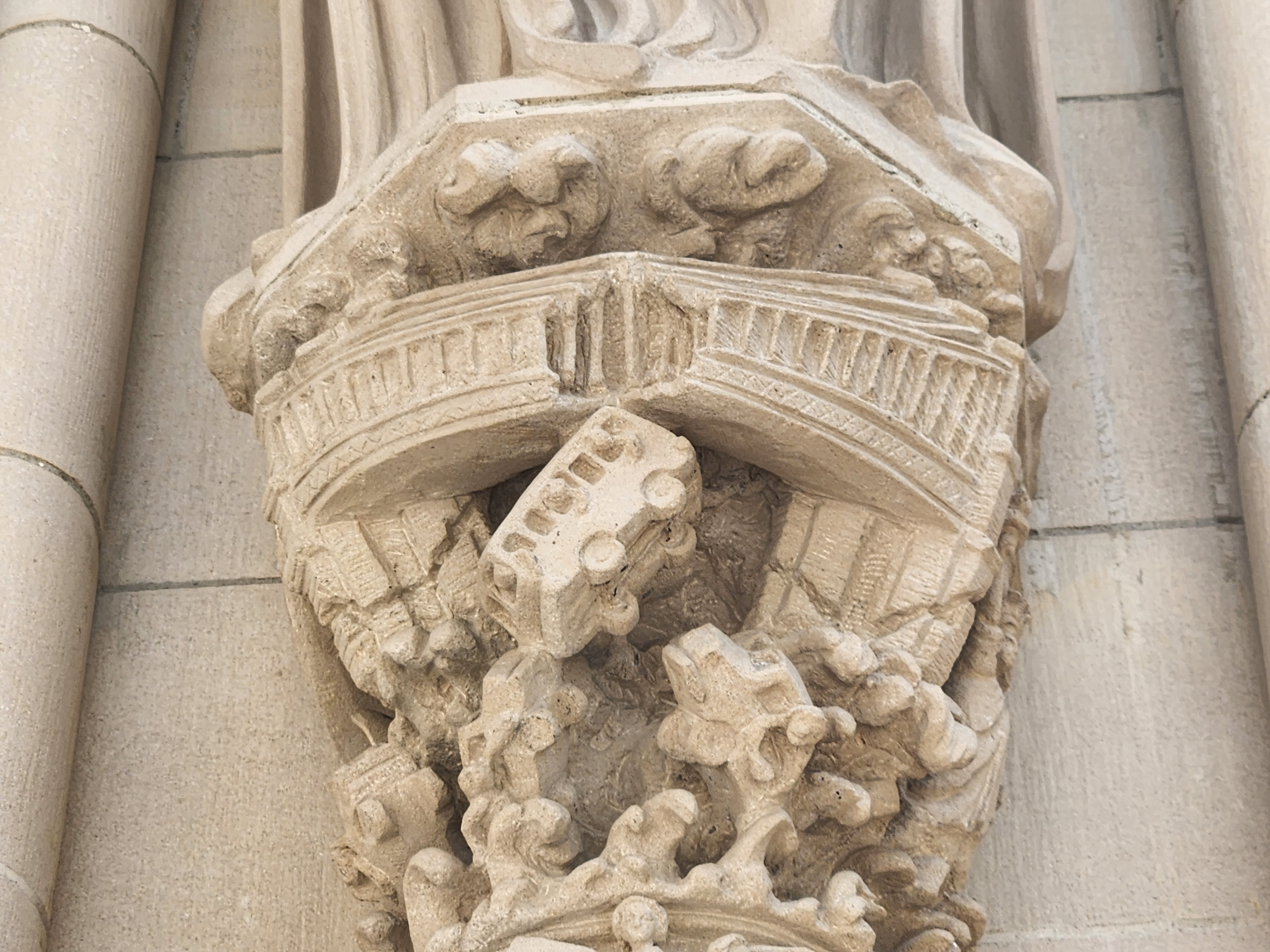
They were preachers who denounced idolatry and immorality and advocated for social justice. The base stone shows the Northern Kingdom in the downward spiral of civil disorder. The artist placed the scene in modern-day New York City, following the Renaissance tradition of placing biblical stories in a contemporary setting.


The next base stone strikes the cord with most viewers. It depicts the falling Twin Towers and, having been carved about 10 years before 9/11, comes across as a prophetic vision. In reality, it has more to do with the tradition of transposing biblical events into present life. The stone describes the biblical event of the destruction of the First Temple. But placing it in contemporary New York City, it shows the mushroom cloud of a nuclear catastrophe, the city engulfed by fire and water, and the falling Twin Towers. The lower part is the counterbalance to the scene of destruction, depicting a beautiful Cathedral rising from the ashes – a reference to rebuilding the Temple of Jerusalem.
The next one depicts prophetic images from prophetic dreams where people rise from their graves as a symbol of hope and rebirth.
11 Elizabeth


Elizabeth was the mother of John the Baptist. Like Sarah, she conceived miraculously in a very old age. Elizabeth and Sarah are positioned right across from one another. On the base stone, Elizabeth is visited by Mary. The subject known as visitation is one of the favorite Renaissance subjects. The vessel with overflowing water symbolizes birth, as well as predicting the future of John’s purpose as a Baptist.
12 John the Baptist

The forerunner of Jesus, he preached his arrival. He is the only figure not looking at other figures, gazing at the city instead. In his hands, he’s holding a shell – an ancient symbol of fertility and life.


Leave a Reply