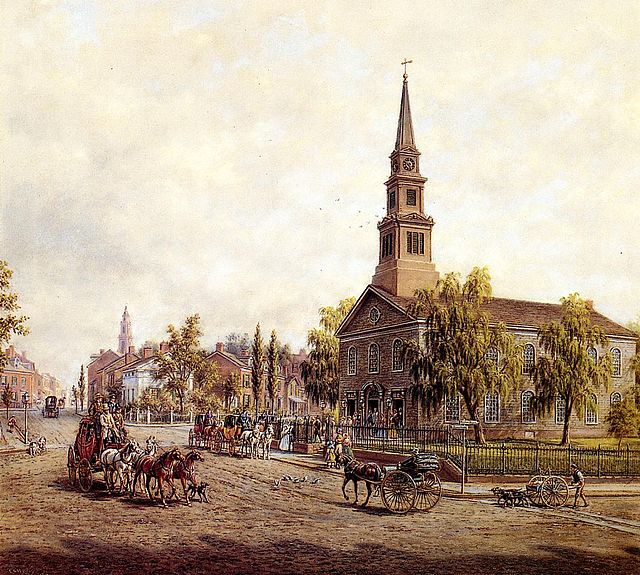
Built in 1799, St. Mark’s-in-the-Bowery is the second-oldest surviving church building in New York. (The first was St. Paul’s Chapel, 1766.) The story of St. Mark’s reaches back even further—into the days when New York was still the Dutch colony of New Amsterdam. The corner of East 10th Street and Second Avenue, where St. Mark stands now, is the oldest site of continuous worship in Manhattan.

Origins of the Church
This land once belonged to Peter Stuyvesant, the last Dutch governor of New Netherland. Here he had a bouwerie, a farm in Dutch. In 1660, he built a small family chapel on his farm, and when he died in 1672, he was laid to rest in a vault beneath the chapel—his grave remains visible today.
Nearly a century later, the Stuyvesant family entrusted the chapel to Trinity Church. In 1799, a new St. Mark’s Church rose on the site, carefully preserving Stuyvesant’s resting place. To this day, it remains one of the few locations in New York that maintains visible links to the city’s Dutch colonial past.
Architecture Through the Ages

St. Mark’s-in-the-Bowery is a rare survivor of Georgian architecture, characterized by simplicity, restraint, and understated elegance. The main body of the church is a rectangular box, typical of Anglican and early Episcopal design, with fieldstone walls and round-arched windows that reflect late Georgian building traditions in America.
What makes St. Mark’s extraordinary is the way it evolved with the times, incorporating new architectural styles while remaining cohesive:
- Georgian Sanctuary (1799): Designed by John McComb Jr., a leading early New York architect.
- Greek Revival Steeple (1828): Designed by Martin Euclid Thompson and Ithiel Town. Thompson also remodeled the interior in 1836, replacing square pillars with slender Egyptian Revival ones, reflecting the eclectic tastes of the era.
- Italianate Portico (1856): Designed by James Bogardus, a pioneer of cast-iron construction. His elegant portico is unique n its use of cast iron in a church.
- Gothic Brick Addition (1861): Designed by James Renwick Jr., famed architect of St. Patrick’s Cathedral, further expanding the church’s stylistic palette.
Together, these layers make St. Mark’s not just a church, but a living record of New York’s architectural evolution, with each addition preserving the spirit of its time.
Stories Beneath the Stones
The churchyard at St. Mark’s-in-the-Bowery serves as both a burial ground and a quiet archive of New York history. Notable figures interred here include:
- Peter Stuyvesant (1612–1672): The last Dutch governor of New Netherland, recognizable by his wooden peg leg. He ruled the colony from 1647 until the English takeover in 1664 and retired to his bouwerie, the site of today’s St. Mark’s. His grave links the church directly to New York’s Dutch colonial past.
- Daniel D. Tompkins (1774–1825): Fourth Governor of New York and later Vice President of the United States under James Monroe. A progressive reformer, he championed public education, infrastructure, and the abolition of slavery in New York. Tompkins Square Park in the East Village commemorates his legacy.
- Philip Hone (1780–1851): Wealthy merchant and Mayor of New York City. His detailed diary documents the city’s daily life, politics, and transformation during the early 19th century.
- Gideon Lee (1778–1841): Leather merchant, politician, and Mayor of New York City, known for his dedication to civic affairs.
- Alexander Turney Stewart (1803–1876): One of 19th-century New York’s wealthiest men and a pioneer of modern retail. His burial at St. Mark’s became infamous when his body was stolen and held for ransom weeks after interment, in one of the city’s most sensational scandals.
The Ghost of Peter Stuyvesant


Legend holds that the restless spirit of Peter Stuyvesant still haunts St. Mark’s. Church bells sometimes ring of their own accord, and the tap of a wooden leg echoes through the nave. During some services, faint sounds of Dutch hymns can be heard, sung by a voice no one sees. It seems the former Director-General of New Netherland still broods over the day his city was handed to the English, guarding the chapel he built centuries ago.
Lying outside the usual tourist routes, St. Mark’s-in-the-Bowery is a hidden treasure that connects modern Manhattan to its colonial beginnings, preserving layers of architecture, history, and legend in one remarkable site.
Leave a Reply