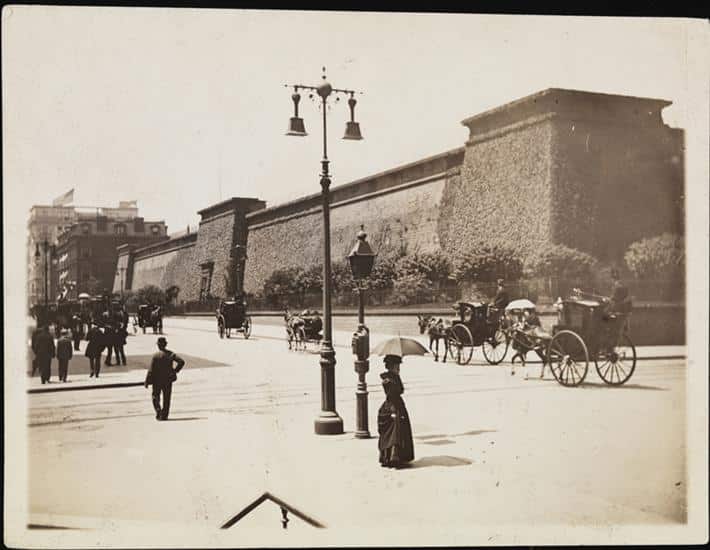
The Distributing Reservoir, with massive granite walls rising nearly 50 feet high, resembled an ancient Egyptian fortress. It stood in the heart of Midtown Manhattan, on Fifth Avenue between 40th and 42nd Streets—the present site of the New York Public Library Main Branch.


Its design was inspired by ancient Egyptian architecture—deliberately imposing, dramatic, and practical. Inside, the reservoir held over 20 million gallons of water, supplying much of the growing city. The newly built Croton Aqueduct delivered fresh water from upstate to Manhattan, where it was distributed from this monumental basin.
In the early 19th century, New York City was dangerously short of clean water, making the reservoir not just impressive but essential. The structure was an amazing feat of 19th-century engineering, but it offered the city more than just water.


Its 25-foot-thick granite walls supported a promenade along the top, where visitors could stroll high above the busy streets below. It quickly became one of New York’s public attractions, not only as a place to stroll but also to enjoy views of Manhattan from above, becoming something of an early observation deck.
Completed in 1842, the monumental structure appeared permanent, but by 1899, it had become obsolete and was demolished.
The fall of the Distributing Reservoir wasn’t sudden. It was the result of a series of technological upgrades and system-wide changes that made this massive Fifth Avenue fortress unnecessary.
When the reservoir opened in 1842, the Croton Aqueduct was revolutionary. As the city expanded, so did its water system. The New Croton Aqueduct, completed in the 1890s, dramatically increased capacity, and new, larger storage reservoirs were built further uptown and in the Bronx. Not only were they larger, but they were also located at higher elevations, allowing for better pressure and distribution.
At the same time, Manhattan itself was changing. By the end of the 19th century, land in Midtown had become far too valuable to house massive infrastructure.

1890

But the biggest change was conceptual. Innovations in water distribution technology enabled water to move more efficiently, without the need for a giant central basin in the middle of Manhattan. Instead of relying on a single central reservoir in Midtown, the system shifted to multiple reservoirs, making water delivery more efficient, more resilient, and easier to scale.
In short, New York outgrew its great Fifth Avenue reservoir.
Demolished in 1899, the Distributing Reservoir joined the ranks of New York’s lost landmarks, becoming yet another wonder that perished when it outlived its usefulness. It gave way to the magnificent Public Library and charming Bryant Park.
The Distributing Reservoir is gone, but its story remains essential. It’s not just the story of technological achievement. It’s the story of infrastructure that can be monumental and beautiful at the same time, and that beauty and utility can coexist.
Leave a Reply