The Rockefeller Center is not just a complex of buildings, but an idea. Built during the depths of the Great Depression, it defied the odds and stood as a testament to human achievement. There are more than 100 permanent artworks throughout the Rockefeller Center, tasked with conveying the philosophy behind the complex.
The original theme of Rockefeller Center, “Homo Faber” (“Man the Maker”), evolved into “New Frontiers”—focusing on social and scientific innovation—and ultimately became “The March of Civilization.” Though worded differently, all of these themes emphasize personal responsibility, achievement, and the forward march of human progress.
At the heart of its 1930s Art Deco aesthetic is the vast lobby mural American Progress. The first version of this mural was commissioned from Diego Rivera, the celebrated Mexican muralist and outspoken communist. What could go wrong when you ask a communist to celebrate capitalism? Pretty much everything. Rivera’s Man at the Crossroads placed a workman at the center, flanked by contrasting visions of capitalism and socialism. Communism was presented as a world of harmony and joy, in a stark contrast with the horrors of depravity of capitalism, drawing in war, vice, and corruption. Upon Rivera’s refusal to alter the imagery, proudly citing artistic integrity, the mural was destroyed. (Read more on this story here.)

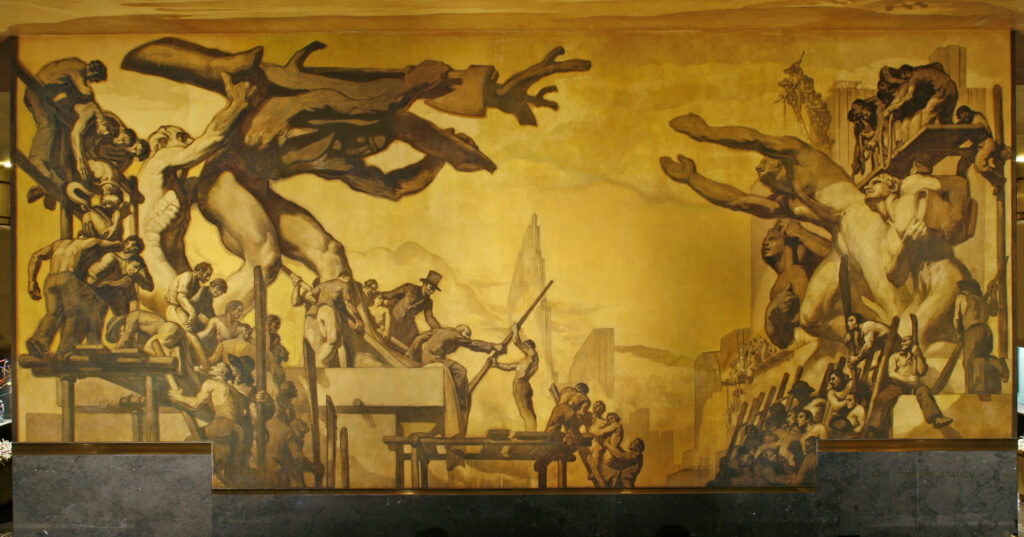
To replace it, the Rockefellers turned to Spanish muralist José Maria Sert. His American Progress, which dominates the space behind the central desk, offers a sweeping allegory of America’s development. Its central theme is the unity of intellect and labor—the “brain” and the “brawn”—as the dual forces driving modern civilization.
On the left, mythological Titans and workers strain to hoist massive stone blocks, their bulging muscles representing the sheer physical power of industrial progress—the brawn. On the right, the brain takes form in three monumental Graces—Poetry, Music, and Dance—symbolizing the intellectual and artistic pursuits that inspire human endeavor.
Two recognizable figures at the center are Abraham Lincoln and Ralph Waldo Emerson. Emerson, the “Man of Thought,” personifies morality and intellectual ideals, while Lincoln, the “Man of Action,” represents leadership. Lincoln’s hand rests on Emerson’s shoulder – the gesture that signifies the required union of thought and action in building modern America. Emerson was a leading abolitionist, and Sert’s composition suggests that the president’s choices were shaped by the moral vision of thinkers like Emerson.
The mural’s background is a nod to its setting: the skyscrapers rising in the background resemble Rockefeller Center itself. Through allegory, mythology, and history, Sert delivers the mural’s core message. He presents a vision of America built on a balance of brain and brawn: for true progress, thought must inspire action, and action must give form to thought.
Leave a Reply