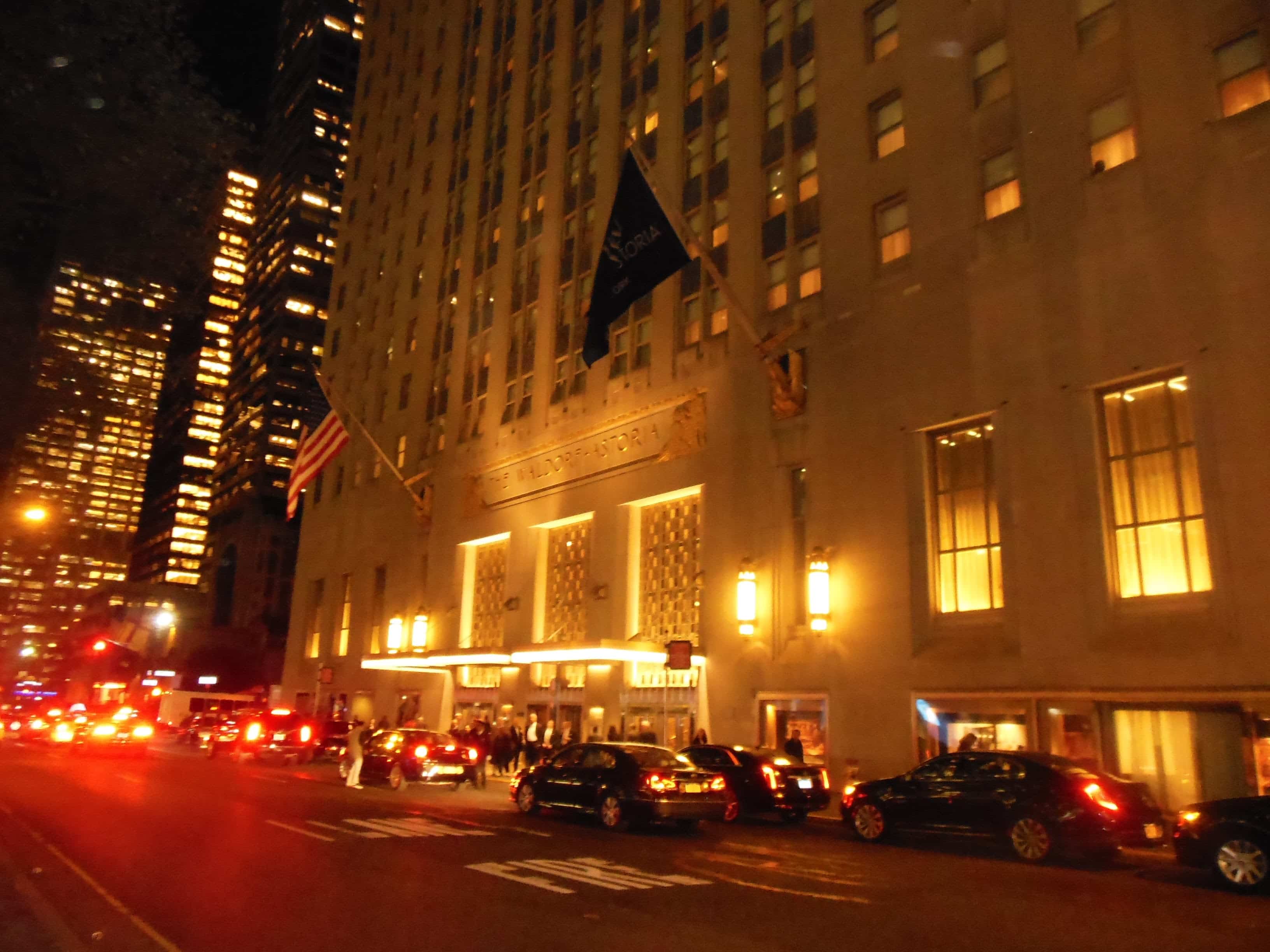
The glorious Waldorf Astoria on Park Avenue is the second reincarnation of one of New York City’s most legendary hotels. Here is its story.
The Original Waldorf-Astoria: Born of a Family Feud
The original Waldorf-Astoria stood at Fifth Avenue and 34th Street, on the site now occupied by the Empire State Building. Its creation was sparked by one of New York’s most famous Gilded Age family feuds.
Before the hotel, the land was home to two adjacent Astor family mansions—one belonging to Caroline Astor, aka Mrs. Astor, the undisputed queen of New York society, and the other to her nephew, William Waldorf Astor. William believed that the coveted title of “Mrs. Astor” should belong to his wife, a claim his formidable aunt firmly rejected.
While the title dispute ended in Caroline’s favor, William retaliated. He demolished his mansion and erected a luxury hotel directly beside his aunt’s home—a calculated social insult, as Mrs. Astor considered hotels deeply inappropriate neighbors for elite residences. He named it the Waldorf, after the German village the Astors came from.
Caroline’s son, John Jacob Astor IV, persuaded his mother to relocate. And, on the site of her former mansion, he constructed a rival hotel—the Astoria. Rather than compete, the cousins decided to combine their efforts and maximize the profits. They united the two buildings with a grand corridor known as Peacock Alley, which quickly became the most fashionable promenade in New York City.
Thus, the Waldorf-Astoria was born. United by a hyphen, it emerged as the world’s largest and most luxurious hotel. “Meet me at the hyphen” became shorthand for meeting up and strutting your stuff at the Peacock Alley.
A New Home on Park Avenue


In 1931, the Empire State Building rose on the original site, and the Waldorf-Astoria moved uptown to its current location on Park Avenue. Designed by the architectural firm Schultze & Weaver in an elegant Art Deco style, the new building was once again the largest hotel in the world, boasting 2,200 rooms.
The Park Avenue Waldorf changed the hotel industry forever by becoming the first hotel to offer room service—a now-essential luxury that began here.
One of its most spectacular spaces was the Starlight Roof, now gone, a four-story-high ballroom on the 19th floor. In the 1930s and 1940s, it was a glittering high-society gathering place, featuring a retractable roof—an extraordinary innovation for its time. Accommodating up to 6,000 guests, it hosted performances by Glenn Miller, Duke Ellington, and Count Basie.
America’s Presidential Hotel
The Waldorf-Astoria has long been known as America’s presidential hotel. It holds the distinction of having hosted every U.S. president since Herbert Hoover in 1931 in its Presidential Suite.
The suite includes multiple adjacent staff rooms, bulletproof windows, and an interior design modeled after the White House. Each president traditionally leaves a gift, many of which are displayed within the suite.
The U.S. government also maintains a large apartment on the 42nd floor as the official New York residence of the United States ambassador to the United Nations.
Built above the railway tracks leading into Grand Central Terminal, the hotel had its own private railway platform—Track 61 (no longer in use). This secretive access allowed President Franklin D. Roosevelt to enter and leave discreetly, maintaining privacy and shielding the extent of his paralysis from the public. While it is unlikely there was a special elevator to the suite, Track 61 enabled private transfers directly from Grand Central to the hotel.
Legendary Residents and Guests


The Waldorf-Astoria was home to an astonishing roster of long-term residents and guests, including Herbert Hoover (after his presidency), Marilyn Monroe, Winston Churchill, Queen Elizabeth II, Charlie Chaplin, Benjamin “Bugsy” Siegel, and Charles “Lucky” Luciano.
In January 1956, one of the world’s most glamorous couples—Prince Rainier III and Grace Kelly—celebrated their engagement at the hotel’s Conrad Suite.
The Duke and Duchess of Windsor resided for years in Suite 42R, known as the “Royal Suite,” located in the Waldorf Towers—the hotel’s exclusive residential enclave.
Composer Cole Porter maintained a grand apartment, Suite 33A, in the Waldorf Towers for nearly 30 years beginning in 1934. Many of his greatest hits were written there, and his restored piano now sits in the hotel’s lobby. After Porter’s death in 1964, Frank Sinatra and his wife Barbara rented the suite, paying a reported $1 million per year and remaining loyal patrons of the Waldorf for decades.
Louis Armstrong died of a heart attack the night after performing his final show in the hotel’s Empire Room. Inventor Nikola Tesla had resided at the earlier Waldorf-Astoria, as did many other luminaries.
The Waldorf Astoria Name
When the Waldorf and Astoria hotels merged, the hyphen symbolized the famous Peacock Alley. Later, when Conrad Hilton acquired the property, he briefly replaced the hyphen with a double one—Waldorf=Astoria—to emphasize that connection. Eventually, all punctuation was dropped, and today the hotel is officially known as Waldorf Astoria New York.
And finally – a Salad!
The world also owes the Waldorf Astoria a culinary debt. In 1896, its maître d’hôtel created what would become the Waldorf salad, made of apples, walnuts, celery, and mayonnaise. The dish was forever linked to the hotel’s name in Cole Porter’s 1934 song You’re the Top with the lyric: “You’re the top, you’re a Waldorf salad.”
How many hotels in the world can boast their name immortalized in a song and in a salad? Not too many. Waldorf Astoria can.
Leave a Reply