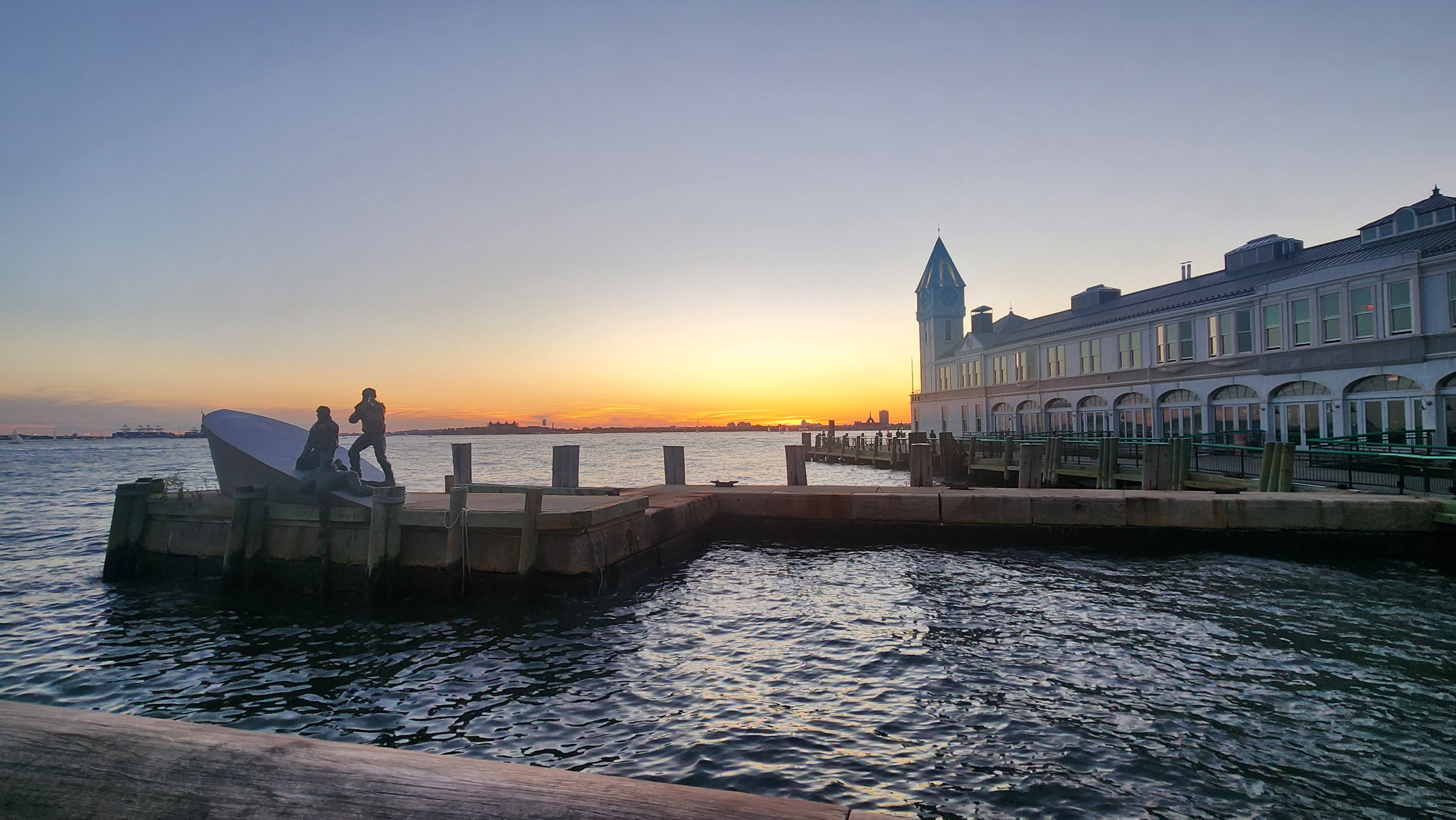
Located in Battery Park, just south of Pier A, the American Merchant Mariners’ Memorial is one of New York City’s most moving and lesser-known monuments.
The sculpture commemorates a real World War II tragedy. In 1942, a German U-boat torpedoed an American merchant vessel in the Atlantic. As the ship sank, the merchant mariners struggled to stay afloat. The German submarine crew photographed the drowning sailors before leaving the scene. None of the American merchant mariners survived.


The monument’s emotional power comes from the way it incorporates the harbor itself. A drowning mariner desperately reaches from the side of the boat, while another, still aboard, reaches down and tries to pull him back. The gesture is heartbreaking: one man is fighting for his life, while another is fighting to save him, even though we know they are doomed. The sculpture was deliberately positioned so that the changing tide becomes part of the memorial. Depending on the time of day and the height of the tide, you may see the drowning man’s entire arm reaching above the surface—or just his hand. The effect is haunting: the harbor seems to swallow the sailor before your eyes.
American Merchant Mariners’ Memorial Project

The memorial was created by American Merchant Mariners’ Memorial, Inc. to commemorate merchant ships and their crews who served the United States in wartime, dating back to the Revolutionary War.
From the very beginning, merchant mariners played an essential role in keeping American forces supplied. During the Revolutionary War, American merchant vessels carried food, weapons, and other supplies, while many merchant sailors served aboard privateers or risked capture at sea. After the Revolutionary War, American merchant sailors faced a serious danger from British warships. They routinely stopped American merchant vessels and impressed sailors, forcibly taking men into the Royal Navy. The practice became a major grievance contributing to the War of 1812. More than a century later, American merchant mariners again found themselves on the front lines of global conflict. During World War I and World War II, merchant ships carried troops, ammunition, fuel, food, and other vital supplies across the Atlantic, often facing German U-boat attacks. During World War II alone, more than 1,500 American merchant ships were lost, and thousands of merchant mariners died.
Although they were civilians, merchant mariners repeatedly sailed into war zones because armies and navies could not fight without a steady supply of men and materials. Their ships carried the fuel, food, weapons, vehicles, and troops that made military operations possible.
The Sculptor: Marisol
Created by artist Marisol Escobar, known simply as Marisol, the bronze sculpture was installed between 1988 and 1991 on a rebuilt stone breakwater in New York Harbor.
Marisol was born in Paris in 1930 and spent much of her childhood in Venezuela. She studied art in Paris and Los Angeles before moving to New York in the early 1950s. She soon became an important figure in the downtown art scene and was associated with many artists, including Andy Warhol. Her sculptures, often made of wood and incorporating painted surfaces and found materials, became known for their enigmatic mix of portraiture, humor, and social observation.
Here, however, Marisol’s work takes on a darker purpose. The American Merchant Mariners’ Memorial is both a historical document and a haunting work of art. The sculpture changes with the tide, making the harbor an active part of the memorial—and turning the viewer into a witness to a terrifying moment that happened more than eighty years ago. That was precisely the point. Marisol designed the memorial so that the viewer does not simply look at a representation of men drowning. Instead, the viewer watches as one of the figures is gradually swallowed by the water.
In this way, Marisol transformed a horrific episode into a memorial not only to those men, but to the thousands of American merchant mariners who lost their lives serving their country.
Merchant Mariners: the Overlooked Heroes
The memorial honors these merchant sailors as an essential but often overlooked part of America’s wartime history. They were civilians, but they sailed into some of the most dangerous waters of the world’s wars, carrying the people and supplies that kept American forces fighting.
As the tide slowly rises and the drowning figure disappears beneath the water, the memorial reminds us of men who knew the dangers of the sea and sailed anyway.
Leave a Reply