John Jacob Astor – the Astor Library founder
The Astor Library bears the name of its founder – John Jacob Astor. He arrived from Germany right after the end of the Revolutionary War, in 1783, looking for opportunities, which he found first in the fur trade and later in real estate. Astor astutely predicted Manhattan’s northward expansion and continuously acquired land beyond the city’s existing limits. Rather than developing his properties, he preferred leasing them, earning him the moniker “The Landlord of New York.”


By the time of his death in 1848, Astor was the wealthiest person in the United States, leaving behind an estate valued at over $20 million—equivalent to 0.9% of the nation’s GDP at the time. He was the first multi-millionaire in the United States, and, considering his fortune in proportion to the US GDP, he is one of the wealthiest people in modern history.
Nobody could accuse John Jacob Astor of generosity, but at the end of his life, he made a huge philanthropic gesture: he allocated approximately $400,000 in his will to establish a public library. This was groundbreaking, as public libraries were virtually nonexistent; wealthy New Yorkers typically maintained private collections. His will detailed specific instructions for the library’s location and operations, and an appointed board of trustees—including his son, William B. Astor, and esteemed writer Washington Irving—oversaw the project.
Astor Library – the first public library in New York
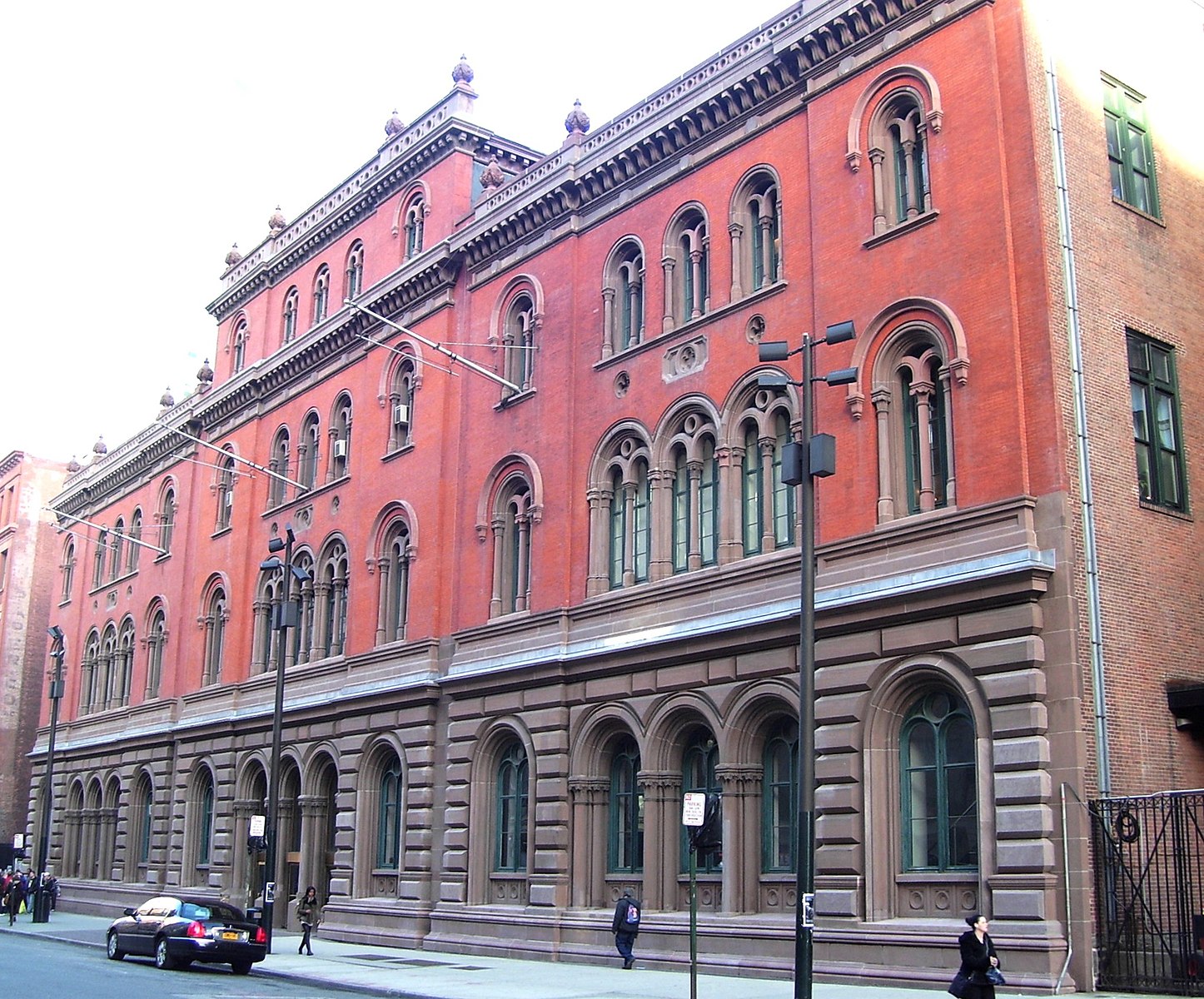
Founded in 1848 and opened in 1854 on Lafayette Place, the Astor Library housed around 80,000 volumes. Though accessible to the public, it functioned as a reference library, open only during daytime hours. Washington Irving served as its first superintendent.
The library’s building, designed in the Rundbogenstil style—a German adaptation of Romantic Classicism—reflected Astor’s German roots. The style, meaning “round-arched,” drew inspiration from Byzantine, Romanesque, and Italian Renaissance architecture.
In 1895, the Astor Library merged with the Lenox Library and the Tilden Trust to form the New York Public Library, initially serving as its main branch. When the iconic New York Public Library building opened on 42nd Street in 1911, the Astor Library closed its doors.
From Public Library to Public Theater

The historic structure narrowly escaped demolition and found new life in 1967 as the permanent home of The Public Theater, founded by Joseph Papp in 1954 as The Shakespeare Workshop. The Public Theater is based on the principles that theater is an essential cultural force and that art belongs to the public.
It is quite poetic that the building that once housed the first public library in New York is now home to one of the nation’s first nonprofit theaters.


Leave a Reply