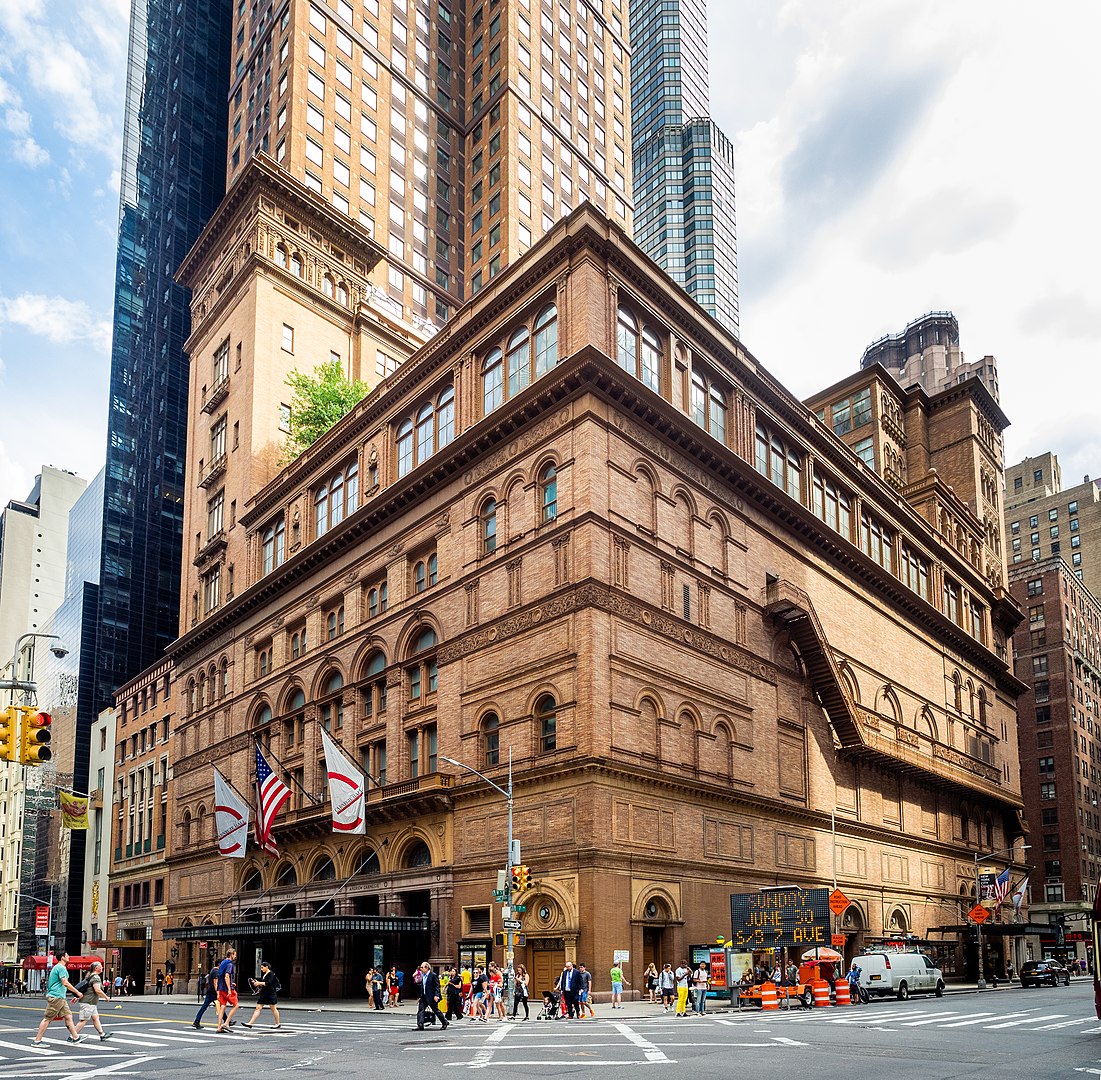

From: Carnegie Hall Rose Archives
After the Civil War, Gilded Age New York was entering the world stage as one of its major players. But it was lacking a suitable concert hall. New York needed a top-notch place for music performances.
Here comes the story of Carnegie Hall.
Table of Contents
Carnegie Hall was conceived in the middle of the Atlantic.


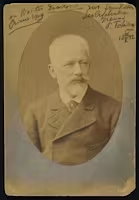
In the spring of 1887, a transatlantic ship was carrying Andrew Carnegie and his new bride to his native Scotland for their honeymoon. The same vessel took the 25-year-old Walter Damrosch, conductor and musical director of the Symphony Society of New York, for his European summer study. During the voyage, the two men were introduced. Damrosch repeatedly brought up the subject of the much-needed music venue in New York. After returning from his honeymoon, Andrew Carnegie presented the city of New York with a $2-million gift for The Music Hall Company of New York.
Carnegie Hall location and architecture

Andrew Carnegie acquired the parcels of land along Seventh Avenue between 56th and 57th streets. These days it’s a prime location in New York City. But the time, this location, a short distance from Central Park, was on the city’s outskirts.
The architect selected to design Music Hall was William B. Tuthill, still a young architect and a talented amateur cellist. It was of primary importance that the architect understood acoustics, and Tuthill’s extensive study of European concert halls led to his receiving the commission. He is responsible for the celebrated acoustics of Carnegie Hall.
He chose to design it in the Italian Renaissance style with a façade of terra cotta and brick.
The plans provided for three performance spaces: the Main Hall (later renamed Isaac Stern Auditorium), the Recital Hall (now Zankel Hall), and the Chamber Music Hall (now Weill Recital Hall).
Opening of Carnegie Hall
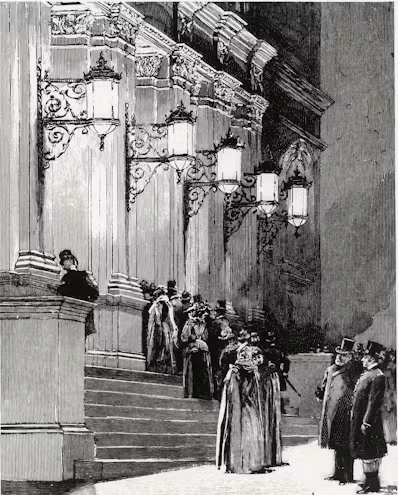

The five-day opening festival attracted the best of New York society, such as Whitneys, Sloans, Rockefellers, and Fricks. On the opening night, May 5, 1891, the streets were choked with horse-drawn carriages that lined up for a quarter-mile. The Main Hall was jammed to capacity. After a lengthy dedication speech was delivered, Damrosch led the Symphony Society in playing “America” and Beethoven’s Leonore Overture No. 3. Then the famous Russian composer Tchaikovsky, who arrived specifically for the occasion, came to the podium to conduct his Marche Solennelle. Damrosch concluded the evening with the New York premiere of Berlioz’s Te Deum.
Watching the balcony overfilled with spectators, Tuthill panicked that the steel columns would not withhold the weight of all the people. Alarmed, he had to leave the performance to re-examine the blueprints of the building.
Not only did Carnegie Hall remain standing, but it also got rave reviews from critics. One of them proclaimed: “Tonight, the most beautiful Music Hall in the world was consecrated to the loveliest of the arts.” Many others followed with similar praises.
The Name: from Music Hall to Carnegie Hall
At the start of the 1894–1895 season, the Board of Trustees changed the name “Music Hall,” associated with vaudeville rather than serious music, to Carnegie Hall.
Carnegie Hall Performers
Two weeks before the Hall officially opened, pianist Leopold Godowsky put in an appearance in the newly completed Recital Hall. In November 1891, pianist Ignacy Jan Paderewski made his debut to extraordinary acclaim. Celebrated composer and pianist Sergei Rachmaninoff made his Carnegie Hall debut in 1909, playing his Second Piano Concerto. A host of other great pianists followed. Arthur Rubinstein gave his Carnegie Hall farewell concert in 1976 after 70 years of performances. People lined up around the block in 1965 for tickets to Vladimir Horowitz’s return to performing after a 12-year break. In 1958, the 23-year-old Van Cliburn took the stage after winning the gold medal in the first International Tchaikovsky Competition in Moscow. This list of pianists includes such luminaries as Maurizio Pollini, Mitsuko Uchida, Martha Argerich, Evgeny Kissin, Lang Lang, Daniil Trifonov, and Sir András Schiff.
In October 1917, while his Russian homeland was burning during the Revolution, 16-year-old Jascha Heifetz made his Carnegie Hall debut. Fellow violinist Mischa Elman in the audience turned to the pianist Leopold Godowsky in the next seat and asked, “Do you think it’s hot in here?” “Not for pianists,” he replied.
The roster of violinists who have played in Carnegie Hall has included such eminent performers as Yehudi Menuhin, Isaac Stern, Itzhak Perlman, Pinchas Zukerman, Midori, and Joshua Bell. The greatest cellists of the 20th century, including Mstislav Rostropovich and Yo-Yo Ma, have also graced the stage on numerous occasions. Over the years, countless singers have appeared in recitals at Carnegie Hall, including Enrico Caruso, Plácido Domingo, Maria Callas, Lily Pons, Renata Tebaldi, Leontyne Price, Montserrat Caballé, Luciano Pavarotti, Beverly Sills, Dawn Upshaw, Joyce DiDonato, and Renée Fleming.
Of course, Carnegie Hall hosted the world’s finest conductors: Gustav Mahler, Leopold Stokowski, Bruno Walter, Herbert von Karajan, Sir Georg Solti, and Riccardo Muti. America’s own Leonard Bernstein made his celebrated 1943 debut conducting the New York Philharmonic at Carnegie Hall, and throughout his entire career, he appeared more than 400 times in the Hall. Arturo Toscanini electrified Carnegie Hall audiences for 28 years at the helm of the New York Philharmonic. With son-in-law Vladimir Horowitz as a soloist, Arturo Toscanini raised more than $10 million for the World War II bond effort in a single 1943 benefit performance.
Legendary concert hall

Rotograph Co. (New York, N.Y.) Postcard, ca. 1905 (mcny.org)

Andrew Carnegie proclaimed at the ceremonial laying of the cornerstone in 1890, “It is built to stand for ages, and during these ages, it is probable that this hall will intertwine itself with the history of our country.” The legendary concert hall remains one of the most important music venues in the world. According to an anecdote, when Jascha Heifetz was on his way to give an evening performance, lost in his thoughts, a pedestrian looking for directions inquired, “Excuse me! Do you know how to get to Carnegie Hall?” “Yes,” said Heifetz. “Practice! Practice!”
Leave a Reply