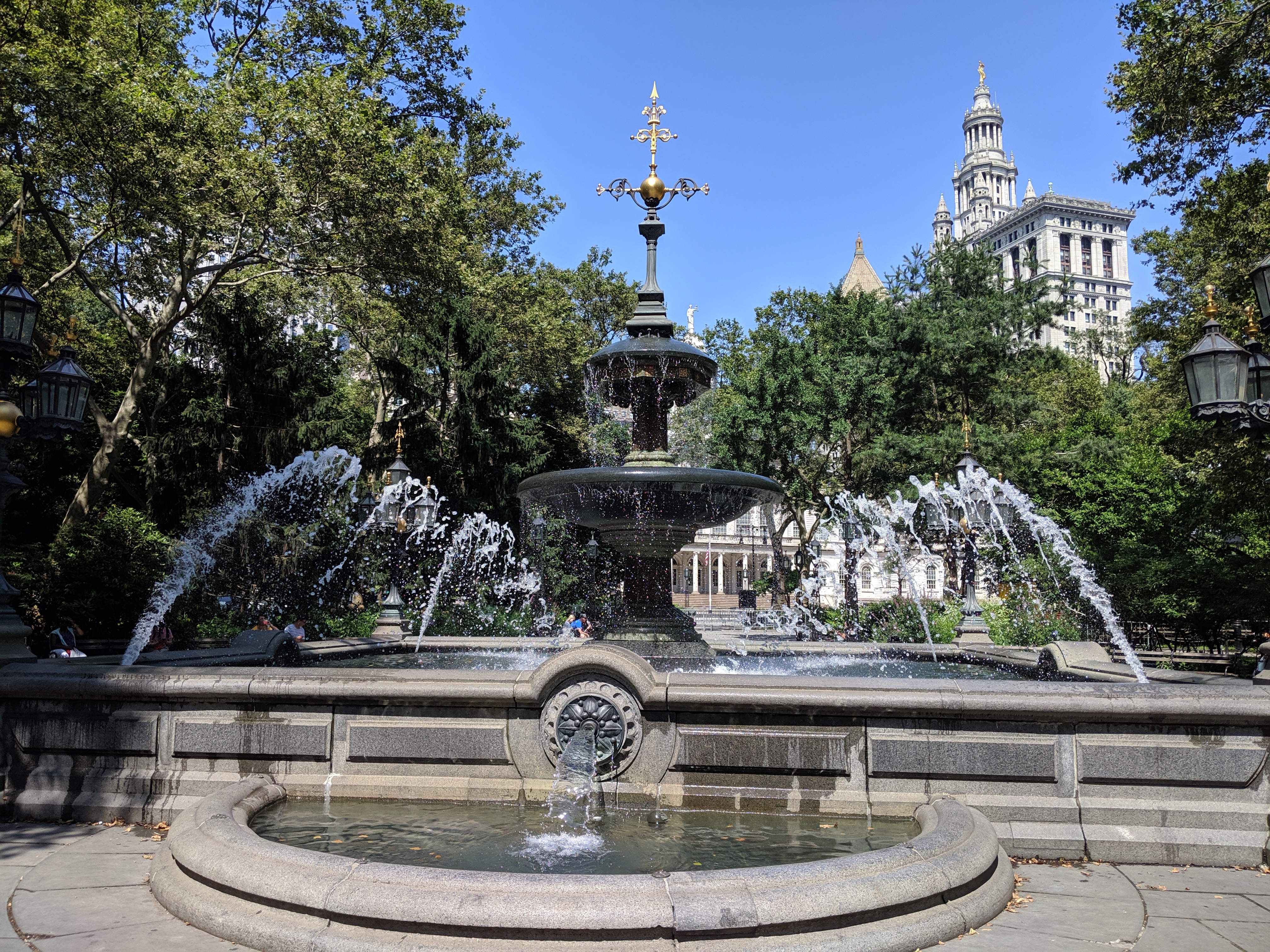
During the colonial period, this lovely park, now located in New York’s Civic Center, was far outside the city limits. It was known simply as the Commons—the open land north of the Dutch settlement of New Amsterdam. Since its humble colonial beginnings, it has served as a pasture for livestock, a military parade ground, a debtors’ prison, the site of public executions, the location of a jail and barracks, and a public gathering place.
At the dawn of the American Revolution, in 1765, the Patriots gathered on the Commons to protest the Stamp Act. It was here that New York’s first Liberty Pole was erected as a symbol of resistance to British rule. A replica, installed in 1921, now stands between City Hall and Broadway, close to its original location.
Here, on July 9, 1776, the Declaration of Independence was read aloud to George Washington’s troops and the people of New York. Inspired by its words, many marched to Bowling Green, where they pulled down the gilded statue of King George III in Bowling Green.
The next chapter is quite brutal. For most of the Revolutionary War (1776–1783), the British occupied New York City. The nearby debtors’ prison, located just behind today’s City Hall, was converted into a prison for American soldiers, while hundreds of prisoners were executed on gallows erected on the Commons.
After independence, the city grew rapidly, and what had once been open land on its outskirts became the site of New York City Hall. Completed in 1812, it remains one of the oldest city halls in the United States still serving its original governmental purpose. Around the same time, the Commons began its transformation into a landscaped public park.

In 1842, the Croton Aqueduct brought fresh water to Manhattan, and City Hall Park once again took center stage. To celebrate this engineering marvel, the city built the Croton Fountain, whose powerful jets could shoot water nearly 50 feet into the air—a spectacular sight for New Yorkers who had never before enjoyed an abundant supply of clean water.
The appearance of City Hall Park has changed countless times over the centuries. The museum, post office, prison, barracks, and other buildings all came and went, each leaving its mark on the landscape.
The Croton Fountain was eventually replaced by the elegant Victorian fountain designed by Jacob Wrey Mould, the architect and co-designer of Central Park’s famous Bethesda Terrace and Fountain.


The imposing City Hall Post Office, completed in 1869, dominated the park for decades before being demolished in 1939. Fortunately, Mould’s fountain escaped the wrecking ball. In 1920, it was relocated to Crotona Park in the Bronx to make room for Frederick MacMonnies’ Civic Virtue fountain.
im

This unfortunate Civic Virtue was represented as a muscular, scantily clad male figure triumphantly standing over two crouching female figures representing Vice and Temptation. The sculpture quickly became controversial, and also Mayor Fiorello La Guardia reportedly disliked the view of Virtue’s bare backside from his office in City Hall. At the mayor’s request, the monument was removed in 1941 and relocated to Queens.
Nearly eighty years later, during the park’s restoration, the beautiful Jacob Wrey Mould fountain triumphantly returned to its original home in 1999.
Several important monuments remain in the park today. One is John Quincy Adams Ward’s statue of Horace Greeley, founder and editor of the New-York Tribune, whose newspaper headquarters once stood nearby on Newspaper Row.
Another honors Nathan Hale, the young American officer captured by the British while gathering intelligence during the Revolutionary War. Before his execution, he is said to have declared, “I only regret that I have but one life to lose for my country.” Although Hale was hanged near present-day East 66th Street and Third Avenue, his monument belongs here in City Hall Park.
Such a small park with such an incredible trajectory through the City’s history: from a bucolic pasture to the place that set the stage for the American Revolution. It witnessed the brutality of the British occupation, celebrated the arrival of fresh water with the completion of the Croton Aqueduct, and even had its brush with the absurd in the form of the Civic Virtue fountain.
But most importantly, it is the location of New York City Hall; it remembers its history with Horace Greeley and Nathan Hale; it restored its beauty with the Jacob Wrey Mould fountain; and, with all its history, it’s a quiet, shady spot, much appreciated by New Yorkers.
Most importantly, it is home to New York City Hall; it remembers its history with Horace Greeley and Nathan Hale; it restored its beauty with the Jacob Wrey Mould fountain. It remains a peaceful oasis—a shady retreat where New Yorkers can pause, relax, and enjoy a place that has quietly witnessed more than three centuries of the city’s history.
Leave a Reply