New York is the city of immigrants; every wave of immigration brought new talents, possibilities, and achievements. First-generation newcomers always faced resentment and had to prove themselves to become part of New York’s complex tapestry of inhabitants. Italian immigrants had a very hard time establishing themselves in the city. The 1880s in New York saw a massive wave of Italian immigration, mainly from southern Italy and Sicily, driven by poverty and political instability. Many arrived uneducated and unskilled, taking the city’s lowest-paid jobs. They faced prejudice and suspicion as Catholic outsiders in Protestant New York and were often stereotyped as criminal or anarchic.
In the 1880s New York, Italians had no political power or public recognition. All New York’s monuments honored famous Anglo-American figures.
Enter Carlo Barsotti
A political exile from Italy, Barsotti made it his mission to elevate Italians from an invisible labor force to a recognized civic community. In 1880, he founded Il Progresso Italo-Americano, New York’s first Italian-language daily newspaper. For new immigrants, Il Progresso was more than a newspaper. It explained American laws, work, housing, citizenship, democracy, rights, and civic participation—guiding newcomers in a confusing, often hostile city. When Italians were divided by region or dialect, Barsotti encouraged them to see themselves as Italian Americans and build a collective identity. Through Il Progresso, he launched fundraising campaigns among even the poorest immigrants. He raised money and negotiated with the city to place monuments to prominent Italians in Manhattan’s public parks. Barsotti literally carved Italians into American history: through these monuments, they could see their heritage reflected in the city’s public spaces—a proud Italian-American presence in New York.


Giuseppe Mazzini Bust (Central Park, 1878)
The Mazzini bust by Giovanni Turini was the first monument erected by Italian Americans in New York City, celebrating Giuseppe Mazzini’s role in the unification of Italy. Mazzini was a leading advocate for Italian unification and modern nationhood. Inscribed on the granite pedestal are two of his core philosophical principles: Pensiero ed Azione (“Thought and Action”) and Dio e il Popolo (“God and the People”), ideals that influenced Italian nationalists—and resonated with Italian immigrants seeking dignity and pride in their new homeland.
The bust was dedicated in 1878 in Central Park, just seven years after Italy became a unified nation.
Giuseppe Garibaldi Monument (Washington Square Park, 1888)
Giuseppe Garibaldi was a 19th-century Italian revolutionary, military leader, and national hero best known for his role in the unification of Italy. A powerful national symbol for Italians, Garibaldi was seen as comparable to George Washington. When early efforts at unification failed, Garibaldi was forced into exile and, from 1836 to 1848, lived in South America, where he fought in the Uruguayan Civil War. In 1849, Garibaldi returned to Italy to support Giuseppe Mazzini and the short-lived Roman Republic. When that experiment collapsed, Garibaldi fled once again—this time to New York. He settled on Staten Island, staying with fellow Italian exile Antonio Meucci. During this period, Garibaldi worked as a candlemaker, recovering from war wounds while planning future campaigns. In 1854, Garibaldi returned to Italy once more, and this time the campaign succeeded. His military leadership helped bring about the unification of Italy under King Victor Emmanuel II, securing his international fame. At the outbreak of the American Civil War, President Abraham Lincoln even offered Garibaldi a command in the Union Army—an offer he declined in order to continue serving Italy’s newly unified nation. Italian sculptor Giovanni Turini, who was commissioned to execute the monument, had himself volunteered in Garibaldi’s Fourth Regiment.
The bronze statue, donated by New York’s Italian-American community, was dedicated in 1888—the sixth anniversary of Garibaldi’s death.
By the 1960s, the monument had acquired an unexpected local tradition. At the start of the academic year, new students in New York University’s School of Finance would toss a penny at the base of the statue for good luck and future prosperity.
Christopher Columbus Monument (Columbus Circle, 1892)
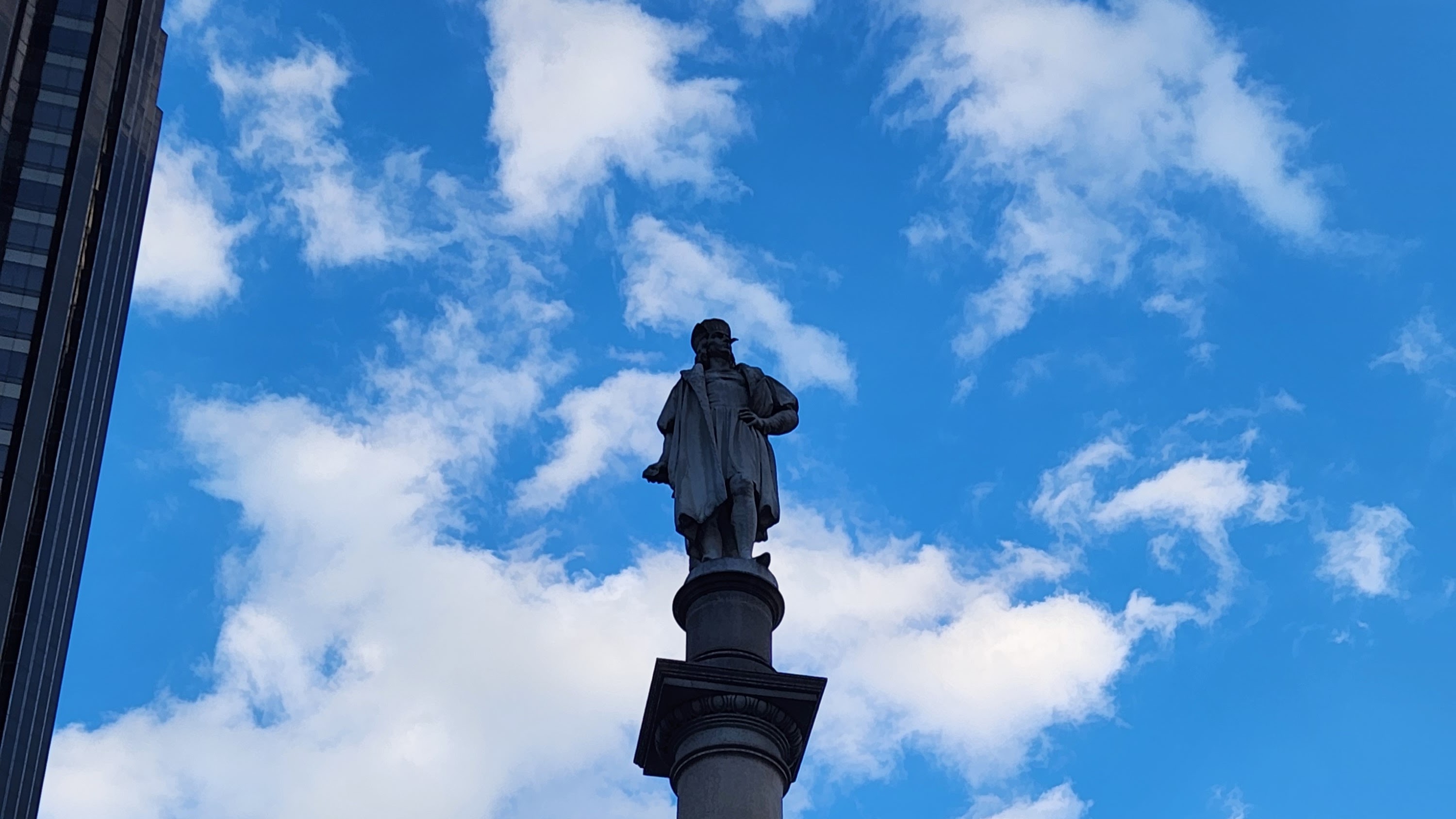
Erected in 1892 to commemorate the 400th anniversary of Columbus’s voyage, the monument was intended as a declaration that Italians were foundational to the history of the Americas.
The prows of three ships piercing the granite column are the Niña, the Pinta, and the Santa María – the ships that Columbus commandeered on his first voyage. A winged figure, studying a globe at the base of the monument, represents Genius or Discovery—a symbolic depiction of the spirit of exploration.
Today, the legacy of Columbus is widely debated, but at the time of the monument’s creation, he was celebrated as a hero within New York’s Italian community. This statue, in particular, became a symbol of Italian-American pride. The fundraising campaign for the monument was a grassroots Italian-American initiative. They not only donated money but also volunteered their labor, working for free to prepare the site. Inscriptions at the base of the column—written in both English and Italian—draw a parallel between the hardships Columbus endured and the struggles facing Italian immigrants in turn-of-the-century America.
The marble statue of Columbus was carved by sculptor Gaetano Russo in Italy.
Giuseppe Verdi Monument (Verdi Square, 1906)
Giuseppe Verdi’s contribution to world culture is unparalleled. He composed 28 operas, many of which became cornerstones of the operatic repertoire for the opera houses around the globe, including Rigoletto, La traviata, Aida, and Otello.
The Verdi Monument depicts the composer flanked by four of his most celebrated operatic characters: Falstaff, Leonora, Aida, and Otello, each representing a different facet of his dramatic genius.
The monument was unveiled in 1906, just one day after the 414th anniversary of Christopher Columbus’s arrival in the Americas. The celebration began with a grand march of Italian societies from Washington Square to the site at Broadway and West 72nd Street. It was both a cultural celebration and a public declaration of Italian-American pride. More than 10,000 people gathered for the ceremony, paying homage to a countryman whose music had shaped Italian identity, enriched global culture, and whose legacy was now permanently inscribed in New York’s public landscape.
Giovanni da Verrazzano (The Battery Park, 1909)
Giovanni da Verrazzano was a 16th-century Italian explorer who undertook several voyages to the shores of North America. On his third expedition, he explored the Atlantic coast, becoming the first European to describe the northeastern coast of the continent. During this journey, he sailed into what is now New York Harbor and was the first European to set eyes on the island that would later be known as Manhattan.
Verrazzano was forgotten and remained virtually unknown as the discoverer of New York Harbor, overshadowed by Henry Hudson, who arrived in New York Harbor almost a century later, in 1609. The Italian Historical Society of America undertook a major campaign to disseminate historical material on Verrazzano throughout the country to bring Giovanni Verrazzano the recognition he deserves.
The Italian community, mobilized by Carlo Barsotti, contributed funds toward the statue, which was completed in 1909. The larger-than-life bronze bust of the proud explorer is accompanied by a bronze female allegorical figure representing discovery. The bridge spanning the New York Harbor narrows was named Verrazzano Narrows, honoring the explorer and linking Giovanni Verrazzano with the harbor he had discovered.
Dante Alighieri (Dante Park, 1921)
Dante Alighieri, the greatest Italian poet, philosopher, and political thinker, lived in the second part of the 13th century and the beginning of the 14th century. Often called the “father of the Italian language,” he chose to write in the Tuscan dialect rather than in Latin. He is best known for The Divine Comedy—a monumental epic that guides readers through Hell, Purgatory, and Paradise—the first great literary masterpiece in the vernacular Italian. Through his work, Dante established Italian as a literary language.
The monument was conceived by the Dante Alighieri Society, and the funds for the statue were raised by Carlo Barsotti, the editor of the first Italian daily newspaper in the United States – Il Progresso. The monument was dedicated in 1921, the 600th anniversary of Dante’s death.
Leave a Reply