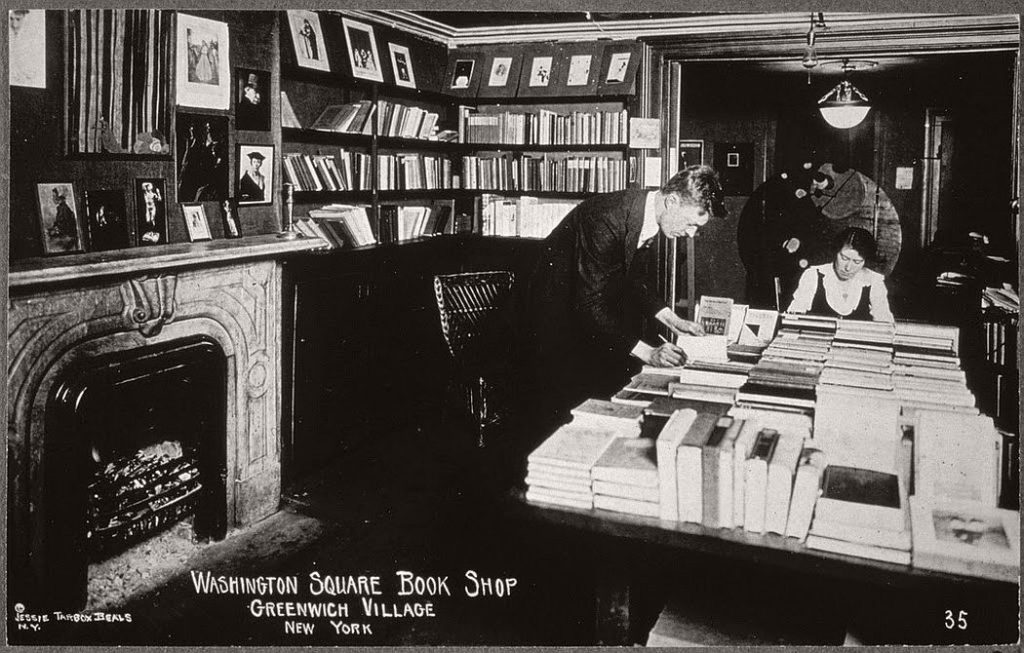
The bohemian Greenwich Village with it creative energy and low rents was a magnet for for 20th-century writers. There were too many to list, but here are some of the literary giants who at one time or another made Greenwich Village their home and a source of inspiration.


Table of Contents
Edna St. Vincent Millay (1892 – 1950)
Edna St. Vincent Millay was one of the most celebrated poets of the 20th century, gaining fame for her poetry and unconventional life. After graduating from college in 1917, Millay moved to New York City, where she became part of the bohemian literary scene in Greenwich Village.
Edna St. Vincent Millay first came into the national spotlight at the age of 20 when she entered her poem “Renascence” into a prestigious poetry competition. She placed fourth, sparking public outcry from readers and fellow poets who felt it deserved first prize. The controversy brought Millay significant publicity, helping to launch her literary career.
She lived in several notable locations, including the famously narrow 75½ Bedford Street. In 1923, Millay’s extraordinary talent was recognized when she became the third woman ever to receive the Pulitzer Prize for Poetry.
Ernest Hemingway (1899 – 1961)
Ernest Hemingway’s connection to Greenwich Village was brief. In 1918, before his service as an ambulance driver in World War I, Hemingway spent several weeks in the Village. He stayed at the Hotel Earle, now known as the Washington Square Hotel, on Waverly Place.
Hemingway fit right in with the Greenwich Village bohemian atmosphere, where he patronized numerous drinking establishments and local writers mingling with writers, artists, and intellectuals. One such place was the Minetta Tavern, a popular gathering spot for literary figures.
Hemingway later described the Village bohemians in the most unflattering terms in his American Bohemians In Paris:
The scum of Greenwich Village, New York, has been skimmed off and deposited in large ladles on that section of Paris adjacent to the Cafe Rotonde. New scum, of course, has risen to take the place of the old, but the oldest scum, the thickest scum and the scummiest scum has come across the ocean, somehow, and with its afternoon and evening levees has made the Rotonde the leading Latin Quarter showplace for tourists in search of atmosphere.
Scott Fitzgerald (1896 – 1940)
F. Scott Fitzgerald was one of the greatest American writers of the 20th century. Born in the Midwest and finishing his life journey on the West Coast, Fitzgerald is often remembered for the time he spent in New York City. He was young, successful, and in love with life and his young wife, Zelda.
Unsurprisingly, Fitzgerald was attracted to Greenwich Village, with its speakeasies and literary haunts. One of his favorites was Chumley’s, the legendary speakeasy on Bedford Street whose owner loved literature and collected the first editions of the books published by his writer friends and patrons. Fitzgerald was a regular in another hotspot popular with the writers – the Minetta Tavern on 113 MacDougal Street. Both venues were integral to the Village, making them a perfect setting for a chronicler of America’s Jazz Age.
Eugene O’Neill (1888 – 1953)
Winner of four Pulitzer Prizes and a Nobel Prize for Literature, Eugene O’Neill was one of the writers who shaped American theater and literature and had strong tight to Greenwich Village.
One of his favorite haunts was the Golden Swan Café, a seedy bar on the corner of West 4th Street and Sixth Avenue, notoriously known as the “Hell Hole” by its eclectic and rowdy clientele. The Golden Swan
was a dive that attracted the Village’s bohemians, street gangsters, Ashcan artists, poets, and writers. It appeared in John Sloan paintings and as Harry Hope’s saloon in Eugene O’Neill’s The Iceman Cometh. Both were regulars who often forgot to leave, falling asleep on the barstools.
Eugene O’Neill arrived in Greenwich Village in 1914 and in 1916, a group of artists from Provincetown, Massachusetts, moved their experimental theater group to New York City. They believed Greenwich Village offered fertile ground for theater with genuine artistic value. Among the early members of the Provincetown Players were Eugene O’Neill and Edna St. Vincent Millay.
The group rented a parlor space at 139 MacDougal Street and launched their first season with O’Neill’s Bound East for Cardiff. The Provincetown Players produced many of O’Neill’s early works, which were unconventional and not meant for mainstream audiences. Greenwich Village was the right place for establishing Eugene O’Neill as one of America’s greatest playwrights.
Robert Frost (1874-1963)
Robert Frost is among the most important and influential poets of the 20th century. He’s particularly known for his realistic depictions of rural New England life and for using colloquial speech in his poetry. He mixed traditional poetic forms and a conversational style, blending formal structure with the rhythms of spoken language.
Robert Frost is the only person to receive four Pulitzer Prizes for Poetry. He never graduated from college but received 40 honorary degrees including degrees from Harvard, Princeton, Oxford, Cambridge, and Dartmouth.
For a short time, in 1920, Robert Frost stayed in 107 Waverly Place .
ee Cummings (1894 – 1962)
ee Cummings is regarded as one of the most important American poets of the 20th century. He wrote approximately 2,900 poems, and much of his work uses idiosyncratic syntax and lower-case spellings for poetic expression.
ee Cummings lived at No. 4 Patchin Place – a small cul-de-sac off West 10th Street. Patchin Place was built in 1848 as housing for local workers in the neighborhood. But in the early 20th century, it became popular with writers and artists. It offered somewhat secluded small residences away from the street but located in the center of the Village life.
The place has not changed much even now, except Greenwich Village no longer offers low rents, and the privacy that had once attracted writers appealed to psychotherapists, who began to locate there in the 1990s, transforming the street into “therapy row.”
ee Cummings lived at Patchin Place for four decades until his death in 1962. It makes him a true resident of Greenwich Village.
Henry Miller (1891 – 1980)
Henry Miller was known for breaking with existing literary forms and developing a new type of semi-autobiographical novel. His writing blended social criticism, philosophical reflection, stream of consciousness, explicit language, sex, and mysticism.
His most known works, Tropic of Cancer, Tropic of Capricorn, and The Rosy Crucifixion, based on his experiences in New York City and Paris, were banned in the United States until 1961 due to their explicit content and challenge to traditional sexual morality.
In 1925, Miller and his second wife, June, moved into 106 Perry Street, only to be evicted in 1926. Henry Miller could not make any money from his works, and, in order to pay the bills, the couple opened their own speakeasy in a basement. After his short stay in the Village, he returned to his parent’s place in Brooklyn.
Anaïs Nin (1903 – 1977)
Anaïs Nin was diarist, essayist, novelist, and writer of short stories and erotica.
She felt that the choice of typeface, paper, and engravings was part of her creative process and self-published many of her works. Nin and her partner, Gonzalo More, established their own press at 144 MacDougal Street in 1942. Soon after, in 1944, they bought a bigger press and moved to 17 East 13th Street at a considerably higher rent. However, the new location, which had a storefront, was more visible. It was also close to many other printing houses and a bookseller row along Fourth Avenue and Broadway.
Before their printing company, 17 East 13th Street housed another printing company – Erskine Press – whose name is carved on the building facade.
Now, it features a plaque that states:
Renowned writer Anais Nin operated her printing press here in the 1940s, where she personally helped produce some of her earliest publications, including their artwork and typeface, regarding these as an extension of her creative process. Her work here helped connect her to a larger publisher and wider audience, eventually inspiring generations of writers and thinkers.
Alan Ginsberg, Jack Kerouac, and William S. Burroughs
The Beat Writers pushed the boundaries of literature and challenged the conventions of mainstream American culture while their lifestyles rejected societal norms. During the late 1950s the Village provided a perfect backdrop for their experimental work and unorthodox lives.
Allen Ginsberg, Jack Kerouac, and William S. Burroughs, central figures in the Beat Generation, were drawn to Greenwich Village by the low rents and bohemian atmosphere.
A resident of Greenwich Village at various points in his life, Kerouac often wrote in the cafes and bars of the neighborhood. Burroughs lived at 69 Bedford Street. All three were fixtures in the local spots, including the San Remo Cafe at 93 MacDougal Street, Chumley’s, White Horse Tavern, and Minetta Tavern.
James Boldwin (1924 – 1987)
James Baldwin was the celebrated novelist, essayist, playwright, and poet. Born and raised in Harlem, Baldwin moved to Greenwich Village, where he spent some of his most creatively productive years, in 1943. He stayed in the apartment of a modernist painter, Beauford Delaney, at 181 Greene Street (now demolished).
Like every other writer, Baldwin frequented the usual establishments such as the Minetta Tavern, the White Horse Tavern, and San Remo Cafe—a hangout for the Village’s artistic elite—which used to be located at the corner of MacDougal and Bleecker Streets.
At one time, Baldwin worked as a waiter at Calypso, a small restaurant located at 146 MacDougal Street (also now demolished). It was an integrated place—still unusual at the time—visited by Paul Robeson, Henry Miller, Marlon Brando, Burt Lancaster, and Malcolm X.
In 1948, Baldwin left for Paris, but frequently returned to New York to write and draw inspiration from the city. During his returns, Baldwin lived in several places in Greenwich Village, including a small apartment on Gay Street. His longest residence in the Village was from 1958 to 1961 at 81 Horatio Street, where he rented an apartment.
Dylan Thomas (1914 – 1953)
Dylan Thomas, a celebrated Welsh poet, came to New York on his first reading tour across the United States in 1950 at the age of 36. During his time in New York, Thomas spent much of it in Greenwich Village, frequenting such esteemed drinking establishments as the White Horse Tavern, Minetta Tavern, San Remo Cafe, and Chumley’s. There, he mingled with his fellow alcohol-appreciating bohemians, including Allen Ginsberg, Bob Dylan, and E.E. Cummings.
His favorite spot was The White Horse Tavern, which gained its notoriety due to Dylan Thomas’ tragic demise. On his last trip to New York in 1953, he made multiple appearances at the tavern. The last visit proved tragic. He boasted of drinking “18 straight whiskies,” and Thomas slipped into a coma. He died shortly after at a nearby St. Vincent’s Hospital. He was only 39 years old.
Leave a Reply