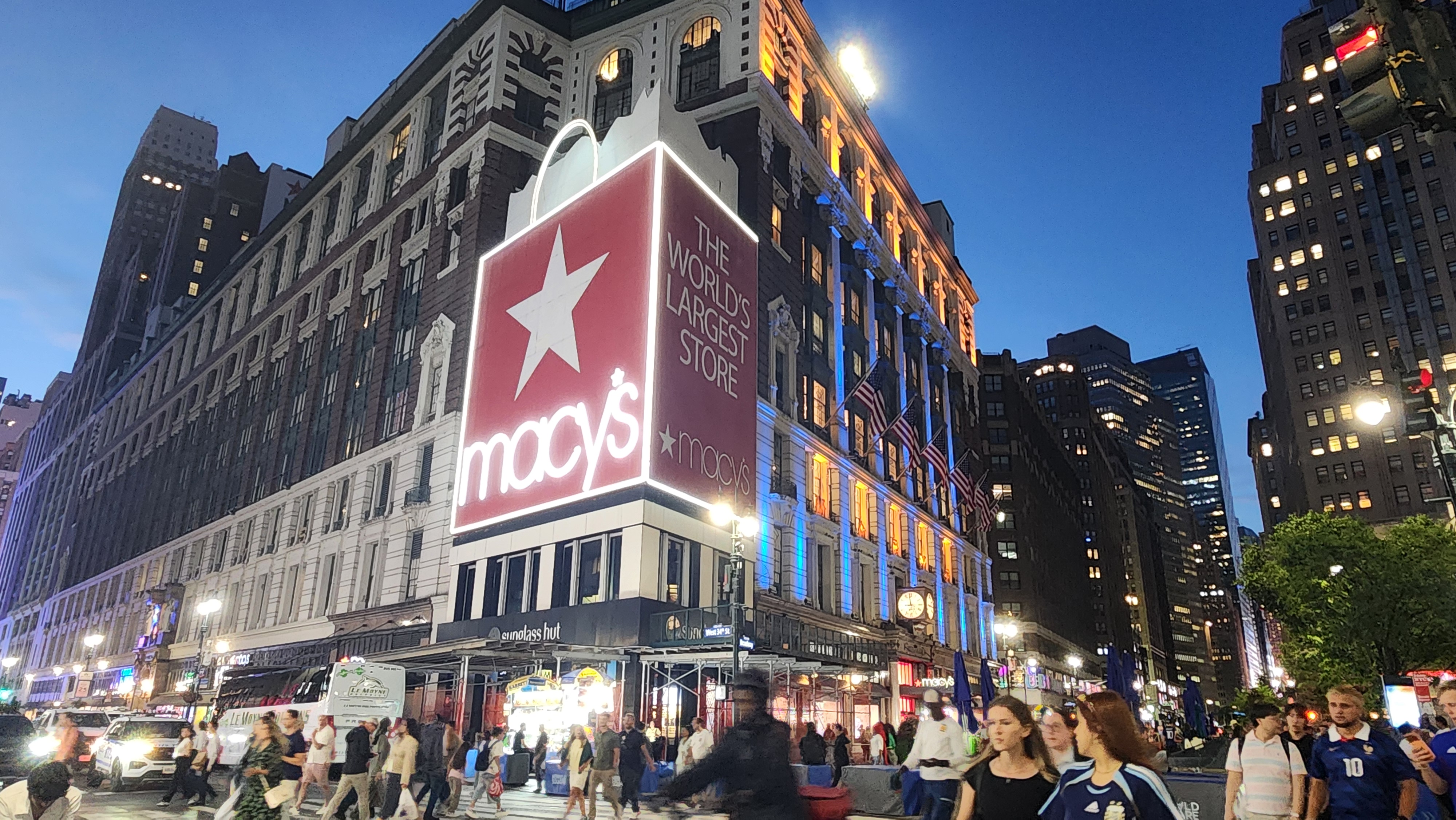
What was marketed in 1902 as “The Largest Store on Earth” began as a humble dry goods store on the corner of Sixth Avenue and 14th Street.
Its founder, Rowland Hussey Macy, was a former Nantucket whaler who had failed several times as a store owner before finally finding success. When Macy’s opened in 1858, first-day sales totaled just $11.06. By the end of its first year, sales had reached $90,000. Sixty years later, in 1918, R. H. Macy & Co. was generating an astonishing $36 million in annual sales.
The store symbol—a red star— was copied from a tattoo he received while at sea as a whaler.
Macy’s success wasn’t just about selling merchandise; it was innovation— Macy’s transformed the way Americans shopped.
One of its greatest innovations was the one-price system. Before Macy’s, prices were rarely fixed. Customers haggled with clerks, and the amount paid often depended on who you were or how well you bargained. Macy introduced clearly marked price tags so every customer paid the same amount—a revolutionary idea that quickly became the retail standard.
The store also pioneered large-scale newspaper advertising, prominently displaying both products and their prices, another innovation that seems ordinary today but was groundbreaking in the nineteenth century.
Macy’s became the first department store in New York City to obtain a liquor license and was among the first major retailers to promote women into executive positions. It also introduced Americans to products that later became household staples, including tea bags, the Idaho potato, and colored bath towels.
In 1896, the company was acquired by brothers Isidor and Nathan Straus. Building on the store’s success, they wanted to take it further. They envisioned a department store unlike anything the world had seen. Straus brothers began buying real estate between 6th and 7th Avenues and 34th and 35th Streets for the largest in the world.


That title was coveted by another retail giant — the Siegel-Cooper department store. According to a long-standing New York legend, the owners of Siegel-Cooper purchased a tiny building at the corner of Broadway and 34th Street, hoping to prevent Macy’s from acquiring the entire block.
Macy’s responded in the most practical way—it simply built around the obstacle and moved to its new home at Herald Square in 1902, becoming the largest store in the world.
That little holdout building still stands today, surrounded by the enormous department store. Look up, and you’ll see the giant shopping bag mounted on its roof, a playful reminder of one of New York’s greatest retail rivalries.
In 1924, many of Macy’s immigrant employees organized a Thanksgiving parade to celebrate their new lives in America. Featuring floats, marching bands, live animals from the Central Park Zoo, and thousands of spectators, it became an instant success. That event evolved into the annual Macy’s Thanksgiving Day Parade, now one of New York City’s most beloved traditions.
Leave a Reply