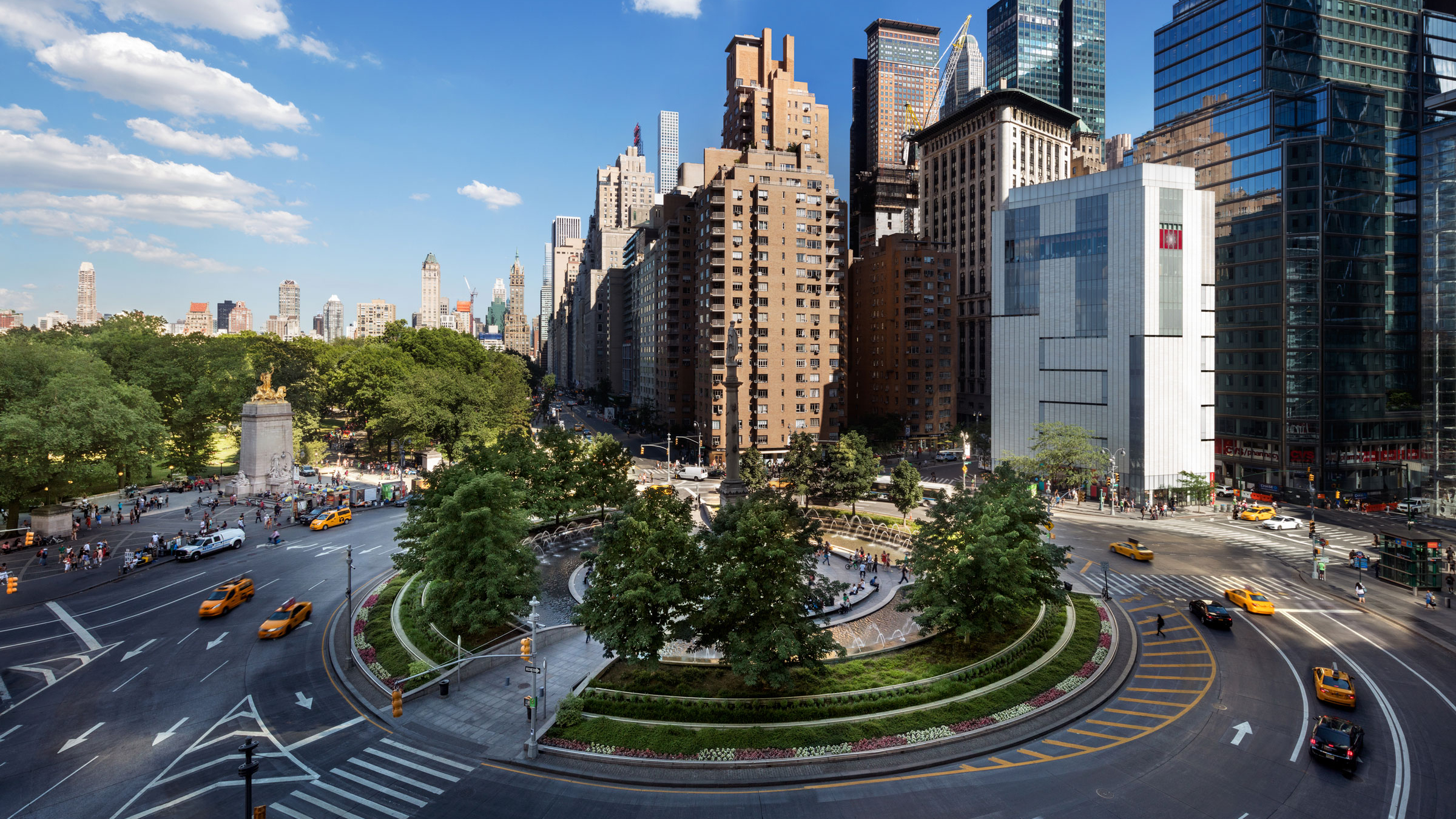
At the southwest corner of Columbus Circle stands one of New York’s most controversial architectural survivors: today’s Museum of Arts and Design, housed inside the former 2 Columbus Circle building designed by Edward Durell Stone.
Completed in 1965, the building represented Stone’s distinctive late-modern style, sometimes described as “International Style II” or “romantic modernism.” Clad in white Vermont marble and punctuated with tiny circular windows, the structure looked unlike anything else in Manhattan. At a time when modernism celebrated glass boxes and strict functionalism, Stone introduced arches, ornament, and references to Venetian palazzos — gestures many critics considered almost heretical.


The project was commissioned by A&P supermarket heir Huntington Hartford as the home of his ambitious Gallery of Modern Art. Hartford envisioned the institution as a conservative alternative to the Museum of Modern Art, which he felt had become too dominated by abstraction and avant-garde trends. But neither the museum nor the building received the welcome Hartford hoped for. Critics attacked the design almost immediately. Architecture critic Ada Louise Huxtable famously dismissed it as “a die-cut Venetian palazzo on lollipops.” The phrase became legendary, and the building entered New York lore as a structure many people seemed to love to hate. Hartford’s museum itself failed after only five years. Ownership eventually passed to the city, and for decades the unusual marble building was largely an office building filled with municipal workers.
Meanwhile, Manhattan’s craft and design world was evolving. Founded in 1956 by philanthropist Aileen Osborn Webb, the Museum of Contemporary Crafts championed handmade objects and studio craftsmanship at a time when craft was often considered secondary to “fine art.” Over the decades, the institution broadened its mission to include architecture, fashion, industrial design, jewelry, glass, ceramics, textiles, and emerging technologies. Reflecting that wider vision, it became the Museum of Arts and Design — MAD. For years, MAD occupied cramped quarters opposite MoMA on 53rd Street, with limited gallery space despite a permanent collection of more than 2,000 works. With roughly four times the exhibition space, the former Stone building at Columbus Circle offered a dramatic opportunity.
In 2002, MAD purchased the building from the city and began a major renovation. The redesign transformed much of the original façade and interiors while preserving the building’s essential circular form. Preservationists fiercely debated the changes, arguing over whether Stone’s original design was being rescued or erased.
When the museum reopened in 2008, the once-ridiculed building had entered a new chapter. Today, MAD is one of New York’s most distinctive museums, known for exhibitions exploring the intersection of art, craft, and design. Rather than focusing solely on painting and sculpture, the museum celebrates artists working with materials — glass, metal, fiber, wood, ceramics, jewelry, and digital fabrication — emphasizing both creativity and the process of making. In many ways, the building’s complicated history mirrors the museum’s mission itself: challenging traditional ideas about what art should look like, how design should function, and which forms of creativity deserve recognition. What was once mocked as an architectural oddity has become an important cultural landmark and a home for a unique museum celebrating the Art of Craft.
The Upper West Side: Unconventional, Iconic and Wonderful SELF-Guided Audio Tour

The tour starts at Columbus Circle. There is so much to see and discover on the Upper West Side. Download at VoiceMap.me/UWS or just scan the QR code on the left.
Leave a Reply