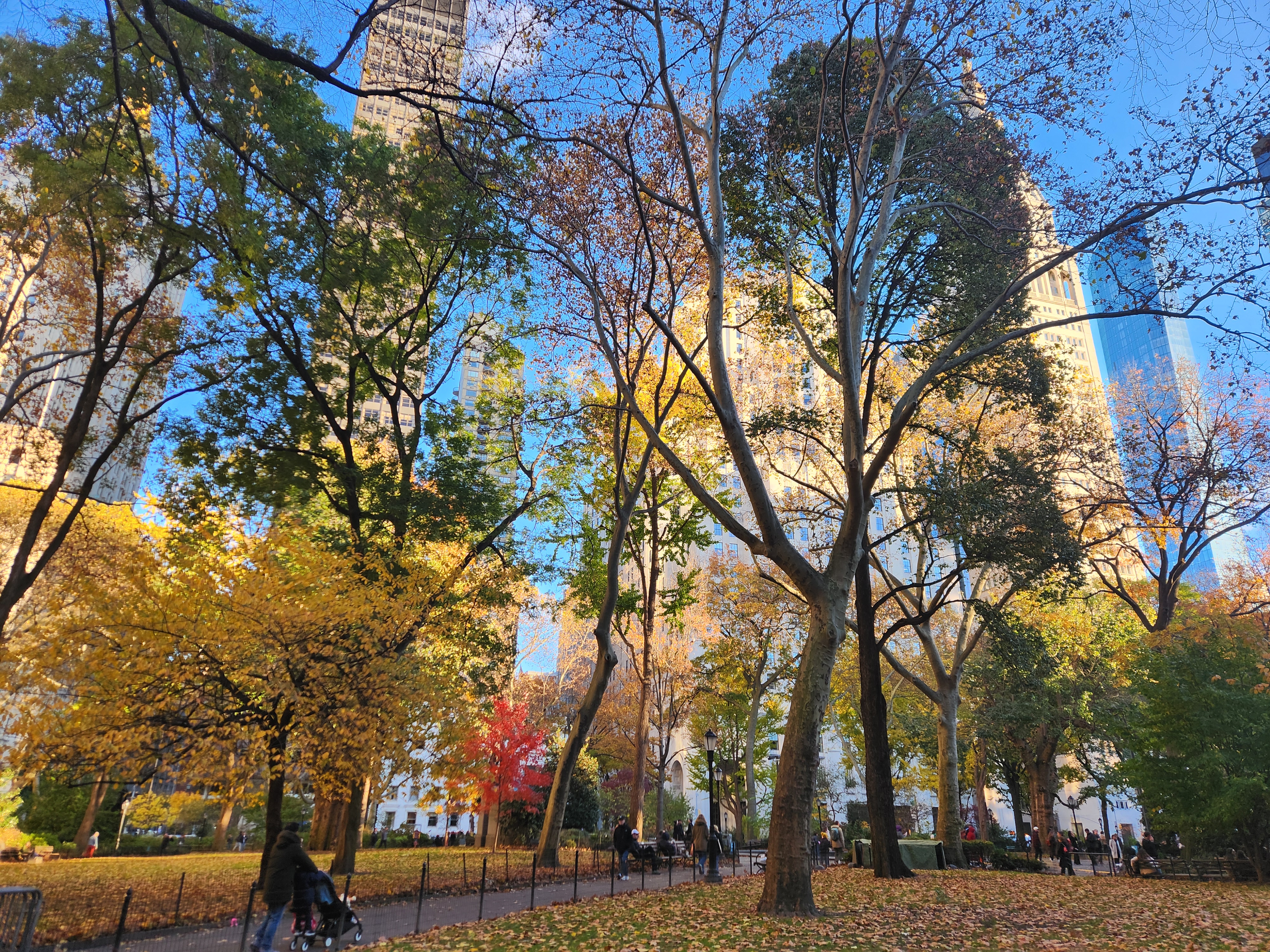
Lovely Madison Square Park is an urban oasis of blooming flowers, shady trees, and green lawns. It’s surrounded by the city’s most famous sights, like the Flatiron Building and the MetLife Tower, and provides some of the best views in New York. The park bears the name of James Madison, one of the Founding Fathers and the fourth President of the United States, who served from 1809 to 1817.

Madison Square Park is a stop in the audio-guided tour, Textures of Two Neighborhoods: Tour of Gramercy and Flatiron Districts. Download at VoiceMap.me/Flatiron or just scan the QR code.
Here is a timeline of Madison Square Park, from its humble origins back in the 17th century to the early 1900th. In its golden days, in the late 19th century, Madison Square emerged as the premier elite neighborhood lined with stylish residences belonging to the best New York families, epitomizing the Gilded Age’s most fashionable location.
Madison Square Park Timeline
- 1686 – The land designated as public property.
- 1794 – The land used as the city’s potter’s field.
- 1811 – After the potter’s field was moved, an army arsenal was moved in, followed by a military parade ground.
- 1847 – Redesigned with pedestrian walkways, lush greenery, lawns, and fountains, it opens to the public as Madison Square Park.
- 1870 – The park was re-landscaped by Chief Landscape Architect Ignatz Pilat; the new design added sculptures of 19th-century political leaders.
- 1899 – The park served as a location for the celebrations of the triumphant return of Admiral Dewey from the Spanish-American War. The Dewey Arch was built for the Admiral Dewey parade at the intersection of Fifth Avenue and Broadway at 24th Street.
- 1876 – 1882 – The Statue of Liberty’s arm holding a torch stands there, as a part of fund-raising efforts for building the Statue of Liberty.
- 1901 – Rocking Chairs Riot
- 1912 – The country’s first public Christmas tree lighting ceremony was held.
- 1918 – 1920 – Madison Square served as the location for the Victory Arch, built in honor of the troops returning home from WWI.


Creator(s): Underhill, Irving, -1960, photographer
Date Created/Published: c1919 May 31.

Irving Underhill.
Library of Congress Prints and Photographs Division

Source: N-YHS Digital Collections


Source: N-YHS Digital Collections
Madison Square Park Monuments and important structures

The General Worth Monument
- Location: Pedestrian island bordered by 25th Street, Broadway, and 5th Avenue
- Date: 1857
DEMOLISHED

Leonard Jerome mansion
- Location: 32 East 26th Str
- Date: 1859 – 1967

Fifth Avenue Hotel
- Location: 200 5th Ave
- Date: 1859 to 1907
The original Madison Square Garden
- Location: North-East corner of the park
- Date: 1879 – 1899

The Second Madison Square Garden
- Location: North-East corner of the park
- Date: 1890 – 1925
- Architect: Stanford White
SCULPTURES

William H. Seward Monument
- Location: South-West corner of the park
- Date: 1876
- Sculptor: Randolph Rogers

Admiral David Glasgow Farragut
- Location: Central North side of the park
- Date: 1881
- Sculptor: Augustus Saint-Gaudens
- Architect: Stanford White

Roscoe Conkling Statue
- Location: South East side of the park
- Date: 1893
- Sculptor: John Quincy Adams Ward

Chester Arthur Statue
- Location: North East side of the park
- Date: 1899
- Sculptor: George Edwin Bissell
BUILDINGS

Appellate Division Courthouse
- Location: 27 Madison Ave
- Date: 1899
- Architect: James Brown Lord

The Flatiron
- Location: 175 Fifth Ave
- Date: 1902
- Architect: Daniel Burnham

The MetLife Tower
- Location: 1 Madison Ave between 23rd and 24th Str
- Date: 1909
- Architect: Pierre LeBrun

New York Life Building
- Location: 51 Madison Ave
- Date: 1928
- Architect: Cass Gilbert
Madison Square Park Famous Residents
- Novelist Edith Wharton, the first woman awarded the Pulitzer Prize for fiction, was born at 14 West 23rd Street. Her maiden name was Jones – she belonged to one of the oldest and wealthiest clans in New York. The expression “Keeping up with the Jones” was about her family.
- On the northwest corner of the park, at 32 East 26th Street, stood a magnificent mansion of Leonard Jerome, a financier, one of the most affluent men in New York City, and a frequent business partner of the Vanderbilts. Jerome’s daughter, Jennie Jerome, who lived in the mansion, later married Randolph Churchill and became the mother of Winston Churchill.
- Luis Comfort Tiffany, an American artist and designer, best known for his work in stained-glass, had a house on 48 East 26th Street.
Leave a Reply