Inside New York City’s Most Spectacular Dining Rooms: these are some of NYC’s Restaurants where food is served against stunning interiors and comes with an appetizer of history.
Campbell Apartment: From Tycoon’s Office to Cocktail Lounge
Location: 15 Vanderbilt Avenue (off 43rd Street) or via the Grand Central Terminal balcony.


The Campbell is a well-known “secret” bar tucked inside the Grand Central. A popular bar for commuters and business types, it’s expensive and noisy. However, it’s also quite stunning. In the ‘20s, it served as the office of railroad magnate John W. Campbell. The opulent office was decorated to look like a Florentine palazzo, with hand-painted ceiling beams, a mahogany balcony, an expansive window of century-old leaded glass, and an enormous fireplace in which Campbell kept his steel safe. There used to be a pipe organ, a baby grand piano, 19th-century Italian furniture (made to resemble 13th-century work), and Campbell’s overpowering desk. Mr. Campbell worked at his famed enormous desk, pantsless. He hated wrinkled trousers and took them off before sitting at his desk. After the workday ended, Campbell put on his pants and turned his office into a grand entertainment space: he was known to invite up to 60 guests for private recitals. John Campbell kept his office from 1923 until his death in 1957. Nowadays, instead of waiting to be invited to one of Mr. Campbell’s exclusive events, you can simply stop by for a nice cocktail.
Tavern on the Green: From a Sheepfold to a Landmark
Location: Central Park West & 67th Street


Tavern on the Green can be magical, especially on summer nights when one can enjoy the large outdoor patio wrapped in twinkling lights. With its remarkable setting within Central Park, Victorian Gothic design, and, of course, the twinkling lights, it’s not just a restaurant; Tavern on the Green is a New York City landmark. Featured in the movies and frequented by celebrities, it became a must-visit for out-of-towners. Among the roster of regular patrons were former most beloved mayor Fiorello H. La Guardia, modern-day princess Grace Kelly, and Fay Wray, an actress better known to the world as King Kong’s love interest. Being a close neighbor, John Lennon was a regular.
The restaurant’s insignia, which pays homage to its history, features a sheep: Tavern on the Green started as a sheepfold! Central Park’s designers, Frederick Law Olmsted and Calvert Vaux, believed that sheep grazing on bucolic pastures provided for a calm, restful atmosphere in the park. To create this pastoral magic, 200 sheep were spirited away from their native lands and brought over to Manhattan to take residence in a Victorian-style sheepfold, which was destined to become the Tavern on the Green. The sheep arrived in 1864 but departed in 1934 during the Great Depression, when it became unsafe for them to graze in the open while New York City’s citizens were starving. The city took over the sheep house and converted it into a restaurant. It was back then that the trees were first wrapped in the well-known twinkling lights.
Tavern on the Green has been updated and remodeled several times. Even though food reviews these days are quite mixed, Tavern on the Green is still cozy, charming, and spectacular at the same time.
The Palm Court at the Plaza: Old New York Glamour
Location: Inside the Plaza Hotel, Fifth Avenue & Central Park South


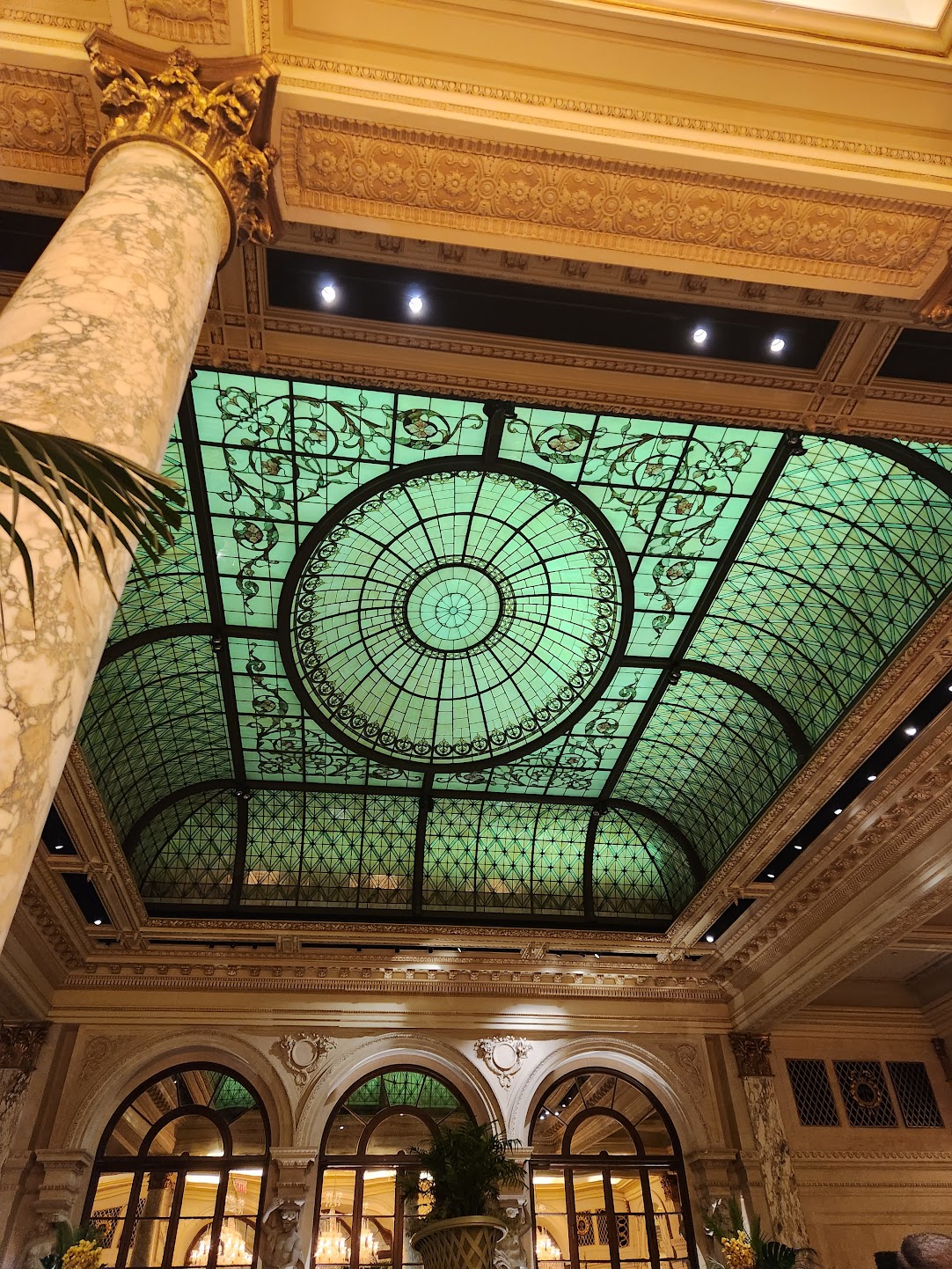
With its luminous dome roof, The Palm Court is one of New York’s most glamorous rooms. It was designed to be opulent but cosy: its ambiance blends European luxury and garden elements. The stained‑glass roof, which creates a bright, atrium-like feel, is its signature and most spectacular feature.
Since 1907, when the Plaza Hotel opened, it has served as a social stage for the crème de la crème of New York society. It was visited by the Gilded Age elites, such as Alfred G. Vanderbilt, George Jay Gould, and Diamond Jim Brady. Later on, DorothyParker, the celebrated writer whose sharp wit was legendary, was fired from her job at Vanity Fair during a Sunday brunch at the Palm Court. Scott Fitzgerald and his young wife Zelda patronized the venue. As a result, The Plaza, along with The Palm Court, was immortalized in Scott Fitzgerald’s The Great Gatsby.
Like most famous dining venues, the Palm Court is quite expensive; however, its signature afternoon tea with tiered trays of delicate sandwiches, freshly baked scones with clotted cream and jam, and elegant pastries is not just a food stop, it’s a New York experience.
Lillie’s Victorian Establishment (Times Square)
Location: 249 West 49th Street.


Visiting Lillie’s Victorian Establishment feels like stepping straight into a time warp. With its lavish Victorian interior—stained glass, carved wood panels, velvet banquettes, ornate mirrors, and the multitude of chandeliers—it feels like one of London’s drawing rooms. The look is inspired by 19th-century England, when dining out was as much about spectacle as sustenance.
Lillie’s Victorian Establishment was inspired by Lillie Langtry, a famous British Actress, a renowned beauty, and socialite of the Late 19th Century. They called her “Jersey Lillie” not because she was from New Jersey but because she was born on the Isle of Jersey in England. A woman ahead of her time, she was a 19th-century influencer, setting fashion, beauty ideals, and celebrity culture. In some ways, Lillie Langtry invented the modern idea of fame. In the 19th century, when women were afraid of controversy, which meant scandal and a reputation ruin, Lillie turned it into fame and power. Her list of prominent suitors was long and even included Bertie, the future King of England, Edward VII.
Lillie Langtry arrived in New York to make her highly anticipated American debut, but the Park Theatre at Broadway and 22nd Street burned to the ground just one night before, leaving only a charred sign with the words “Lillie Langtry”. Despite losing her costumes and venue, she moved her show to another location and opened the following week, launching a successful US tour.
La Grand Boucherie – The Spirit of a Grand Parisian Brasserie
Location: 145 West 53rd Street
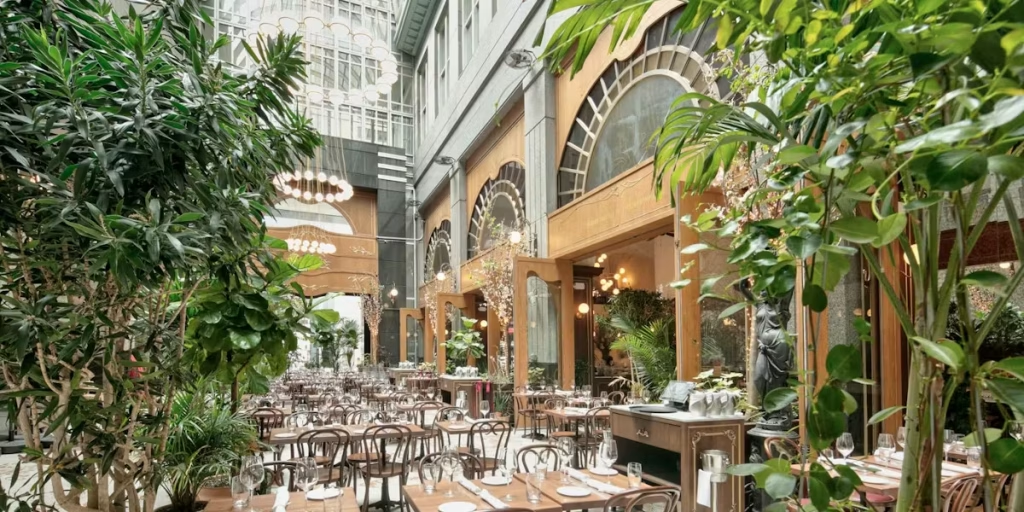

If you are in New York but feel like escaping to Paris for a couple of hours, La Grand Boucherie is a great choice. It is not a historical place, but it channels the spirit of a Belle Époque Parisian brasserie. High ceilings, expansive mirrors, and ornate molding give the space a distinctly European feel, designed as much for people‑watching as for dining.
Unusual is its location on 6 ½ Avenue, a unique, six-block-long pedestrian walkway running north–south between West 51st and West 57th Streets, between Sixth and Seventh Avenues. This “Avenue” is not really an Avenue; it’s a passageway through open-access lobbies called POPS (Privately Owned Public Spaces). New Yorkers know that one can navigate Midtown using the lobbies and atriums of office buildings, which are often open to the public. 6 ½ Avenue takes advantage of the six city blocks stretch creating this covered, secluded passageway. The Grand Boucherie makes you feel transported to Paris. At least while you are dining.
Della Robbia Bar – The Only Remaining Ceiling with Blue Terra-cotta
Location: 4 Park Avenue at East 33rd Street.


If you are in the mood for a steak and an excellent martini, you might as well go for it in a very unique setting. Inside of Wolfgang’s Steakhouse Restaurant on Park Ave is The Della Robbia Bar, named after the most famous terra cotta artist in history – the Italian Renaissance master Luca della Robbia. The use of terracotta in interior design was fashionable at the dawn of the 20th century, though hardly any of these spaces survive.
The main feature of the room is its spectacular ceiling made of Guastavino tile. Spanish architect and builder Rafael Guastavino created a special vaulting technique called the “Tile Arch System.” The self-supporting arches with interlocking terracotta tiles can be found around town, notably in places such as the Oyster Bar. However, this one is unique: it is the only ceiling trimmed by bright blue terra-cotta tiles.
The Della Robbia Bar is a surviving part of the Della Robbia Grill, which, in the 1920s, was considered one of the best restaurants in the city. Its guest list included silent cinema star Rudolf Valentino, legendary glutton of the Gilded Age Diamond Jim Brady, and Enrico Caruso, the world’s premier operatic tenor.
Wolfgang’s Steakhouse is a chain with several locations around the city, and you can get a good steak at any of them. However, the Della Robbia Bar is a bar inside its Park Ave location, and it’s a true feast for your eyes.
Fraunces Tavern – Where the Founding Fathers Dined and Planned the American Revolution
Location: 54 Pearl Street


How many places in the world offer dinner and beverages at the exact location where the Founding Fathers once dined and conducted official business of the country? Fraunces Tavern is one such place.
In the 18th century, Fraunces Tavern was the favorite with the Sons of Liberty, who planned the American Revolution over Fraunces’ hearty meals. In 1783, at the Revolutionary War’s end, George Washington famously declared himself a private citizen planning to retire to his family estate in Virginia. He gave a farewell dinner for his officers in the Long Room of Fraunces Tavern. Shortly after the American Revolution, the American government conducted its business from Federal Hall, located on Wall Street. Since the Federal Hall wasn’t large enough to accommodate all the new government offices, the Departments of Foreign Affairs, War, and Treasury (headed by Alexander Hamilton) were located in the Tavern itself!
By the 1900s, the place was dilapidated and facing demolition, but luckily, in 1907, the Sons of the Revolution bought the building and restored it as closely as possible to its original condition. Now, Fraunces Tavern operates as both a museum and a restaurant.
The tavern features several beautifully designed dining rooms, each with its own style. The food is excellent, and one of many rooms in Fraunces Tavern is the cozy “Dingle Whiskey bar,” which, being a part of the “American Whiskey Trail,” serves over 200 whiskeys.
Grand Central Oyster Bar – A Place to Grab a Dozen Oysters Before Catching a Train
Location: Inside Grand Central Terminal, 89 E 42nd St


One of New York City’s iconic seafood restaurants, famed for its oysters and historic setting. As you enter the room, the first thing you’ll notice is the cave-like multi-arched ceiling laid with interlocking terracotta tiles by Rafael Guastavino.
The Oyster Bar started serving food in 1913 when the Grand Central Terminal had just opened. It quickly became one of New York’s best-known spots, serving thousands of commuters, shoppers, and office workers. One of its signature dishes was the oyster stew, whose recipe was a highly guarded secret. The recipe hadn’t changed since 1919 and was only revealed by the head cook in 1974.
Besides its remarkable setting, the restaurant features an impressive menu with over 25 varieties of fish, oysters, and shellfish, which can be washed down with any of the 30 wines by the glass. The quality and selection of the oysters are well matched by the venue’s unique beauty and historic feel.
One If by Land Two If by Sea – Romantic Dining in the Company of Ghosts
Location: 17 Barrow Street


“One if by Land Two if by Sea” is one of the most enchanting and romantic spots in New York City. It’s hard to imagine that this cozy place was once a carriage house that belonged to Aaron Burr, a Founding Father and Vice President of the United States during Thomas Jefferson’s first presidential term.
To understand the story behind its memorable name, it helps to know that “One, if by land, and two, if by sea” is the phrase coined by the American poet Henry Longfellow in his poem, Paul Revere’s Ride. The poem speaks of the fact that Paul Revere arranged to have a signal to alert the patriots about the approaching attack by the British – one lantern if the British were coming by land and two if they were coming by sea.
Aaron Burr resided in a modest house at 17 Commerce Street, with a carriage house nearby, right where the restaurant is located now. Over time, Burr had to sell most of his New York property, and the carriage house was used by many owners for various purposes. Later, the current owner acquired it in 1970 and restored it to its early 19th-century charm.
“One If by Land, Two If by Sea” is a treasure of the West Village. The food is amazing, and the setting is most romantic. And, there are ghosts… Aron Burr’s daughter, Theodosia, left New York when she got married. She perished in a shipwreck on the way to New York to visit her father. Ever since, the ghosts of Aron Burr and his beloved daughter, Theodosia, still frequent the premises.
Leave a Reply