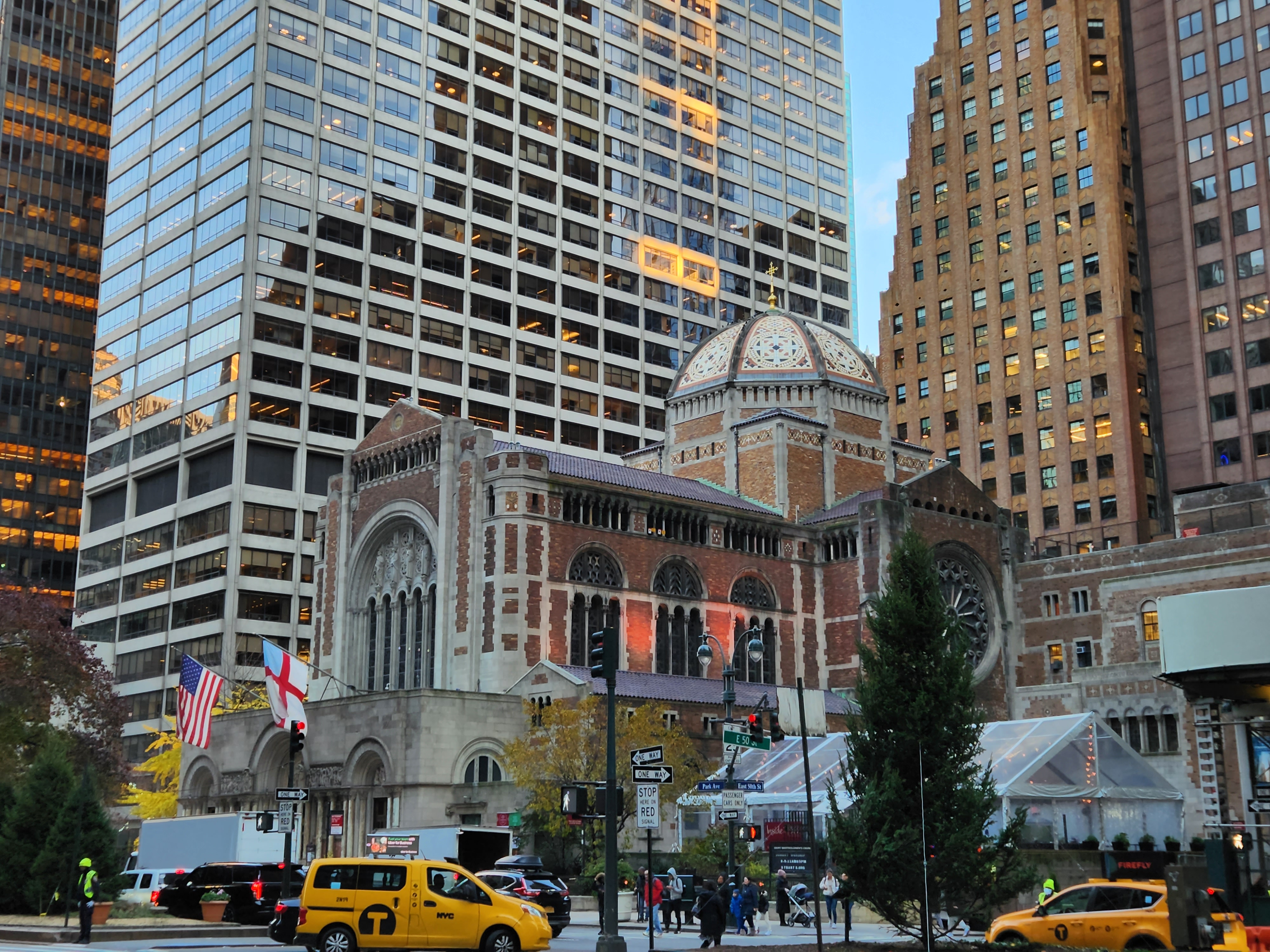
Beautiful and exotic-looking, St. Bartholomew’s Church—better known as St. Bart’s—was built in the Byzantine Revival style, a design that feels more at home in Constantinople than on Park Avenue. Truly one of the most unusual structures in New York, it has traveled in time from the 19th century to our day, and in place, from downtown to its present location on Park Avenue.
A Brief History of St. Bart’s (1835–1872)
St. Bartholomew’s Parish, serving a small Episcopal congregation, began its life in 1835, holding services in a modest church at the corner of Great Jones Street and Lafayette Place. By 1872, the parish had grown influential enough to commission a grand new church at Madison Avenue and 44th Street.


The Vanderbilts’ patronage ensured ample funds to hire one of the most prominent New York architects, sparing no expense on materials and embellishments. Designed by James Renwick Jr., the architect of St. Patrick’s Cathedral, the church was built in the French Romanesque style. Its most celebrated feature was the triple portal, richly carved and dedicated as a memorial to Cornelius Vanderbilt, patriarch of the powerful Vanderbilt dynasty.
The Park Avenue Church and the Vanderbilts
By the early 20th century, the Madison Avenue site no longer suited St. Bartholomew’s growing congregation. A new home was commissioned on Park Avenue and entrusted to architect Bertram Grosvenor Goodhue, who designed it in the Byzantine Revival style, drawing inspiration from the great early Christian churches of Constantinople.
Completed in 1918, the church is a masterpiece of brick, limestone, and colorful terra cotta, crowned by a monumental dome.
While St. Bartholomew’s was not founded by the Vanderbilts, its Park Avenue location is closely connected to the Vanderbilt family. After Cornelius Vanderbilt II died in 1899, his widow Alice Gwynne Vanderbilt became a major benefactor to religious and charitable causes. In 1914, she donated the land on Park Avenue at 50th Street, right in the heart of “Vanderbilt territory”, for the St. Bartholomew’s congregation.


The Vanderbilt Portal
The Vanderbilt Portal—the richly carved Romanesque entrance built as memorial to the dynasty patriarch Cornelius Vanderbilt—was donated by Cornelius Vanderbilt II to the earlier Madison Avenue church. It was considered far too important to lose when St. Bartholomew’s moved to Park Avenue.
The portal was carefully taken apart at the Madison Avenue site. Each block and carved piece was numbered and cataloged in order to be reassembled precisely. Once at the new site, the pieces were reconstructed in their original order under Goodhue’s direction, creating a seamless integration of the Romanesque portal into the new church.
The magnificent portal still welcomes worshipers today.
Who was St. Bartholomew?
St. Bartholomew was one of the Twelve Apostles. After the Resurrection, Bartholomew became a tireless missionary, carrying the new faith far from Jerusalem. Some say he reached India and left behind a copy of Matthew’s Gospel; others place him in Mesopotamia, Persia, and finally Armenia. There, he converted a king—and earned the fury of those who clung to the old gods. His death is one of the most dramatic among the apostles: Bartholomew was captured and flayed alive. In art, he is often depicted holding a knife and his own skin.
Byzantine Revival Architectural Style


The Byzantine Revival style is an architectural movement that looked back to the early Christian and Byzantine churches of the Eastern Roman Empire (4th–15th centuries), especially those in Constantinople. It flourished mainly in the 19th and early 20th centuries, often as part of the broader Romanesque revival styles. While both styles feature round arches, heavy rustication, and different textures created by the use of brick, limestone, and terra-cotta, they present themselves differently. While Romanesque Revival often appears fortress-like, Byzantine Revival has a lighter, more exotic feel. Its star features are domes and the use of mosaics.
Music and the St. Bart’s Organ
St. Bart’s is a musical landmark. Its Aeolian-Skinner pipe organ—installed and expanded through the 20th century—numbers over 12,000 pipes, making it one of the largest instruments in the world and the largest in New York City. The church is renowned for its choir and world-class organists, sustaining a rich tradition of sacred music.
Social Mission and Recognition
St. Barts welcomes everyone with the slogan “Everybody needs a place.”
In recognition of its architectural and cultural importance, St. Bart’s was designated a New York City Landmark in 1967 and later added to the National Register of Historic Places.
Don’t Miss
✨ Step inside to hear the powerful sounds of St. Bart’s organ. The church is especially known for its Christmas Eve and Midnight Mass, which is nothing short of magical.
Leave a Reply