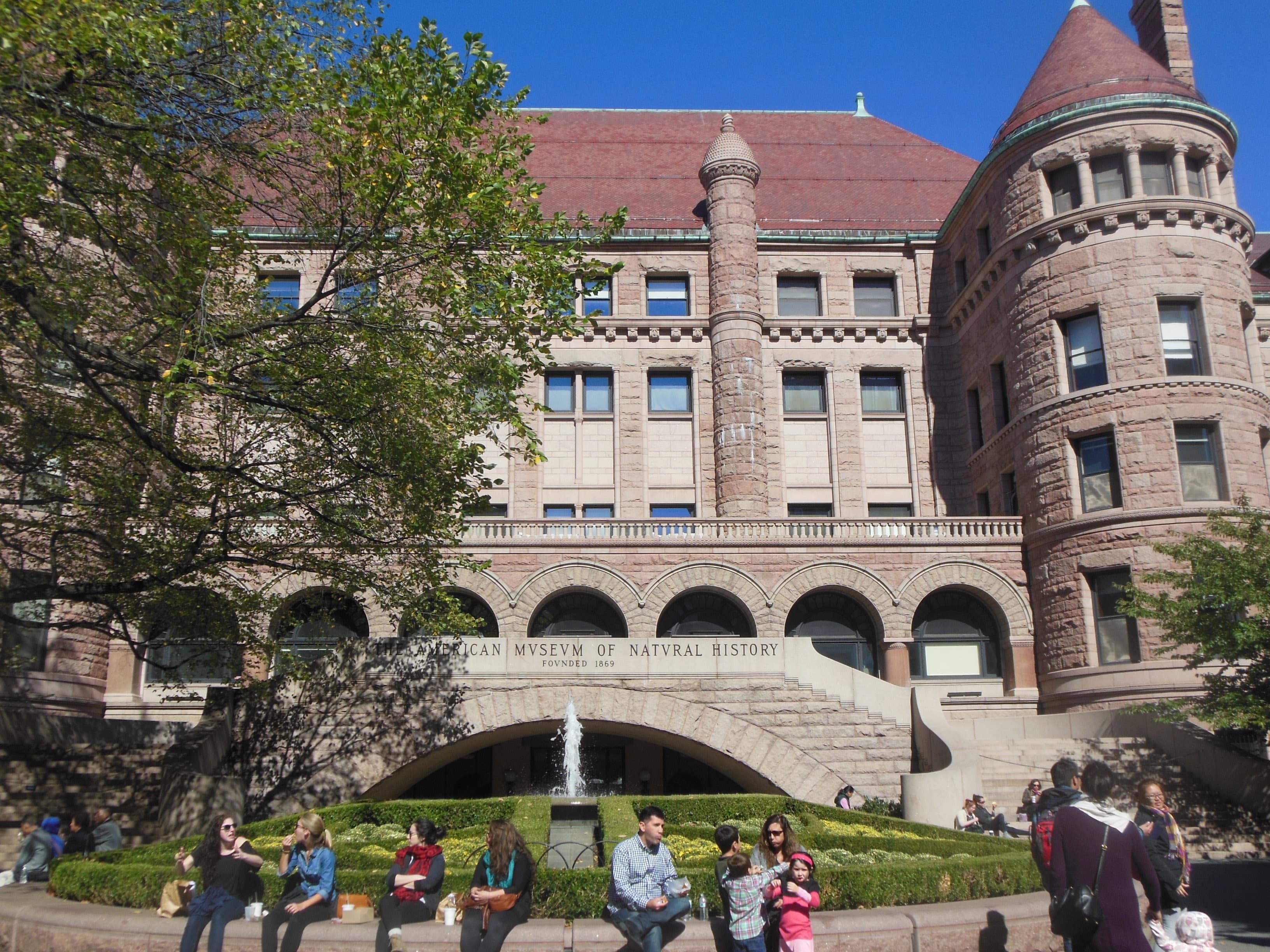
The American Museum of Natural History is one of the largest and most celebrated museums in the world. Spanning four city blocks, it forms a vast complex of 23 interconnected buildings housing 45 permanent exhibition halls.
Its collections are equally staggering—more than 32 million specimens and artifacts ranging from plants, animals, fossils, and minerals to meteorites, human remains, and cultural objects—of which only a fraction can ever be displayed.
American Museum of Natural History Origins
The idea for the American Museum of Natural History emerged in the mid-19th century, when New York’s civic leaders were eager to build scientific institutions that could rival those of Europe. In the 1860s, natural science was booming—Darwin had just published On the Origin of Species (1859), explorers returning from the American West were bringing back remarkable specimens, and museums in London and Paris were becoming major research centers. New York lacked anything comparable – a museum dedicated to understanding the natural world, collecting and preserving specimens, educating the public, and supporting scientific research.


From the beginning, the Museum was envisioned as part of the grand cultural landscape surrounding Central Park. Its first home was inside the Arsenal building within the park, and its first permanent structure—designed by Calvert Vaux, co-designer of the park—opened in 1877 on 77th Street. Ever since, the Museum and the Park have grown side by side: one celebrating nature outdoors, the other interpreting the natural world within its walls.
Theodore Roosevelt Memorial


When the Museum planned a grand new entrance in the 1930s, the city chose to dedicate it to Theodore Roosevelt—New York native, and 26th president of the United States. Roosevelt had a lifelong connection to the Museum and became known as the “Conservation President,” setting aside some 230 million acres of public land, including 150 national forests, 51 federal bird reserves, five national parks, and 18 national monuments.
Completed in 1936 and designed by John Russell Pope, the Theodore Roosevelt Memorial forms the Museum’s monumental entrance on Central Park West. Its original centerpiece—a bronze sculpture of Roosevelt on horseback flanked by a Native American and an African American figure—became the subject of controversy over its symbolism and, sadly, was removed in 2022.
Famous Collections and Iconic Displays
The Museum’s permanent and temporary exhibitions span almost every branch of the natural sciences—biology, zoology, geology, anthropology, astronomy, and ecology.


Some of its most iconic treasures include:
- The legendary habitat dioramas of African, Asian, and North American mammals
- The full-size Blue Whale model suspended over the Hall of Ocean Life
- The 62-foot Haida war canoe from the Pacific Northwest
- The 34-ton Cape York meteorite
- The Star of India, one of the largest star sapphires in the world
- The spectacular Fossil Halls, home to fully mounted dinosaur skeletons
Akeley Hall of African Mammals
Since its opening in 1936, the Akeley Hall of African Mammals has been regarded as one of the world’s great museum displays. It is named for Carl Akeley (1864–1926)—explorer, sculptor, photographer, and the father of modern taxidermy. Akeley revolutionized taxidermy by replacing crude stuffing with detailed internal armatures made of wood, wire, and skeletal elements. He sculpted each muscle in clay, cast the form, and then fitted the skin over the cast. His dioramas recreate animals in precise locations and moments in time, blending scientific accuracy with immersive artistry.
The Rose Center for Earth and Space
The Rose Center, which replaced the old Hayden Planetarium, is one of the Museum’s most striking contemporary additions. The building is a transparent cube wrapped around the dramatic white sphere of the planetarium theater—architecture that looks as though it stepped out of a science-fiction film. Inside, a spiral walkway descends from the sphere past hanging models of stars, planets, and galaxies.
Dinosaur Halls
The fourth floor contains three spectacular fossil galleries. Using real fossils, life-size mounts, and interactive computer stations, these halls present the most up-to-date scientific interpretations of how dinosaurs and early vertebrates lived and behaved.
The Upper West Side: Unconventional, Iconic and Wonderful SELF-Guided Audio Tour

The American Museum of Natural History is on this audio tour of the Upper West Side. Download at VoiceMap.me/UWS or just scan the QR code on the left.
The American Museum of Natural History is a place where the wonders of the natural world—from the depths of the oceans to the edge of the Universe—come vividly to life. Its spell has extended far beyond its walls, making the Museum not just a setting but almost a character in several films. In The Squid and the Whale, the iconic giant squid-and-whale diorama becomes a powerful visual metaphor in a story about a Brooklyn family coming apart. In Wonderstruck, the Museum plays a central, atmospheric role, weaving together two children’s stories set decades apart. And of course, there is Night at the Museum, where Ben Stiller stars as a night guard who discovers that the exhibits spring to life after dark—a premise that transformed the Museum into a global pop-culture landmark.
Leave a Reply