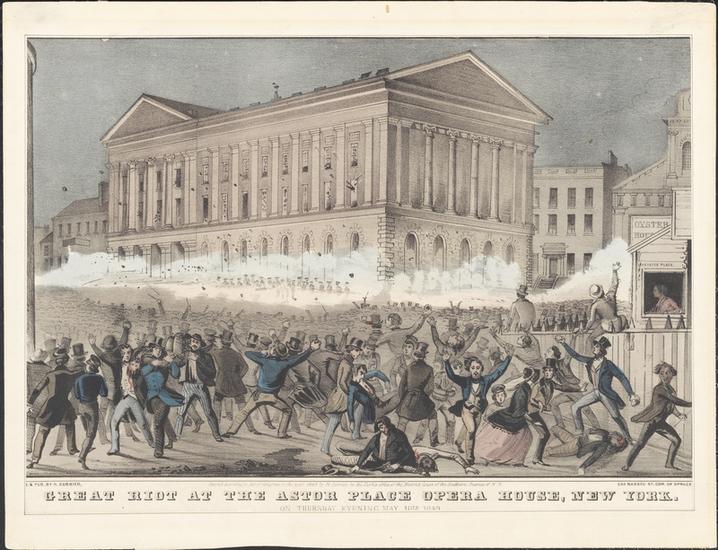
Among many civil unrests and organized protests in New York, this one stands out. Its cause was a theatrical production, and its result was the deadliest theater riot in history. Never before or since so many people lost their lives over the interpretation of a Sheasksperian character.

A humble street corner in the East Village, where Lafayette Street meets the 8th street, used to be occupied by quite an elitist institution – the Astor Place Opera House. The venue, however, went down in history not because of its opera productions but because of one of the deadliest riots in the history of New York. The deadliest theater riot in history took place here in 1849.
The Astor Place Opera House
The Astor Place Opera House was built with the intention of attracting only the city’s most refined inhabitants. The society’s uppercuts, modeling European aristocracy, desired to attend cultural performances while sporting the latest fashions and the most sparkling jewelry pieces. The dress code required patrons to wear kid gloves. Plebeians, obviously, were never not allowed to attend. They were to enjoy performing arts at the theaters located along the Bowery.
Shakespearean actors William Macready and Edwin Forrest

Public domain, via Wikimedia Commons

John Jackson, Public domain, via Wikimedia Commons
The Opera House was not able to sustain itself for the entire season with just an opera, and added theatrics productions to its repertoire. To boost attendance, the Astor Opera House invited William Macready, a famous British Sheasksperian actor, to grace its stage in his signature role of Macbeth.
At the same time, a famous American actor, Edwin Forrest, had just returned from a European tour where he was treated unkindly. In the act of defiance, Forrest set out to perform with his version of Macbeth along the route of Macready’s American tour.
The Astor Place Riot

On a fateful day in 1849, when Macready stepped on the stage of the Astor Opera House as Macbeth, Forrest performed the same role nearby in the Bowery theater. These simultaneous performances ignited one of the most famous riots in New York’s history. It was an American versus British and the working class versus the privileged.
Macready’s opening night was ruined: somehow, the people from the Bowery crowd snuck into the theater and treated Macready to various unpleasant objects, including rotten eggs. The actor fled in terror and disbelief, refusing to perform for the next two nights. Convinced by the management that the situation was under control, he returned to the stage. What happened next was astounding: the menacing crowd of 10,000 or 20,000 people surrounded the theater, attacking it with stones and whatever objects that could be used in a street fight. It took the military and firearms to restore order.
The aftermath: “Massacre Opera House” at “DisAster Place”
In the aftermath, between 20 and 30 people were killed and many more wounded.
Not able to overcome the reputation of being the “Massacre Opera House” at “DisAster Place,” in 1853 the theater closed permanently. The interior has been dismantled, and the furnishings sold off, with the shell of the building sold for $140,000 to the New York Mercantile Library, which renamed the building “Clinton Hall.” The building that once housed the Astor Opera House was torn down 1890.
Location Lafayette Street between Astor Place and East 8th Street
Opened – 1847
Closed – 1853
Leave a Reply