Established in 1859, The Cooper Union is among the nation’s oldest and most distinguished higher education institutions. The Cooper Union College was founded by inventor, industrialist, and philanthropist Peter Cooper and offered a world-class education in art, architecture, and engineering. Based on Peter Cooper’s belief that education is the key not only to personal prosperity but also to civic virtue and harmony, Cooper Union is a unique institution.
Peter Cooper, the founder of Cooper Union

Peter Cooper received virtually no formal schooling, but had a gift for commerce and a knack for invention. He made fortunes in real estate, iron, steel, railroads, telecommunication, glue, and… jello. In 1845, Peter Cooper patented a method for the manufacture of gelatin, a tasteless gelling agent that later, with added fruit flavorings, became Jell-O.
He owned half the telegraph lines in North America and was a key investor and driving force behind the first Atlantic cable from North America to Europe. Nearing sixty, Peter Cooper was among the wealthiest and most celebrated men in the United States. But, unlike many of his Gilded Age contemporaries, he lived simply. He believed in philanthropy and wanted to share his good fortune by helping others get an education in order to improve society.
The Cooper Union: education regardless of wealth, gender, or color


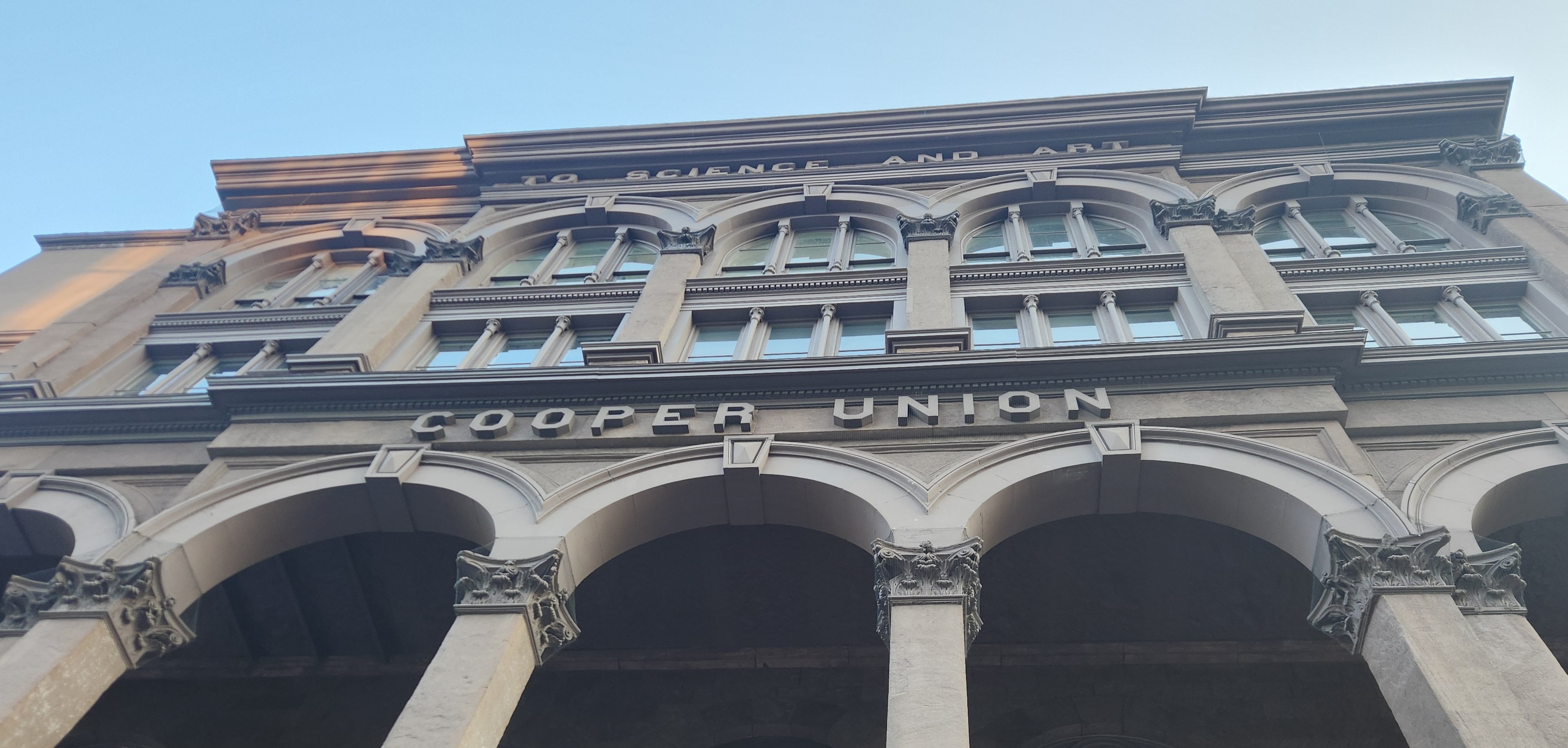
The Cooper Union facade
He was convinced that one should be able to receive an education regardless of social status, wealth, gender, or color. Based on these principles, Peter Cooper made his school free for the working classes. The school was open for women as well as men, and there was no color bar at Cooper Union. Since working people could not enroll in a full-time program, he opened a public reading room stocked with the latest newspapers and periodicals.
Peter Cooper wanted the Cooper Union to play a central role in the political and cultural life of the country. With that in mind, he established the largest secular meeting room in New York City. It seated 900, and soon after it opened, it made history. Abraham Lincoln, a virtual unknown in New York, gave a speech that propelled him to the presidency and defined the country’s future.
The Cooper Union offered free tuition until recently, when it made a very controversial decision to start charging. Cooper Union has owned the ground lease on the Chrysler Building site since 1902. The rent Cooper Union accrued from Chrysler has helped subsidize the tuition-free education. When the lease ran out, Cooper Union could no longer provide free education. Cooper Union and the Chrysler are in a legal battle over the rent money right now.
The statue of Peter Cooper
The statue of Peter Cooper near the Cooper Union building was created by Augustus Saint-Gaudens, one of New York’s most prominent sculptors. Son of a shoemaker, he started his career as an apprentice to cameo-cutters while taking evening art classes at the Cooper Union. It’s symbolic that Peter Cooper’s statue was designed by Augustus Saint-Gaudens – a man whose talents would have never been realized had it not been for the excellent education he received in the Cooper Union.
Leave a Reply