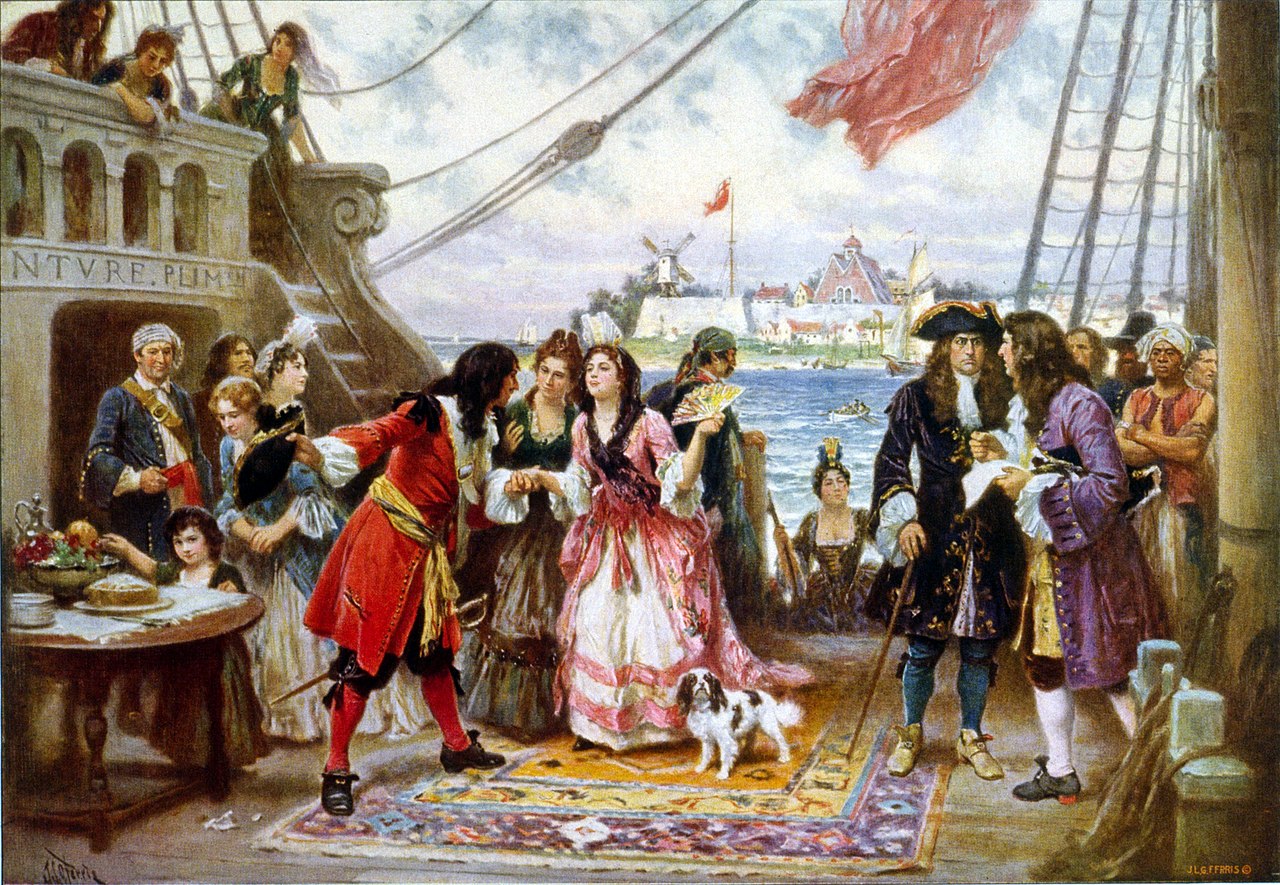
It is said that if a spirit has unfinished business, it will linger. The restless spirit of Captain Kidd is still roaming around Wall Street, where he lived once, protecting his never-found treasure.
Here is the story of Captain William Kidd.
The fortune smiled on William Kidd from a young age. Born in Scotland in 1654, he became a well-respected sea captain and moved to New York City. Here, in 1691, he married a young and very wealthy widow. Sarah Bradley was born into a well-off family in New York, and before marrying Captain Kidd, had already been widowed twice. Her second husband was a prominent Dutch merchant who left her a considerable fortune, making her one of the wealthier women in the city. Sarah and William became a well-known couple in New York society, owning a large home just off Wall Street and enjoying eminent social status. The story could have ended right here if it hadn’t been for the allure of the sea that kept calling William Kidd back.

Captain Kidd took a job as a privateer.
Let me explain. At the time, the seas were teaming with pirates, attacking ships and stealing cargo. Governments and trading companies hired private individuals authorized to attack and capture enemy vessels to protect their interests at sea. Essentially, privateers were legal pirates operating with the backing of a nation or a trading company. They carried a letter of marque, an official document that allowed them to seize ships, goods, and cargo from enemy ships. From the 16th to the 19th centuries, privateering was a common practice, especially in conflicts between major European powers like England, Spain, and France. Captain William Kidd was commissioned as a privateer by the British Crown with a mission to hunt down pirates and attack French ships during the Nine Years’ War. The captain had a number of successful voyages, but the last one proved fateful.
Captain Kidd’s Last Voyage
Captain Kidd set sail in 1696 for the Indian Ocean in search of the French ships. But it seemed like the lady luck had abandoned him. He was at sea for two whole years without catching any vessel. His crew, paid for by the spoils of the captures, went on without wages for too long. They turned mutinous, overpowered the captain and attacked a few ships that were not legal targets under his privateering commission. One of them was the Quedagh Merchant, an Armenian ship flying a French flag but owned by Indian merchants. Also, while Captain Kidd was at sea, the war between the British Empire and France ended, which changed the act of attacking French ships from legal to piracy and pushed Captain Kidd over the line from privateer to pirate in the eyes of the law.
Trial and Execution
After hearing rumors that he had been branded a pirate, Kidd sailed to the American colonies in 1699 to seek protection from his influential backers in New York and Boston, many of whom were prominent politicians. Kidd believed his supporters would help clear his name, as he claimed he was only acting within the bounds of his privateering commission. Even though he tried to negotiate his freedom by offering the location of his hidden treasure, he was arrested and sent to England for Trial. Kidd was sentenced to death and hanged on May 23, 1701 in London. His execution was gruesome; the first rope broke, and he had to be hanged a second time. After his death, his body was tarred and hung in a gibbet by the Thames River, a common practice to warn others against piracy.
But what about the treasure?
The treasure luted from the Quedagh Merchant was never found, fueling centuries of treasure-hunting lore. Some believed it was buried in various locations, including Gardiners Island off Long Island, Connecticut, the Caribbean, and the Liberty Island in New York Harbor. Before being arrested, Captain Kidd met his wife and gave her something. Part of the treasure? A map? We will never know. Throughout the 18th and 19th centuries, treasure hunters were drawn to Liberty Island (called Bedlow Island back then) by rumors of buried pirate gold.
In 1825, Sergeant Gibbs and Private Carpenter, stationed on Bedlow Island, decided to try their luck. They located the spot and started to dig. When they found a wooden box and were about to claim the treasure, a terrifying vision appeared before them. Sergeant Gibbs described a ghoul with black skin, horns, giant wings, and a tail. Carpenter said the creature was red, had no legs, but it moved around fast. The angry spirit of Captain Kidd, breathing sulfur, grabbed the wooden box from the hole. Sergeant Gibbs fell unconscious while Private Carpenter was shaking and screaming.
Other stories tell of treasure hunters who, as soon as they managed to get to the chest, saw a gigantic figure dressed as a pirate before being swallowed by an ocean tide.
Will the Spirit Ever Rest?
In 1701, Captain Kidd was hanged for piracy, but he maintained his innocence until the end. He did not get a fair trial in London and was betrayed by his friends in New York. Maybe his spirit searches for something more elusive than protecting the treasure. What if it’s not riches, but redemption, that Kidd seeks? What if his restless wanderings are driven by a need to clear his name? What if his spirit, bound by the injustice of history, waits for someone to tell his story?
Perhaps, my story will set him free.
Leave a Reply