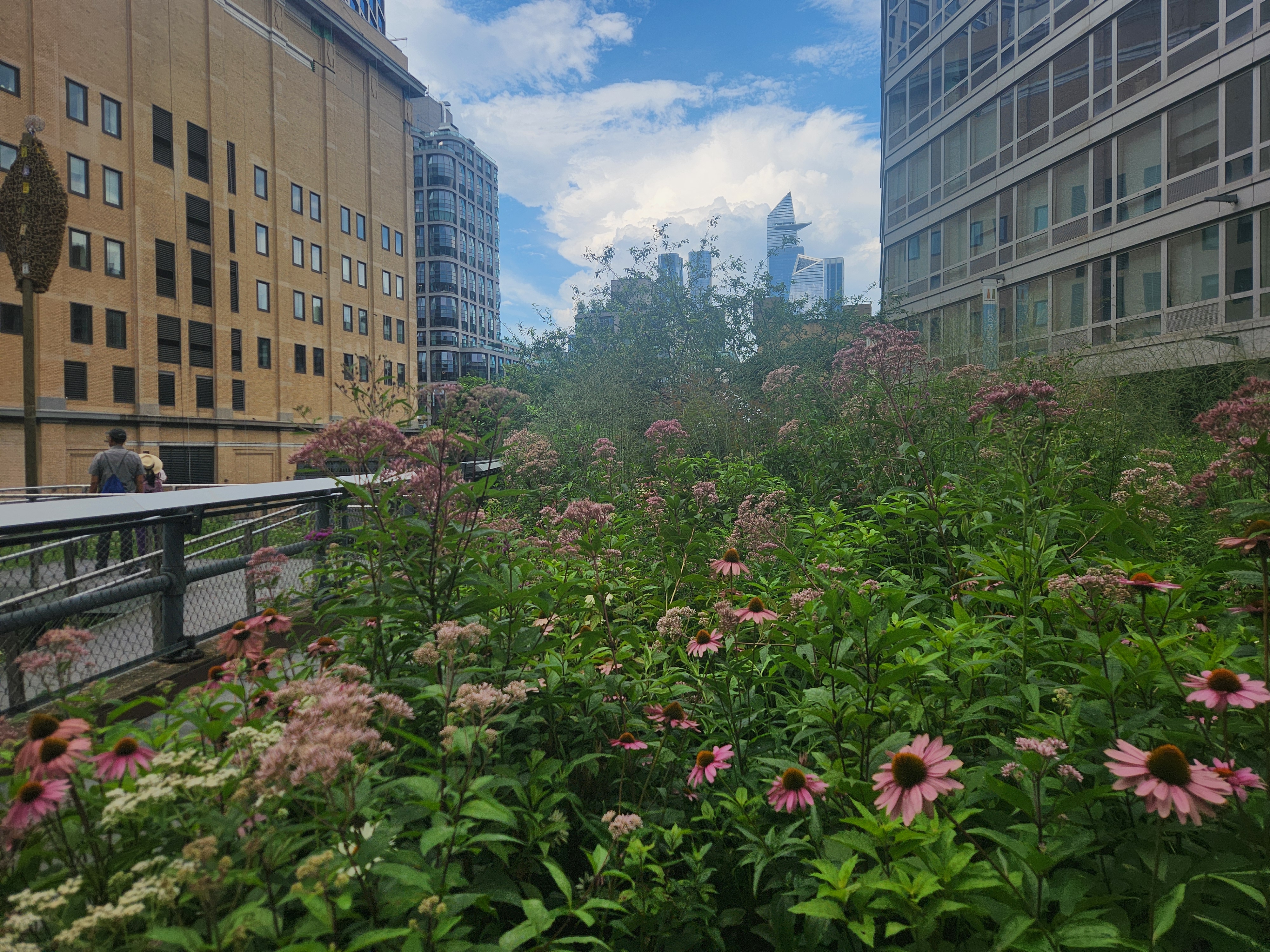
The High Line is a stunning 1.5-mile elevated park built atop an abandoned freight rail line, stretching from Gansevoort Street in the Meatpacking District to West 34th Street near Hudson Yards. Today, it’s one of New York City’s most innovative and beloved public spaces—but its origins lie in an entirely different era and purpose.
Table of Contents


The High Line History: Death Avenue and West Side Cowboys
In the 19th and early 20th centuries, this area of Manhattan was gritty and industrial. Freight trains of the New York Central Railroad rumbled down Tenth Avenue at street level, delivering goods to factories and warehouses lining the Hudson River. These trains shared the road with pedestrians, wagons, and—later—automobiles, creating a chaotic and dangerous situation.
Visibility was poor, safety systems were nonexistent, and accidents were tragically common. So many people were killed by trains along this stretch of 10th Avenue that it earned the grim nickname “Death Avenue.” Hundreds of people lost their lives in collisions with steam trains—cyclists, horse-drawn carriages, and pedestrians alike.
To mitigate the danger, a law passed in the 1850s required a man on horseback to ride ahead of each train, waving a red flag by day and a red lantern by night. These mounted lookouts became known as the “West Side Cowboys.” Wearing wide-brimmed hats and leather boots, these urban cowboys patrolled the “Death Avenue.”
Next Chapter: The rail line gets elevated
By the early 20th century, this street-level freight system had become unsustainable. Under the guidance of urban planner Robert Moses, a massive infrastructure project, the West Side Improvement Project, was launched. In 1934, the rail line was elevated, lifting the trains above street level. The last cowboy rode in 1941, closing the chapter on Death Avenue.
The elevated tracks served factories, warehouses, and meatpacking plants from Gansevoort Street to 34th Street. In some places, the trains even ran through buildings, delivering meat, produce, and mail without interrupting street traffic.
Abandonment of the rail line
But history moves quickly. By the 1950s, trucking had begun to replace rail freight, and usage of the High Line had dwindled. In 1980, the last train—hauling three carloads of frozen turkeys—rattled down the tracks. After that, the structure was abandoned. Nature slowly reclaimed it, turning the elevated railway into a secret urban wilderness of wildflowers and weeds. It became the domain of graffiti artists, urban explorers, and photographers.
In the 1990s, much of the city pushed for its demolition. However, a grassroots organization called Friends of the High Line had a different vision. Through community advocacy, design competitions, and high-profile support from celebrities and city officials, they launched an ambitious campaign to transform the old railway into a public space.
Birth of the High Line
The result is one of the world’s most admired examples of adaptive reuse and sustainable urban design. Opening in phases (2009, 2011, 2014, and 2023), the High Line weaves walking paths and gardens through the original rail tracks, preserving the spirit of the overgrown landscape that once thrived there. Native plantings echo the wild flora that took root in the abandoned railbed.
The High Line – an open air art gallery
Along the way, public art has become central to the High Line experience. Its rotating exhibitions transform it into an open-air gallery unlike any other.

Recent highlights include:
- “Dinosaur” by Iván Argote – a hyper-realistic aluminum sculpture of a giant pigeon perched dramatically on the Spur at 30th Street and 10th Avenue.
- “Foot Fountain (pink)” by Mika Rottenberg – a whimsical 10-foot pink leg sculpture that spits water when visitors pedal a nearby pump.
- “Fossil Psychic Stone Mimicry (Mosaico Bench I)” by Kerstin Brätsch – a sculptural mosaic bench at 23rd Street that mimics fossilized stone, merging artwork and functional seating.
Modern architecture along the High Line
Here are some of the most notable examples of modern architecture along the High Line, from south to north:


The Standard, High Line (848 Washington St)
Architect: Ennead Architects
Completed in 2009, this glass-and-steel hotel straddles the High Line. Its full-length windows offers panoramic views from the inside—and sometimes, cheeky glimpses into guests’ rooms.
The Lantern House (515 W 18th St)
Architect: Thomas Heatherwick
Nicknamed for its lantern-like bay windows, this condo project fuses industrial brickwork with whimsical curves. It hugs both sides of the High Line with a glass bridge connecting the twin towers.
Zaha Hadid’s 520 West 28th
Architect: Zaha Hadid
This is the only New York building by the late Pritzker Prize–winning architect. Its futuristic, flowing lines resemble a spaceship docked alongside the High Line. The building is a sculptural landmark, redefining luxury with an underground robotic parking garage and private IMAX theater.
100 11th Avenue
Architect: Jean Nouvel
This building’s shimmering, irregular facade is made of 1,650 different-sized panes of glass—angled to reflect light differently throughout the day.
HL23 (515 W 23rd St)
Architect: Neil Denari
this angular glass-and-metal structure cantilevers over the High Line. With just 11 units, it’s one of the most unique small-scale towers in the area.
The Getty (239 Tenth Ave)
Architect: Peter Marino
Formerly a gas station, now a luxury complex, The Getty has limestone cladding, high ceilings, and houses both galleries and sky-high penthouses.
The Shed (545 W 30th St at Hudson Yards)
Architects: Diller Scofidio + Renfro and Rockwell Group
A cultural centerpiece of Hudson Yards, The Shed features a telescoping shell that glides open or closed, allowing it to physically transform for performances and exhibits.
Vessel & Hudson Yards Towers
Hudson Yards, the largest private real estate development in U.S. history, features towering glass skyscrapers like 30 Hudson Yards (home to The Edge observation deck) and the honeycomb-like sculpture known as Vessel.


Leave a Reply