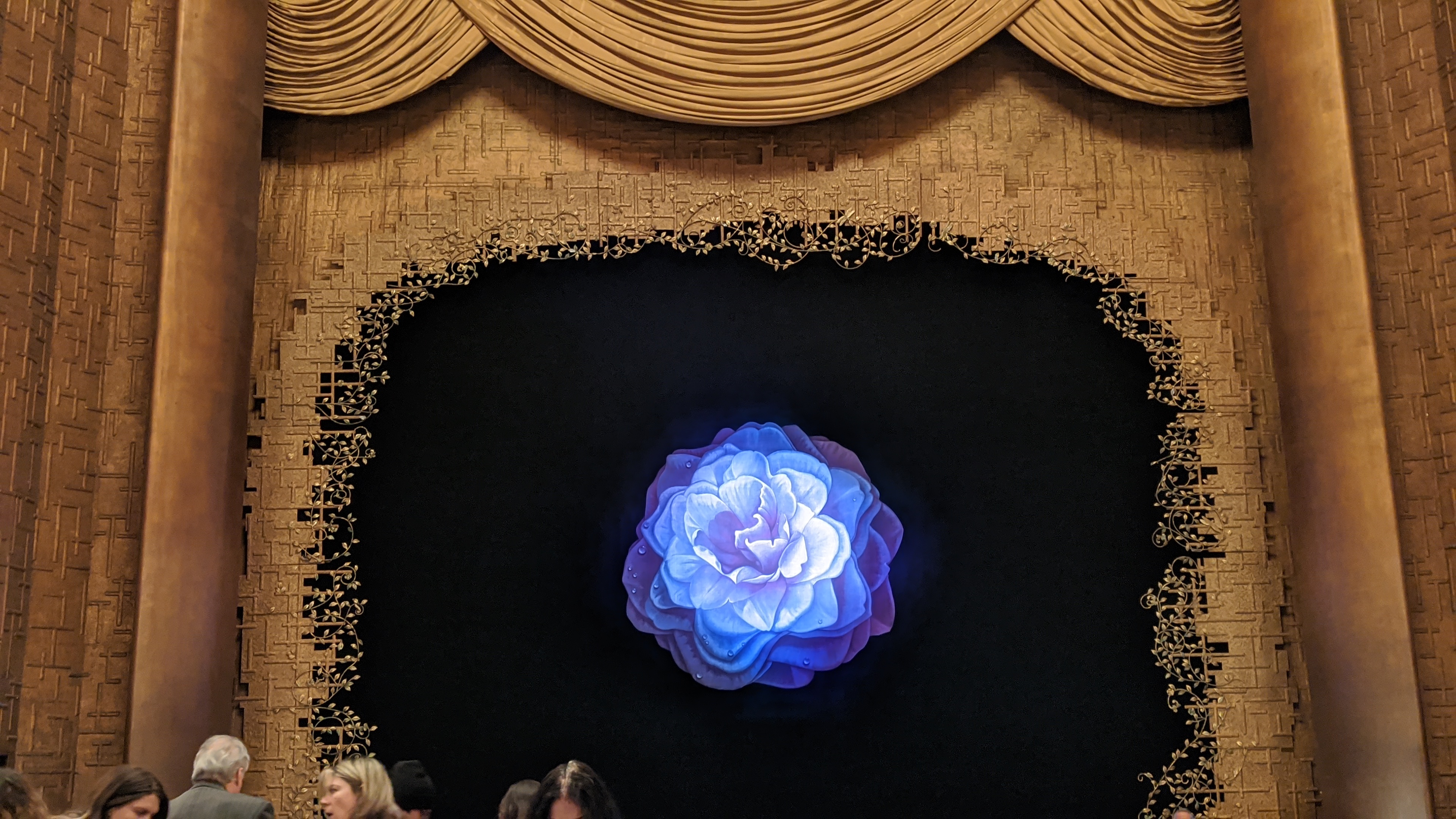
The Metropolitan Opera House is one of the world’s most venerable opera venues. Each year, the Met presents over 200 performances, staging around 20 different opera productions. Its stage has been graced by the greatest voices in operatic history, including Renée Fleming, who has appeared more than 250 times at the Met; Plácido Domingo, who performed an astonishing 855 times and holds the record for the most opening-night appearances; and legendary figures such as Enrico Caruso, Luciano Pavarotti, and Maria Callas.
The current Metropolitan Opera building, designed by Wallace Harrison as part of the Lincoln Center complex, opened in 1966. Its modernist façade is adorned with two monumental murals by Marc Chagall—The Triumph of Music and The Sources of Music—each measuring an impressive 30 by 36 feet, setting the tone before one even enters the building.
The interior of the Metropolitan Opera


The interior of the Metropolitan Opera House is designed to feel ceremonial and grand. Visitors enter into a soaring five-story light-filled lobby with sweeping staircases. The sense is deliberately theatrical: this is not just a place to hear opera, but a place to arrive. Suspended above the lobby are the famous crystal chandeliers, inspired by galaxies and Sputniks. A gift from the Austrian government in gratitude for American assistance in restoring Vienna’s State Opera after World War II, the chandeliers are composed of thousands of Swarovski crystals. Before each performance, they slowly ascend toward the ceiling in a ritualized prelude signaling the performance’s start.
With a seating capacity of over 3,800, the Metropolitan Opera is the largest opera house in the world and home to the largest repertory opera company. Inside the auditorium, five tiers of horseshoe-shaped balconies wrap around the space, creating both grandeur and intimacy. Despite its immense scale, the hall is renowned for its acoustics, engineered so that voices carry without amplification.
Metropolitan Opera History
Although the present building dates to 1966, the Metropolitan Opera itself was founded much earlier, in 1880. Before that time, New York’s high society attended opera at the Academy of Music on 14th Street, where opera functioned not only as a cultural experience but also as a display of social power. The old-money families—led by Mrs. Astor—held the theater’s private boxes. Not only were the number of boxes limited, but they were also jealously guarded by the elites from the “new-money” industrialists. The newcomers like the Vanderbilts, J.P. Morgan, and Jay Gould, for all their money, were not able to buy a box in the Academy of Music. In a legendary snub, William K. Vanderbilt’s staggering $30,000 offer for an opera box for the 1880–81 season was refused.
The city’s nouveau riche responded decisively by building their own opera house: the Metropolitan Opera on Broadway at 39th Street. From its opening night, it was an immediate triumph, celebrated for its legendary acoustics and its 36 private boxes. The new Met quickly eclipsed the Academy of Music, which could not compete and soon closed its doors. The only serious flaw in the building’s design was its limited storage space, forcing elaborate opera sets to wait outdoors—sometimes even in winter. In the 1930s, attempts to relocate the Met to what would later become Rockefeller Center were thwarted by the Great Depression. It would take until 1966 for the Metropolitan Opera to finally move to its permanent home at Lincoln Center.
The Metropolitan Opera remains the star of Lincoln Center and one of New York’s greatest cultural treasures.
The Upper West Side: Unconventional, Iconic and Wonderful SELF-Guided Audio Tour

The Metropolitan Opera House is one of the stops on the Upper West Side tour. Download at VoiceMap.me/UWS or just scan the QR code on the left.
Leave a Reply