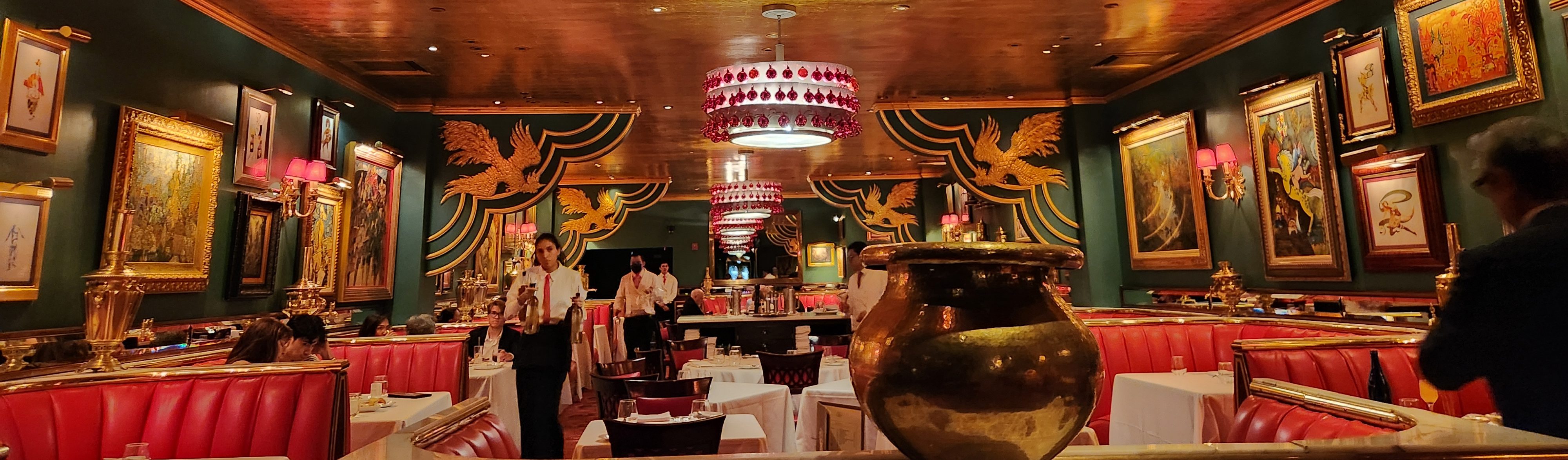
Just steps from Carnegie Hall, at 150 West 57th Street between Sixth and Seventh Avenues, stands one of New York’s most legendary restaurants: The Russian Tea Room.

Founded in 1927 by former members of the Russian Imperial Ballet who had fled the upheavals of the Russian Revolution, it still serves a selection of Russian expatriate favorites such as blini, caviar, borscht, and vodka. The Russian Tea Room was born of nostalgia and remained that way for years to come. Its regulars included legendary choreographer George Balanchine, co-founder of the New York City Ballet, and Ayn Rand, Russian-born writer and philosopher.

1960-80, MCNY Digital Collection

ca. 1940, MCNY Digital Collection

1935, MCNY Digital Collection

1935, MCNY Digital Collection
The Russian Tea Room, a next-door neighbor to Carnegie Hall, became a gathering place for those in the entertainment industry. Actors, producers, musicians, literary agents, and theater insiders crowded its red banquettes. At lunchtime, the room buzzed with deals, gossip, and celebrity sightings.
One longtime admirer captured its atmosphere perfectly:
“But oh, the old, real Russian Tea Room was so great at lunchtime. Theater, movie and book agents all chowed down together. Producers — names that appeared in the credits for good productions — dotted the room. Famous people swept in and became instant royalty. There was a sense as you gave your coat in on the left and queued up at the maitre d’s stand that many important things might happen while you had your blinis with caviar, omelette or Borscht.”
In 1996, to the great despair of New York élite, the Russian Tea Room was bought by Warner LeRoy, the restaurant impresario and owner of Tavern on the Green. After four years and $36 million in renovations, it reopened, but it was no longer the same. The new décor featured red colored walls, a gold ceiling, pink tablecloths, and an enormous glass bear filled with fish. While some, such as Martha Stewart, praised the design, the old-timers were horrified. To them, the old soul of the restaurant — its faded glamour, quiet intimacy, and émigré melancholy — had been replaced by theatrical kitsch.
The Russian Tea Room is notoriously overpriced and not known for its service consistency. Nevertheless, it is an institution rooted in history. It has been visited by Woody Allen, Jacqueline Kennedy Onassis, Mel Brooks, Arthur Rubinstein, and Jascha Heifetz, among many others. In 1982, a young Madonna worked there as a coat-check clerk before becoming a global superstar. Scenes from Manhattan, Tootsie, and The Turning Point were filmed inside the Tea Room, further cementing its place in New York lore.


Afternoon Tea, served daily in the mid-afternoon, is a good time to visit. Those looking for a taste of old Russian nostalgia may want to indulge in the restaurant’s signature cocktail, the Cavitini, made with Russian vodka and accompanied by Hackleback caviar.
In 2017, the restaurant celebrated its 90th anniversary in suitably extravagant fashion, offering such frugal specials as Caviar and Champagne for a mere $275, discounted from the usual $410, and a Champagne-and-Caviar combination for $499 instead of $900. The Russian Tea Room’s 100th anniversary is just around the corner. My guess is that champagne will be bubbling, vodka will be flowing, and caviar will be nostalgically served atop blini. It will not be cheap.
Leave a Reply