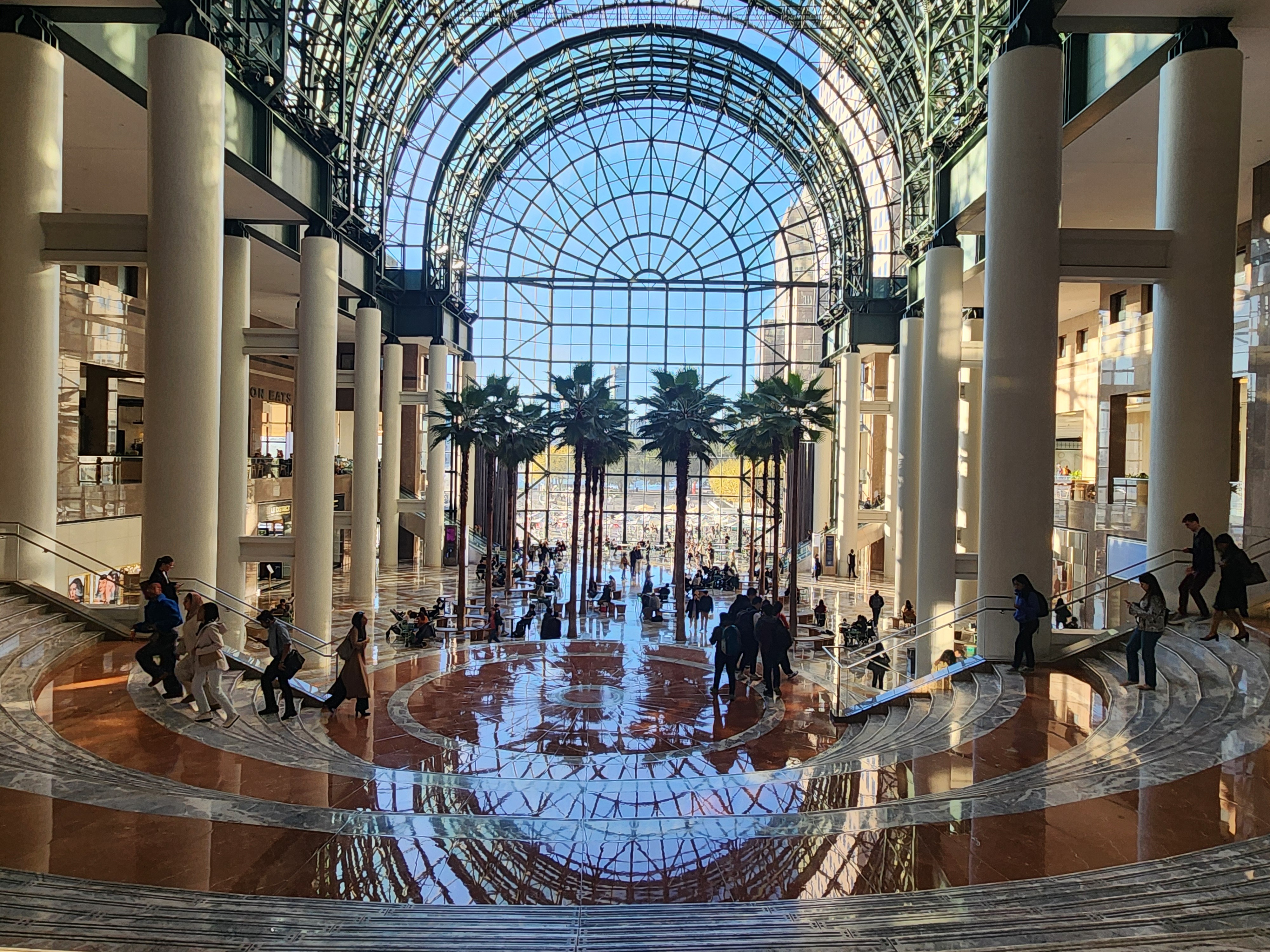
On the Hudson River waterfront, just across from the World Trade Center, one can find one of the most dramatic yet inviting interior spaces: the Winter Garden Atrium. The soaring, vaulted glass roof creates drama, while earthy-colored marble adds warmth. The space is bathed in natural light, and the presence of palm trees suggests an indoor oasis.
The Winter Garden Atrium, completed in 1988 as part of the World Financial Center (now Brookfield Place), was designed by architect César Pelli. He created a space that evokes serenity in contrast with the bustling energy of the city. At 10 stories and 120 feet high, the vast, light-filled space is a dramatic departure from the busy streetscapes of Manhattan. Its design encourages visitors to stop and linger. The Winter Garden goes far beyond being an office space lobby. It’s a year-round gathering place where New Yorkers can pause for food, exhibits, concerts, or take a quiet break under the tropical palms.
A Day of Loss and Escape
On September 11, 2001, the Winter Garden was torn apart. The collapse of the Twin Towers shattered its glass vault, ripped through its steel, and destroyed the palms. That morning, the atrium became something else entirely: an escape route. Thousands of people fleeing the towers poured through the broken space toward the Hudson River promenade.
A Symbol of Renewal
Just a year later, on September 17, 2002, the Winter Garden reopened. It was the first major building near Ground Zero to be restored, and became a powerful symbol of resilience for New Yorkers, devastated by the destruction of September 11. While the Twin Towers, along with the rest of the World Trade Center, were lost forever, the Winter Garden, brought back to life, was a life-affirming symbol of survival.
The Life of the Palms

The palms themselves have story of renewal. Growing indoors without the toughening force of wind or rain, they can only thrive here for about a decade. Once they reach 55 to 60 feet in height, they’re replaced with younger trees shipped in from Florida.
The Winter Garden staircase


The grand staircase in the Winter Garden Atrium creates a ceremonial pause—its broad, marble steps invite visitors to ascend and take in the view. Made of Italian marble, it is a central feature of the atrium. The original staircase was built using Alabaster and Coral Roho Alicante marble, also called “glowing coral”. The quarries for those varieties were depleted by the time of the rebuilding, and architects selected warm-toned Monte Carlo marble as a replacement for some of the original stone.
The majestic staircase functions as an amphitheater for performances and events. After the restoration, the top of staircase opens to a large glass window at the far end of the atrium, offering a view of the 9/11 Memorial.


The Urban Oasys
Designed in the 1980s, the Winter Garden remains one of New York’s most striking public spaces. More than an architectural showpiece, it is an urban oasis—home to concerts, art installations, and seasonal festivals, as well as cafés and shops. From here, you can step out to the North Cove Marina for sweeping views of the Hudson River, or walk through a connecting passage into the rebuilt World Trade Center. The Winter Garden is not the only place in the city to take respite from the daily hustles, but it’s the only one where one can stay beneath the palms with a view of the Hudson.

Download the audio guide “The Oculus Unfolded: Architecture, Symbolism, and Secrets” at VoiceMap.me/Oculus or just scan the QR code.
Leave a Reply