Like them or hate them, they are here. In the ever-changing Gotham City, nothing stays still, and new architectural creations – skyscrapers, modern apartment buildings, office towers – are appearing like mushrooms after the rain. They are changing the New York City skyline to the dismay of many, causing strong emotional reactions, often negative. Still, some of them are quite amazing in terms of new architectural ideas and mind-blowing engineering solutions. Here are some of the notable additions to New York’s eclectic architectural presence.
Table of Contents
520 West 28th Street/Zaha Hadid Building
- Architect: Zaha Hadid
- Year: 2017
- Location: 520 West 28th Street (Chelsea)

The Condominium, located at 520 West 28th Street and designed by Iraqi-British artist Zaha Hadid, is easily one of the most impressive residential buildings in NYC. The 11-floor condo featuring 39 luxurious residences is characterized by curves contrasting the surrounding buildings.
Iraqi British architect Zaha Hadid became famous for her futuristic style with curving façades and unexpected angles. In her architectural vision, she creates spatial forms that challenge conventional concepts of geometry and symmetry, taking inspiration from nature. The fluidity of form is not just aesthetically striking; it also influences the user experience and the relationship between humans and their environment. Hadid’s architectural philosophy transcends conventional boundaries, blending functional structures with a dramatic artistic statement.
The Zaha Hadid Building is her only residential building in New York and one of the last projects before her death.
https://www.related.com/our-company/properties/520-west-28th
Via 57 West
- Architect: Bjarke Ingels Group
- Year: 2016
- Location: 625 W 57th St (Midtown West)


VIA 57 West is an entirely new vision in residential architecture – The Courtscraper. Many apartment buildings of the early 20th century were built around a courtyard, allowing for a private space for residents and additional light exposure in the apartments. In the design of VIA 57 West, this idea is combined with that of a high-rise living.
Looking at the building from the air, one can notice another reference: the courtyard in the middle of the structure resembles Central Park in the middle of Manhattan.
The building’s distinctive triangular shape allows for sweeping views and abundant natural light. The apartments are organized in a fishbone layout, orienting them towards the Hudson River. Uniquely designed terraces are carved into facades, maximizing views and ensuring privacy.
One High Line
- Architect: Bjarke Ingels Group
- Year: 2024
- Location: 500 W 18th St (Chelsea)
- Height: 300-foot (91 meters) and 400-foot (122 meters)

One High Line is a pair of twisting towers housing luxury condo units and a hotel. The main distinct feature of the project is the facades that angle away from each other at the base and twist around on the way up.
According to Bjarke Ingels, the sculptural solution of the towers reflects the industrial history of West Chelsea and celebrates its present-day statue as a hub of contemporary architecture. The facade was inspired by the 19th-century warehouses of the Meatpacking District. The towers’ twisting allows more windows to face the High Line and the Hudson River.
56 Leonard Street/The Jenga Building
- Architect: Herzog & de Meuron
- Year: 2017
- Location: 56 Leonard Street (Tribeca)
- Height: 821 feet, 57 stories

This unique skyscraper located in Tribeca is impossible not to notice. Its unconventional design makes the building look like a tower in the Jenga game, which gives it its moniker.
Its most defining feature is “houses stacked in the sky.” Not only is the idea visually distinctive, but it also gives a personal identity to each apartment. The sameness of apartments in most residential apartment buildings is replaced here with the individuality of private homes, only up in the sky.
The Jenga Building has been hailed by critics as “The most alluring addition to the downtown skyline in decades.” (New York Magazine) and “One of NYC’s 10 most important buildings of the past decade.” (Curbed).
And here is a quote from The Financial Times of London: “Refreshing, startling and just absurd enough, this cascade of modernist villas is destined to be one of the most extraordinary piles in a city already dense with surprise and architectural incident.”
Le Jardim
- Architect: Isay Weinfeld
- Year: 2017
- Location: 527 West 27th Street (Chelsea)


Here, Manhattan living meets Brazilian design.
Jardim is a set of two 11-storey luxury apartment buildings with 36 one- to four-bedroom residences designed by Brazil-based architect Isay Weinfeld. It is his first project in New York.
Jardim is the Portuguese word for garden, which alludes to its main feature – “indoor-outdoor living.” The residences are designed to invite nature into the living space. It’s achieved by floor-to-ceiling windows with unobstructed views into the gardens, and spacious private terraces connected with indoor areas by sliding glass doors. The lush, tranquil multi-level courtyard gardens are a focal point for Jardim. While the gardens are serene, the entrance to the building – a brick-vaulted private lit-up tunnel- has a dramatic theatrical flair to it.
Lantern House
- Architects: Heatherwick Studio
- Year: 2020
- Location: 515 W 18th St (Chelsea)


Lantern House, located in Chelsea, undoubtedly has a distinct look. In contrast with new glass apartment buildings, this one is made of old-timey brick and defined by “lantern” shaped windows.
Quoting the architect: “The design for Lantern House came from looking at the city’s existing buildings and thinking about which ones you might want to live in, not just look at.”
The windows are a historical reference, the idea borrowed from the bay window characteristic of late Victorian and Edwardian-era buildings where curved windows allowed light into dark Victorian living rooms. In the same fashion, the three-dimensional windows allow a lot of light into the rooms and give residents spectacular views.
Another nod to history is the material that reflects Chelsea’s industrial heritage. The building is clad in brick, drawing inspiration from Chelsea’s industrial warehouses. The building’s architecture is not universally loved. It’s been criticized for using “one idea about a window, repeated,” further calling the bay windows a “gimmick gone too far.”
The Greenwich
- Architect: Rafael Viñoly
- Year: 2024
- Location: 125 Greenwich Street
- Height: 912 feet, 88 floors

Rafael Viñoly Beceiro was a Uruguayan-born architect based in New York responsible for several high-profile (if not universally admired) projects. His last work is 125 Greenwich Street – a residential skyscraper located Downtown, close to the World Trade Center.
The tower’s structure is designed to resist wind forces, making it possible to create curved floor-to-ceiling glass windows, allowing for wide-open vistas.
Viñoly maintained that in the time of many ‘starchitects’ creating glamorous projects, it’s not the flashy design, but the function is his top priority. It’s ironic as his 432 Park Ave has been the subject of numerous lawsuits and complaints regarding flooding, electrical problems, and excess building sway. This building has been criticized and ridiculed.
Fred A. Bernstein, writing in The New York Times, noted Viñoly’s avoidance of a “signature style” beyond his allegiance to modernism and his “penchant for enclosing large spaces under glass, creating luminous interiors.”
8 Spruce Street/New York by Gehry
- Architect: Frank Gehry
- Year: 2011
- Location: 8 Spruce Street (Downtown, FIDI)
- Height: 870 feet (265.2 m), 76 stories


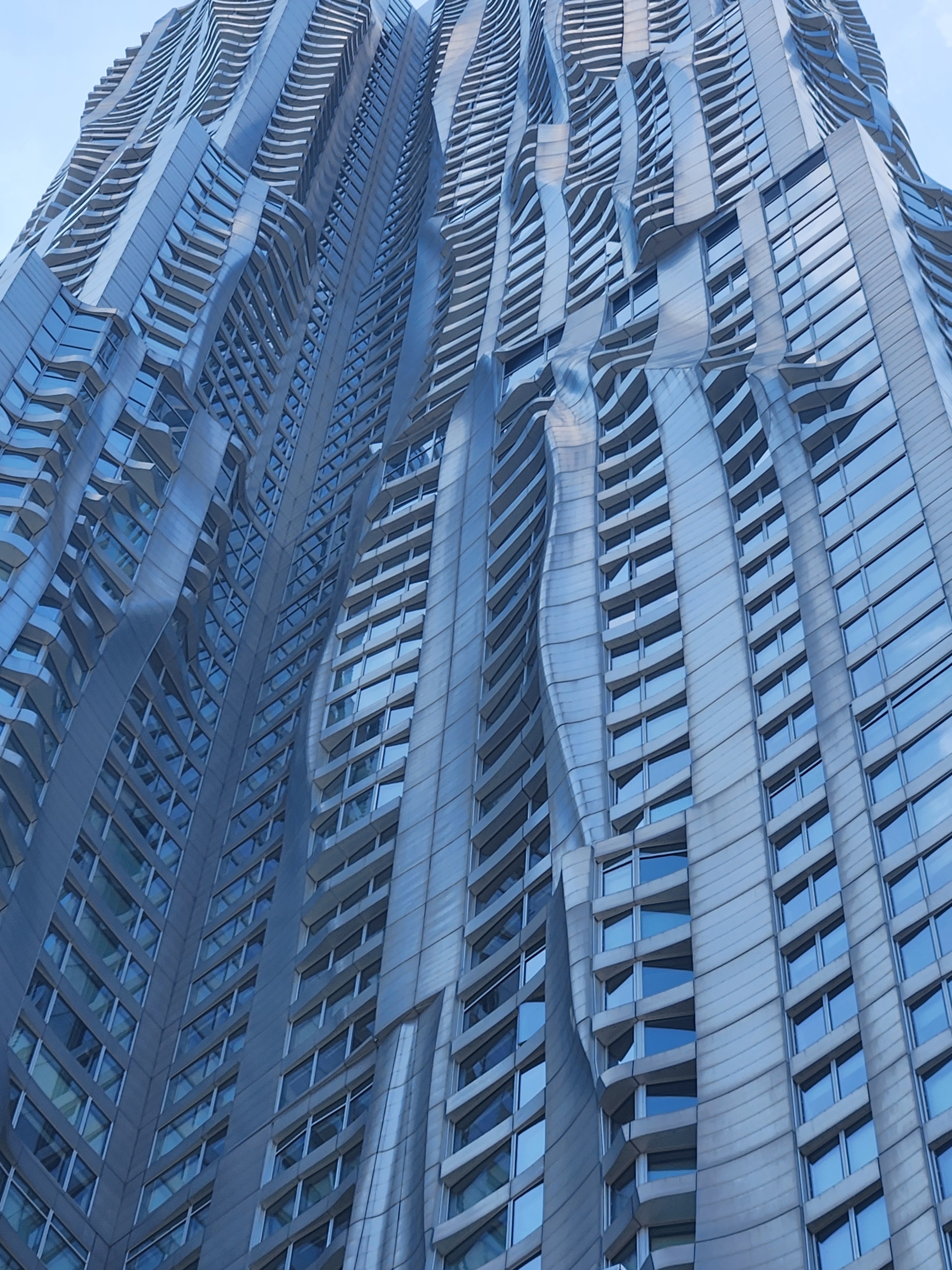
The 8 Spruce Street is Mr. Gehry’s first skyscraper; at the time of construction, it stood as the tallest residential tower in the Western Hemisphere.
It looks most striking from the east or south, transforming its texture with changing light. Sometimes, its surface looks like waves (steel waves create an illusion of movement), and other times, it evokes an image of a sail crinkled by wind. This effect is achieved by 10,500 steel panels that cover its exterior. The majority of them are of different shapes, creating the effect of constant change. While the windows themselves are rectangular, their widths vary to match the facade’s profile, forming numerous bay windows.
The architect is clearly making a statement. The building’s endlessly shifting surface is a response to the conformity and standardization of steel and glass towers. Instead of practical sameness, he offers a distinct artistic assertion.
Central Park Tower
- Architect: Adrian Smith + Gordon Gill Architecture
- Year: 2021
- Location: 217 West 57th Street (Midtown, Billionaire’s Row)
- Height: 1,550 feet, Floor count 98

Pretty much universally disliked by New Yorkers, the building is described by its creators as “A beacon of glass and steel rising 1,550 feet on famed Billionaire’s Row in New York City” and “one of the most prestigious addresses the world.” Without false modesty, they define it as a “new architectural landmark.”
The most valuable commodity on the island of Manhattan is its land. Developers have always been searching for ways to maximize the value of every parcel, and (since the turn of the 20th century) they solved it by building upward. First came the skyscrapers – continuously habitable buildings at least 150 meters (492 feet) tall. These days, they are dwarfed by supertall skyscrapers – buildings that measure 300 meters (984 feet) or higher. The latest engineering achievement in skyscraper design is the slender skyscraper – a building with a minimum 1:10 ratio of the width of its base to its height. These needles take the smallest possible footprint while stacking up a lot of real estate on top of it.
The tallest of them all is the Central Park Tower. This slender, supertall building houses 179 of the most exclusive homes in the world. The Central Park Tower now stands as the tallest residential building in the world and, with a ratio of 18:1, the second skinniest in New York. It is the highest rooftop in the Western Hemisphere.
Steinway Tower
- Architect: SHoP Architects
- Year: 2020
- Location: 111 West 57th Street (Midtown, Billionaire’s Row)
- Height: 1,428-foot(435-meter), Stories: 80, 60 units


111 West 57th Street is the world’s skinniest skyscraper with a height-to-width ratio of 24:1. It’s also the second tallest residential tower in the Western Hemisphere. The building has only one apartment per floor.
111 West 57th Street, aka Steinway Tower, sits partially on top of the Steinway Hall building – the piano company’s headquarters and showroom. The landmarked Steinway Hall building was designed in 1925 by the prolific and well-respected architectural firm of Warren and Wetmore. As an homage to the golden age of the Manhattan skyscraper and a connection to its historic site, the Steinway Tower exterior uses authentic traditional New York material: terra-cotta.
Another nod to architectural history is the tower’s form, which re-interprets the Midtown Manhattan zoning law of 1916 – the law that required mandated setbacks. Many buildings from the late 1920s and 30s, like the Empire State, solved it as a “wedding-cake” with distinct tiers, each set back from the one below, resulting in a wedding-cake shape. Twin-towered buildings, like San Remo, satisfied this requirement by putting towers above the base. Steinway Tower offers an original solution for becoming skinnier with height without mimicking historical precedent.
The Copper Buildings
- Architect: SHoP Architects
- Year: 2018
- Location: 626 1st Ave, between E 35th and E 36th streets (Murray Hill)
- Height: 540 feet and 470 (48 and 41-story)

These copper-clad residential towers take their name from cooper – the material used to cover its north and south facades. It is rarely used on buildings, making The Copper Buildings not only unique but also the tallest copper buildings in the world. Copper has always been used in New York’s architecture as a decorative element, like the crown of the Woolworth Building. The SHoP architects, interested in playing with materials that change in appearance over time, chose copper for its oxidizing quality. The towers’ copper hue will eventually oxidize and become green, similar to the Statue of Liberty.
The towers are designed in such a way that they appear to “dance” with each other. They are connected by a three-story bridge on floors 27, 28, and 29, approximately 300 feet from the ground. The skybridge, the highest in New York City and the first to be built in 80 years, houses a lap pool, lounge, and other amenities.
Critics have praised the project for moving away from glass towers in favor of texture and character. Some of the copper panels are already turning green. The Copper Buildings have a unique chance in modern architecture to visibly grow old.


Leave a Reply