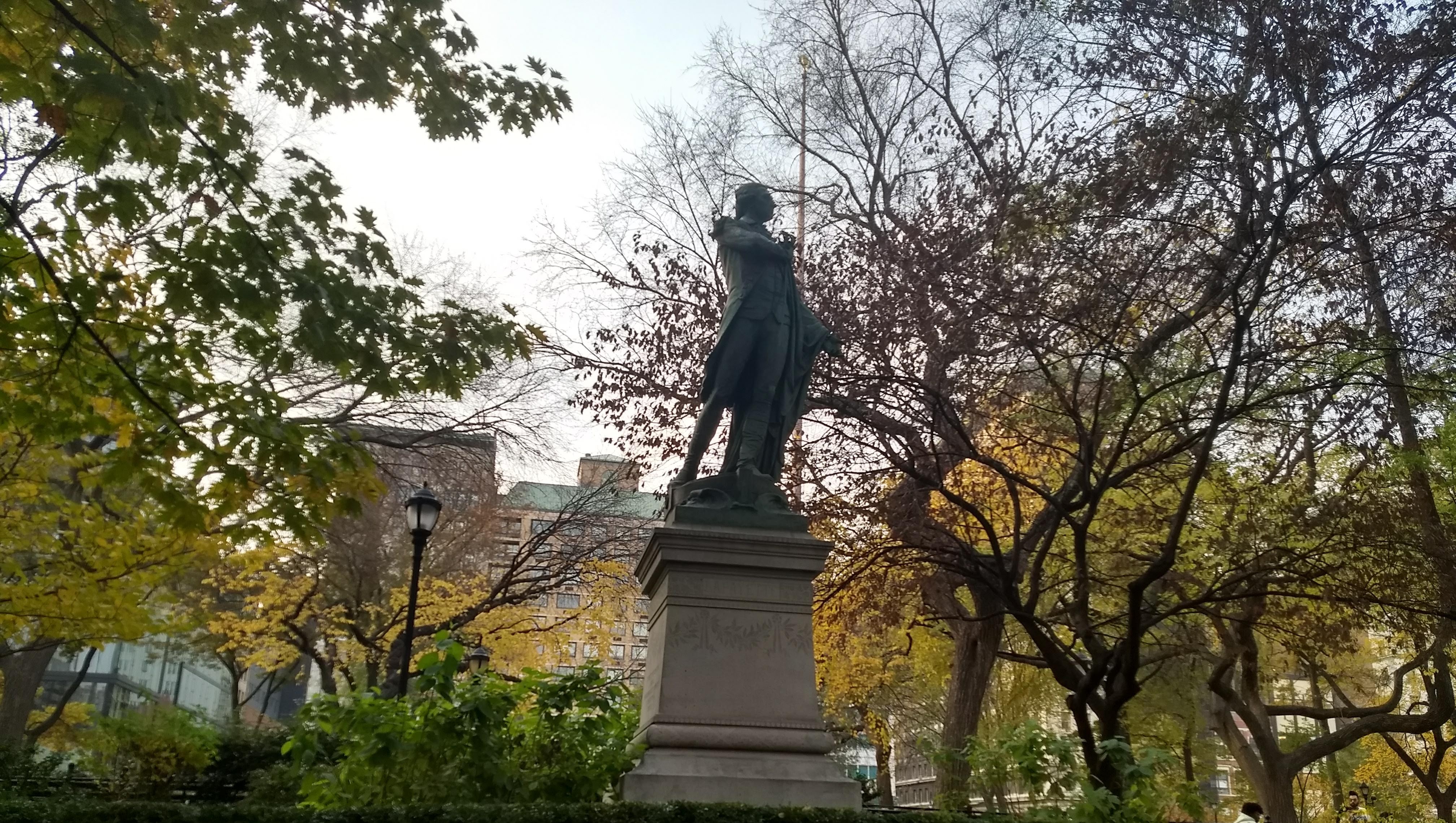
Lafayette in Union Square: To the City of New York, France
On the east side of Union Square stands a monument depicting the Marquis de Lafayette as a young officer. One hand holds an unsheathed sword against his chest, while the other reaches forward, offering his services to the young republic. Look closely: he stands aboard a ship bound for America.


The inscription on its pedestal reads:
“To the City of New York, France. In remembrance of sympathy in time of trial. 1870–1871.”
Another inscription, on the opposite side, recalls Lafayette’s own words:
“As soon as I heard of American Independence, my heart was enlisted.”
Union Square is home to monuments honoring some of the most important figures in American history. At the southern end, George Washington sits astride his horse, commemorating his triumphant return to New York after the British evacuation in 1783. At the northern end stands Abraham Lincoln, holding a document in his left hand, often interpreted as the Emancipation Proclamation.
How did a young French aristocrat earn a place alongside these towering figures of American history?
A Frenchman joins the American Revolution
Marie-Joseph Paul Yves Roch Gilbert du Motier, Marquis de Lafayette (1757–1834), was born into one of France’s wealthiest aristocratic families. He had inherited a fortune, married into another prominent family, and had every reason to enjoy a comfortable life at court. But he craved something else: glory.


He was only 19 when he decided to join the American cause. Leaving his pregnant wife behind, Lafayette crossed the Atlantic to help the American colonies fight for independence.
In 1777, he arrived in America and offered his services to the Continental Army. He soon became a trusted associate of General George Washington, who appointed him a major general. The two developed a close relationship that went beyond their military duties. Washington came to regard the young Frenchman almost as a son.
Lafayette not only took part in Washington’s campaigns but also proved invaluable as a diplomatic intermediary. Returning to France in 1779, he lobbied for additional military and financial assistance for the American cause. He came back to America in 1780 with the promise of French support and played an important role in the Virginia campaign, which culminated in the British surrender at Yorktown in 1781.
From the American Revolution to the French Revolution
Lafayette’s commitment to liberty did not end with American independence. Back in France, he became a leading figure in the French Revolution.
In 1789, he helped draft the Declaration of the Rights of Man and of the Citizen, a document influenced in part by the American Declaration of Independence and the Virginia Declaration of Rights. He passionately advocated a constitutional monarchy and commanded the French National Guard.
But while the American Revolution succeeded, the French Revolution took a radical turn. Lafayette’s political position made him a target of the revolutionaries. In 1792, while attempting to flee France, he was captured by Austrian forces and spent five years in captivity before being released in 1797.
He eventually returned to France but kept his distance from Napoleon Bonaparte’s increasingly authoritarian rule. Following Napoleon’s defeat, Lafayette resumed his political career and continued to advocate for constitutional government and civil liberties.
A hero returns to America
In 1824, as the United States prepared to celebrate the 50th anniversary of its independence, Lafayette returned for a farewell tour. Americans welcomed him as a national hero. Crowds gathered to see him, and Congress voted him $200,000 and a grant of 24,000 acres of land in recognition of his services during the Revolution.
Lafayette was celebrated as one of the last surviving heroes who had fought for American independence. His friendship with Washington and his continued commitment to democratic principles made him a beloved figure on both sides of the Atlantic.
A gift from France to New York
The statue in Union Square was a gift from the French government to New York City, in recognition of the assistance New Yorkers had provided to Paris during the Franco-Prussian War of 1870–1871. During the conflict, American relief committees organized aid for the people of Paris, who were suffering during the siege. New Yorkers were among those who responded. France commissioned a statue of Lafayette as a gesture of gratitude. French residents of New York also contributed to the project, raising money for its granite pedestal.
Bartholdi’s Works in New York
The sculpture was created by Frédéric-Auguste Bartholdi (1834–1904), the French artist who would later become famous for designing the Statue of Liberty. The Lafayette monument was dedicated on September 6, 1876, during America’s centennial year with Bartholdi in attendance.
Bartholdi’s Lafayette monument is one of several reminders of the close historical ties between France and the United States. A decade after its dedication, his most famous work, the Statue of Liberty, would arrive in New York Harbor as another gift from France.
Lafayette: The Frenchman Who Fought for American Independence
Next time you cross Union Square, take a moment to look for Lafayette’s monument. His statue commemorates not only a Frenchman who helped America win its independence, but also the courage to give up privilege and comfort in pursuit of one’s convictions.
Leave a Reply