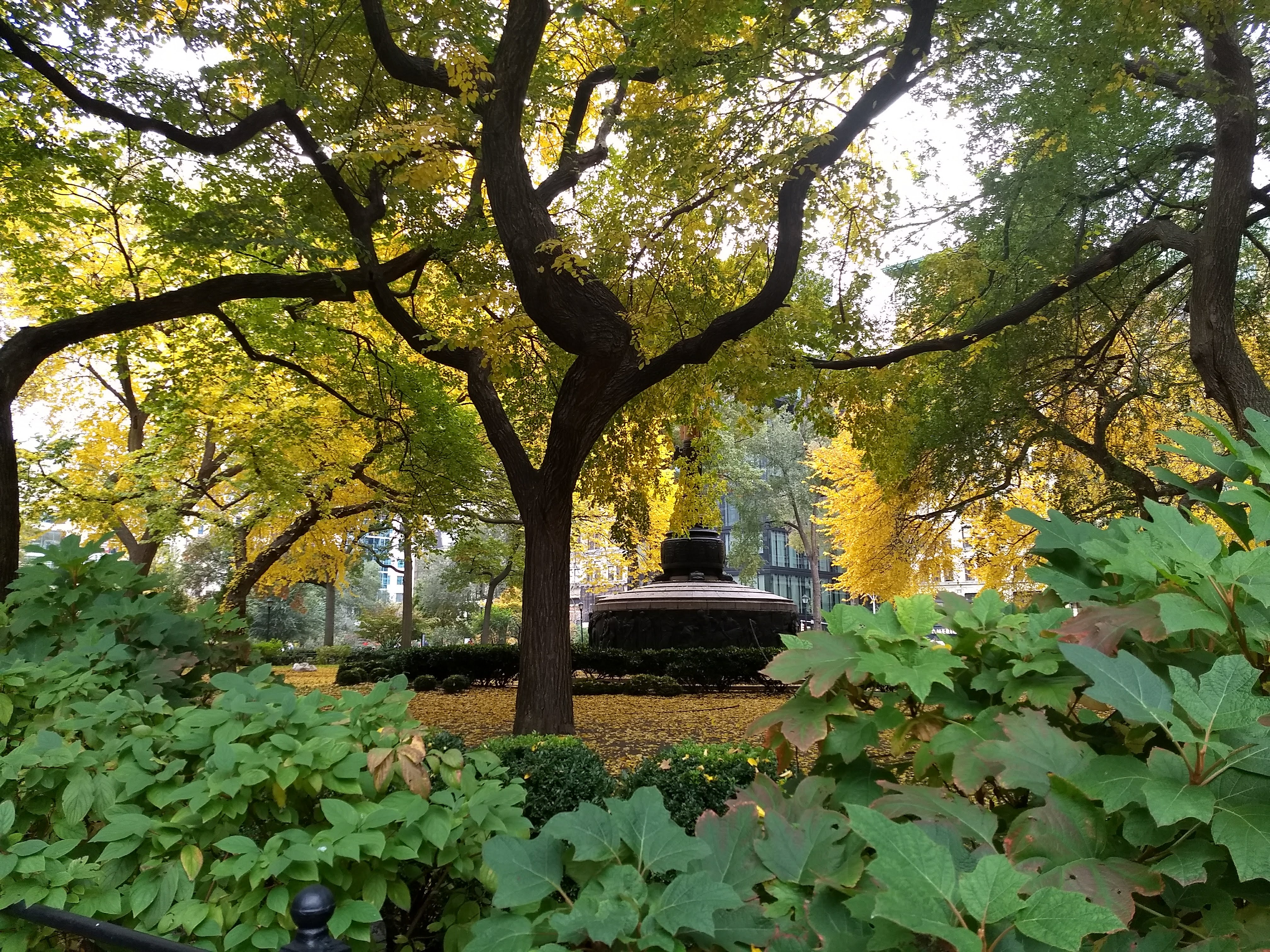
Union Square Park is one of New York’s loveliest parks. But why is it called Union?
Does it refer to the Federal Union of the United States? No.
Labor unions? No.
The answer lies in Manhattan’s geography. Union Square sits at the junction of two of Manhattan’s principal thoroughfares: Broadway and the former Bowery Road, now Fourth Avenue which came together at an acute angle, too awkward to build on. The city decided to form a square at the junction and, in 1815, designated the area as a public commons, naming it Union Place after the two roads’ union.
That’s how Union Square got its name: not from politics or labor, but from streets meeting.
From Public Square to City Park
Union Square Park officially opened in 1839. In 1842, the completion of the Croton Aqueduct brought a new landmark to the square: a fountain celebrating the arrival of fresh water from the Croton River – a revolutionary engineering achievement that gave New York City a reliable supply of clean water. By the mid-19th century, Union Square, surrounded by elegant residences, emerged as one of Manhattan’s most fashionable neighborhoods.


In 1872, the park was redesigned once more, this time by Frederick Law Olmsted and Calvert Vaux, the creators of Central Park. They removed the iron fence and surrounding hedges, opening the park to the streets, planted hardy trees, and widened the sidewalks. Most importantly, they created a large gathering area at the north end, designed to accommodate public meetings, rallies, and celebrations.
The redesign transformed Union Square from an enclosed, garden-like retreat into an open civic space, which turned the park into a stage for public life where New Yorkers could gather during moments of national importance.
A Stage for American History: How Union Square lived up to its name.
1861 — Rally for the Union
Shortly after the Confederate attack on Fort Sumter and the beginning of the Civil War, Union Square hosted one of the largest public gatherings in American history. On April 20, 1861, an estimated 200,000 people gathered to support President Abraham Lincoln and preserve the Union.
1870 — Dedication of the Abraham Lincoln Monument


Union Square was a fitting location for a Lincoln monument. On September 16, 1870, New Yorkers gathered for the dedication of a statue by sculptor Henry Kirke Brown. Only five years after Lincoln’s assassination, the monument commemorated the president whose leadership had become inseparable from the struggle to preserve the Union.
1882 — Birthplace of Labor Day

On September 5, 1882, Union Square became the gathering point for one of the most consequential demonstrations in American labor history: the first Labor Day parade. Organized by the Central Labor Union, the parade brought thousands of workers down Broadway to Union Square, where they gathered to advocate for workers’ rights and recognition of labor’s contributions. Although the park’s name has nothing to do with labor unions, labor history became one of its defining associations.
1901 — Mourning President McKinley
After President William McKinley was assassinated in September 1901, New Yorkers gathered in Union Square for memorial ceremonies honoring the fallen president. By this time, the square had become one of the city’s most important places for collective mourning.
1927 — Sacco and Vanzetti Protests
On August 23, 1927, Union Square became a gathering place for protests against the executions of Nicola Sacco and Bartolomeo Vanzetti, two Italian immigrant anarchists convicted of murder in Massachusetts in 1921. Their trial became controversial, pointing to anti-immigrant sentiment and political beliefs that influenced the verdict.
1930s — Labor and Social Movements
During the Great Depression, Union Square became a center for demonstrations by unemployed workers, labor organizations, and political movements.
1960s–1970s — Protest and Activism
During the Vietnam War era, Union Square continued its long tradition with anti-war demonstrations and political rallies.
1970 — First Earth Day
On April 22, 1970, Union Square hosted events celebrating the first Earth Day, connecting it with the emerging environmental movement.
1976 — The Union Square Greenmarket


In 1976, New York City launched its Greenmarket program to connect local farmers with city residents. The market brought fresh produce from farms into the heart of Manhattan, creating a gathering place centered on food and community. Today, the Union Square Greenmarket draws shoppers year-round.
Union Square: Not Just a Park but a Union
Union Square was named for the meeting of two roads, not for the political or labor movements. Yet the name took on new layers of meaning. Although Union Square has been redesigned several times since 1872, Olmsted and Vaux’s central idea endured: it was meant to be more than a garden. It was a public space where New Yorkers could gather, make their voices heard, and participate in civic life.
Leave a Reply