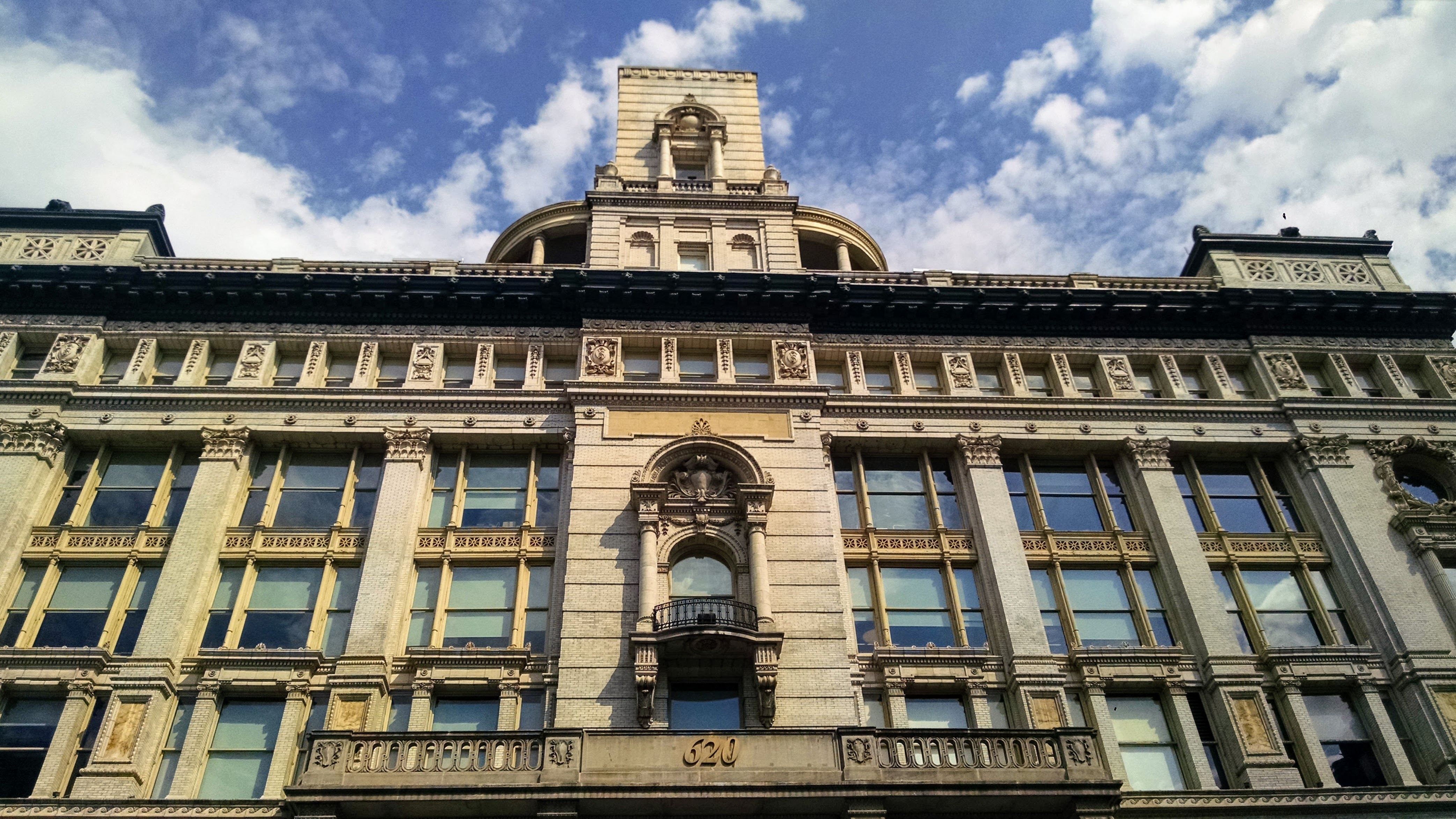
In 1896, New York got a new kind of attraction: a department store so enormous, so extravagant, and so ambitious that it was designed to be a destination in its own right.

Siegel-Cooper wasn’t simply a place to buy things. It was a “shopping resort”—a place where you could eat, send a telegram, make a telephone call, exchange foreign currency, conduct business, leave your children at a nursery, and, of course, shop.
The store occupied an enormous block-front building on Sixth Avenue between West 18th and 19th Streets. When it opened on September 12, 1896, New Yorkers turned out in astonishing numbers.
The New York Times described the opening as the culmination of a plan to create a department store capable of rivaling any establishment in the world. Eleven thousand people pushed through the doors during the first ten minutes, and by the time the store closed that evening, approximately 150,000 shoppers had passed through its doors.


New York had never seen anything quite like it.
Siegel-Cooper Advertising Strategy
Siegel-Cooper advertised aggressively, promoting eye-catching bargains designed to bring customers through its doors.
The strategy was simple:
Make the prices irresistible. Make the store spectacular. Get people through the door.
And once they were inside, Siegel-Cooper gave them plenty of reasons to stay.
Siegel-Cooper: Reasons to Stay
Siegel-Cooper offered 125 departments, selling everything from clothing and household goods to furniture, toys, food, and fashion accessories. But what made the store extraordinary wasn’t simply the merchandise. It was the astonishing range of services available under one roof.

There was a bank, a telegraph office, a long-distance telephone service, a foreign-currency exchange, stock-trading services, a dental parlor, a restaurant, a barber shop, and a rooftop observatory.
The restaurant could seat hundreds of people, and the roof offered visitors a view over the city.
Siegel-Cooper understood that much of its clientele would be women. The store made it easy for the ladies not to choose between childcare and shopping: it provided a nursery staffed by trained nurses.
In other words, Siegel-Cooper was designed so that a customer could spend hours inside without ever having to leave. Shopping had become an experience.
Arriving at the “Big Store”
Getting to Siegel-Cooper was part of the experience.
The Sixth Avenue Elevated Railroad ran directly alongside the building, and Siegel-Cooper had something almost unheard of: customers could enter the store directly from the elevated train.
A station stood at the store’s doors, and a ramp carried passengers from the elevated level straight into the building’s second floor. The enormous second-floor windows even allowed passengers on passing trains to look into the store as they traveled by.
A contemporary Siegel-Cooper guide proudly announced:
“The Sixth Ave. Elevated Railroad has a station at its very doors.”
Siegel-Cooper Pioneering Design
Built between 1895 and 1897 and designed by the architectural firm DeLemos & Cordes, Siegel-Cooper was an imposing Beaux-Arts monument to the new age of mass retailing.
It was also an important moment in the history of American architecture. The building was the first large steel-frame mercantile structure in New York City, allowing its designers to create enormous interior spaces with relatively few structural interruptions.
The exterior combined brick, stone, terra-cotta, marble, and cast iron around the innovative steel frame.
Siegel-Cooper exemplified the transition from the cast-iron commercial architecture of the mid-19th century to the steel-frame construction that would make the skyscraper possible.
“Meet Me at the Fountain”
“Meet me at the fountain” became an expression that needed no explanation. You’d be meeting at the entrance lobby inside Siegel-Cooper. There stood the fountain — a version of The Republic, the monumental female figure created by Daniel Chester French for the 1893 World’s Columbian Exposition in Chicago. Water cascaded around the statue, illuminated by concealed colored lights and surrounded by marble and brass.
Siegel-Cooper understood that the store itself could be the attraction.
The Store That Could Signal the News
The building’s rooftop offered another remarkable attraction.
A huge searchlight occupied the tower at the top of the building. Its powerful beam could reportedly be seen for miles, and it was used to signal election results and other news to the public. The searchlight could even be used to project advertising messages onto the underside of clouds at night.
For a city fascinated by new technology, it was another way for Siegel-Cooper to announce itself to New York.
Siegel-Cooper and the Titanic
Siegel-Cooper was connected to one of the greatest maritime disasters in history. When the Carpathia arrived in New York on April 18, 1912, carrying survivors of the Titanic, a Marconigram was sent to Siegel-Cooper & Co. on Sixth Avenue requesting 25 coats and 19 pairs of trousers for the destitute survivors, to be delivered immediately to Pier 54.
Julia Siegel, daughter of Henry Siegel, was herself a Titanic survivor traveling aboard the Carpathia. Her husband, Tyrell Cavendish, perished in the sinking. So did Isidor Straus, co-owner of Macy’s, Siegel-Cooper’s great rival.
Siegel-Cooper vs. Macy’s
Siegel-Cooper’s ambition famously competed with another New York retail giant: Macy’s. Both companies wanted to be recognized as the city’s—and perhaps the world’s—greatest department store.
The rivalry eventually moved uptown to Herald Square.
Around the turn of the century, a crucial little building stood at the corner of Broadway and West 34th Street, precisely where Macy’s wanted to expand. In 1900, the building was purchased by Robert H. Smith for $375,000. Historical accounts generally hold that Smith was acting on behalf of interests associated with Siegel-Cooper, attempting to prevent Macy’s from securing the strategically important corner.
Macy’s just built around it. The little building became one of New York’s great architectural curiosities—a tiny survivor almost completely obscured by Macy’s enormous shopping-bag sign.
In 1911, Macy’s finally purchased the property for $1 million, giving the corner its enduring nickname: the Million Dollar Corner.

Incidentally, both competing stores, Siegel-Cooper and Macy’s Herald Square, were designed by the same architects – DeLemos & Cordes.
Siegel-Cooper Now
This enormous building was once one of New York’s great attractions—a place where shopping became entertainment, where women could leave their children with nurses while enjoying a day of grooming and shopping, where a fountain became a citywide meeting place, where an elevated train delivered shoppers directly into the building, where a giant searchlight could announce the news and project advertisements onto clouds, and where a telegraph message from the Carpathia brought the needs of Titanic survivors to the store’s attention.


Today, the historic Siegel-Cooper building remains a mixed-use commercial property with retail stores on the ground level and office spaces above.
The Siegel-Cooper Company disappeared, but the building itself survived. More than 125 years later, it still turns heads—and still does what it was built to do: bring people through its doors to shop.
Isn’t it a great Siegel-Cooper legacy?
Leave a Reply